




May 7, 2026
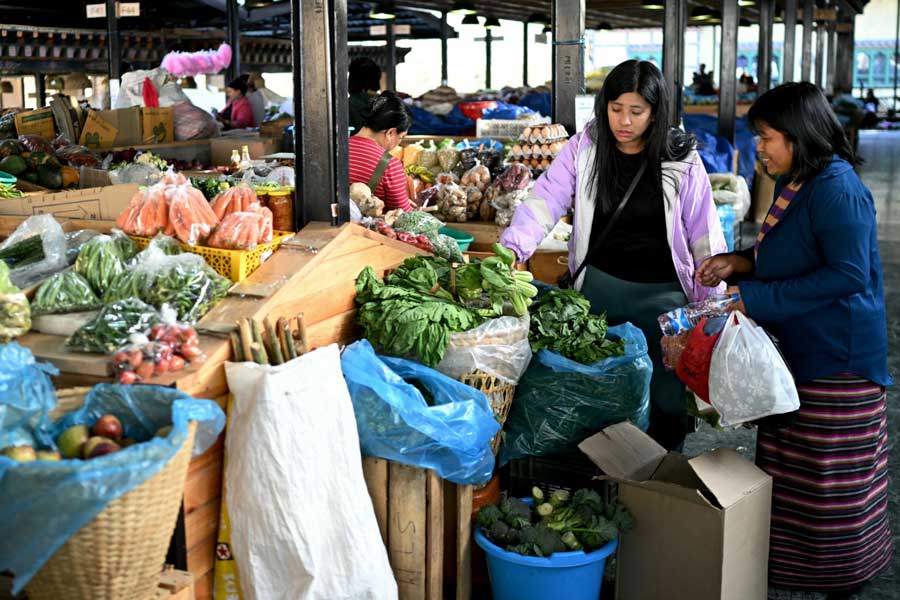
THIMPHU – Eighty-six percent of citizens in the country do not consume sufficient vegetables and fruits, while 27 percent of households cannot afford a diet that meets their nutrient needs.
To address these interconnected challenges of dietary insufficiency and affordability, the World Food Programme (WFP) deepened its support to Bhutan last year.
WFP focuses on strengthening food systems, nutrition and emergency preparedness through partnerships and capacity-building aligned with national priorities.
Country Director and Representative of WFP Peter Rodrigues, said the government made significant investments in school food and nutrition programmes, including doubling stipends.
“WFP has been working with the ministries involved to plan nutritious meals for children, especially by connecting local farmers and markets with schools to provide more nutritious meals to students,” he said.
In 2025, WFP worked closely with the government to achieve key targets, including the development of strategic investment plans for niche high-value products and livestock.
He said Bhutan lies in a seismic zone prone to natural disasters. “As part of the preparedness plan, WFP and the government carried out logistical capacity assessments, among others,” he said.
Impact and priorities
According to the country director, WFP’s work in supporting farmers, improving school meals, and strengthening emergency preparedness is part of long-term investments aligned with the 13 Five-Year Plan.
“WFP Bhutan’s investment in building resilience of farmers, improving school meals and strengthening emergency responses in 2025 is part of our efforts to support the targets set by the Five-Year Plan of the Royal Government of Bhutan,” he said.
He added that the results will unfold over time.
“In the agriculture sector, we will see farmers earn increased income, improved access to markets, and increased production over time. Nutrition gardens and meal planning tools supporting school nutrition are also investments in the future generation of Bhutan, and their impact will be seen in the long run,” he said.
On future priorities, Rodrigues said WFP will continue mobilising resources and supporting key interventions despite constraints.
“Mobilising resources and implementing programmes is a continuous process,” he said. “We will continue to mobilise resources for index-based insurance, emergency response and preparedness, and the construction of green school kitchens.”
He added that WFP remains confident of working with the government to deliver its Country Strategic Plan (2024–2028).
Food security and nutrition
The WFP Bhutan Annual Country Report 2025 highlights progress in strengthening food systems and nutrition outcomes.
Strategic Investment Plans (SIPs) in agriculture and livestock attracted new investment, boosting incomes, creating jobs for women and youth, and improving food security.
Through nationwide training on the School Meal Planner (SMP) PLUS tool, over 60 percent of schoolchildren now receive more diversified meals under the National School Feeding and Nutrition Programme, which has been fully handed over to the government.
Nutrition remains a concern, with Bhutan facing a triple burden of 17.9 percent child stunting, widespread anaemia, and 33.3 percent obesity.
To address this, WFP supported nutrition education, school-based programmes, and established nutrition model gardens. In 2025, 25 such gardens were developed in Trongsa, Zhemgang, Sarpang, and Tsirang, linking smallholder farmers to schools and markets.
Agriculture and market systems
Aligned with the 13th Five-Year Plan and the 21st Century Economic Roadmap (2025), WFP supported Bhutan’s shift to high-value, export-oriented agriculture.
The roadmap targets long-term economic transformation across sectors including agriculture, renewable energy, tourism, digital technology, and finance.
Despite employing 39.9 percent of the workforce, agriculture continues to face low productivity, climate risks, and rising imports.
To address this, WFP supported value chain development in dairy, poultry, piggery, spices, and coffee through Multi-Stakeholder Platforms (MSPs). Around 300 value chain actors were engaged, along with 100 farmer groups supported in climate resilience and nutrition-sensitive farming.
In Trongsa, a dairy MSP identified the need for a central milk processing facility and improved collection networks.
WFP is also working with the Ministry of Agriculture and Livestock to develop a second Agriculture Resilience Plan for central and southern Bhutan, focusing on climate- and soil-appropriate crops and high-potential commodities.
Emergency preparedness
To strengthen resilience against climate shocks such as floods, erratic monsoons, and seismic risks, WFP supported national emergency preparedness systems.
A Logistics Capacity Assessment mapped infrastructure and service gaps, while 14 manuals and an Emergency Logistics Preparedness Procurement Manual were developed to improve response speed.
WFP also trained government agencies and De-Suung volunteers, with 45 partners receiving emergency preparedness training in logistics, coordination, and data management in 2025.
Partnerships and constraints
In 2025, more than 1,400 stakeholders benefited from capacity-building initiatives supported by the World Food Programme (WFP).
Projects such as BRECSA, implemented with IFAD and funded by GAFSP, contributed to food and nutrition security, with a strong focus on women farmers and vulnerable rural households, where poverty remains significantly higher than in urban areas.
However, funding constraints remain a challenge. Bhutan’s transition to lower-middle-income status has reduced donor support.
While WFP mobilised 54.4 percent of its Country Strategic Plan funding requirements, only USD 0.76 million of the planned USD 1.9 million for 2025 was utilised, largely due to implementation delays, with the total CSP budget standing at USD 14.6 million.