




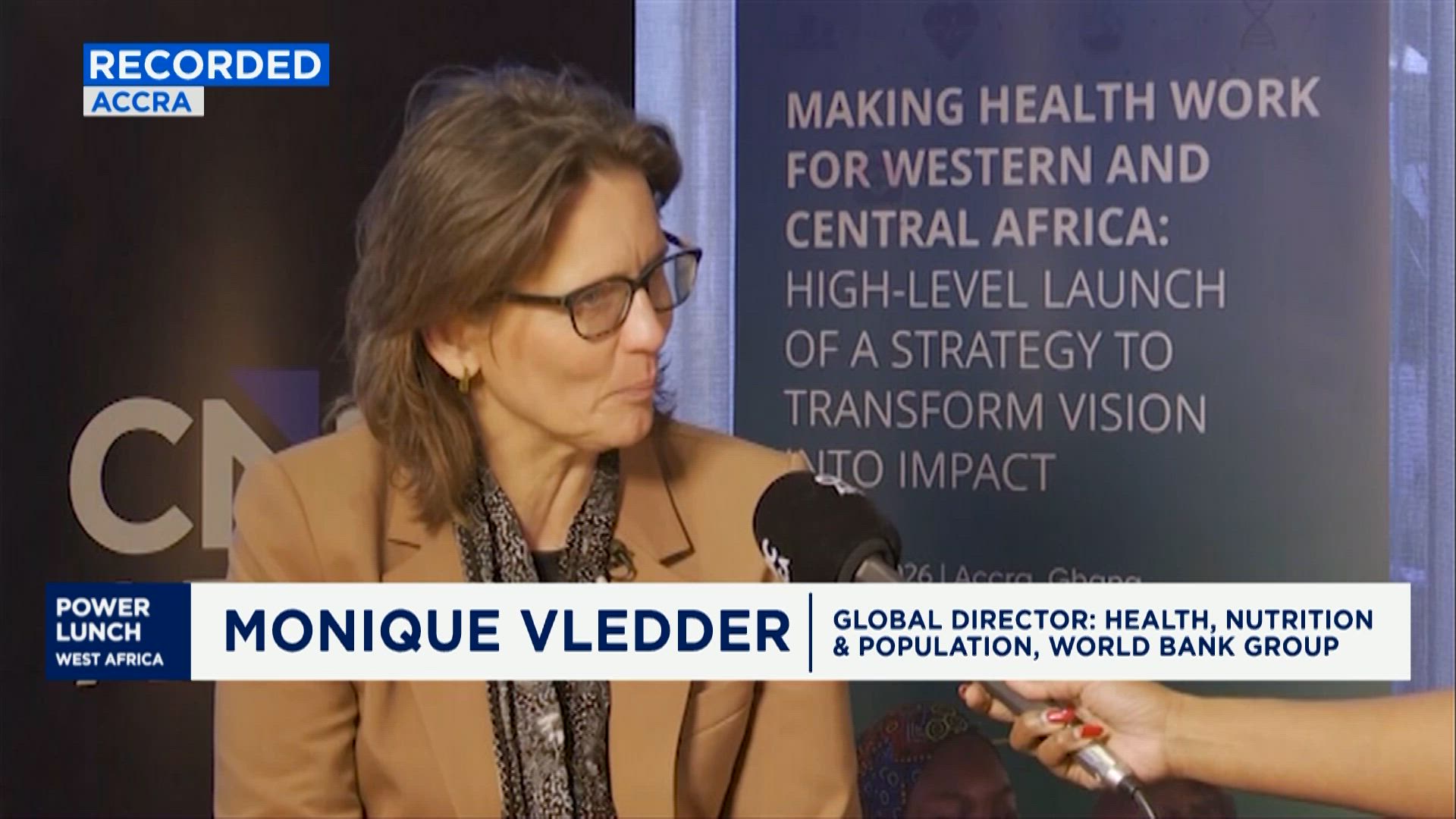
The World Bank Group has launched a new Health, Nutrition and Population strategy for West and Central Africa, setting out what it describes as a country-led roadmap to expand access to quality, affordable essential health services across one of the world’s youngest and fastest-growing regions.
Speaking to CNBC Africa, World Bank Group Director for Health Monique Vledder said the regional strategy is designed to help accelerate the institution’s broader global target of reaching 1.5 billion people with essential health services by 2030. Within West and Central Africa, the ambition is to reach 200 million people, as the Bank looks to translate headline commitments into implementation plans shaped by national priorities.
Vledder said the strategy launch comes two years after the World Bank announced its 1.5 billion target, and marks a shift from goal-setting to execution.
“It’s been a very exciting day today,” she said, noting that ministers and senior officials from across the region had gathered to outline their priorities. “What we did today was to launch the strategy for Africa West in terms of how to implement, and how to reach more people with better and affordable services.”
According to Vledder, discussions at the launch underscored several recurring themes: digital transformation, stronger primary healthcare systems, better use of domestic resources, additional financing for health, and the opportunity to build medical manufacturing capacity in the region.
That mix of policy priorities reflects a widening view of health as not only a social imperative, but also an economic one. Vledder said governments increasingly recognize that healthier populations are more productive, better able to participate in labor markets, and more capable of driving long-term growth.
“The country government leadership is really central,” she said. “We were just delighted to see so many countries here with very clear policy priorities and with a very strong commitment to the centrality of health, not just because of people’s well-being and dignity, but also because healthy people can participate in a productive way in the workforce and earn their own income.”
The World Bank’s strategy appears to hinge on that principle of government ownership. Rather than imposing a uniform regional blueprint, the institution says it is working with countries to develop “country compacts” that define national policy priorities and create a framework for aligning financing from multiple sources.
Under that approach, World Bank funding is intended to work alongside bilateral support, civil society participation and private-sector investment, all coordinated around government-led plans. The emphasis on accountability and national leadership comes as African governments face growing pressure to do more with constrained public finances and rising development needs.
Vledder suggested officials from both health and finance ministries are showing a stronger willingness to link health spending with economic strategy. That matters in a region where budget trade-offs are often sharp and where health systems continue to face gaps in infrastructure, workforce capacity and access.
Still, the Bank made clear that governments alone will not be able to deliver on such a large-scale target. A key plank of the strategy is deeper engagement with private-sector players, both as investors and as providers of innovation.
“In most countries you have a very active and thriving private sector in health, and they bring a lot of innovations,” Vledder said. She added that the sector can also support job creation, particularly for young people, while helping expand access to services and products.
The Bank’s view is that stronger policy frameworks and regulatory reforms can make it easier for private capital to enter health systems in ways that generate both public-health gains and commercial sustainability. That includes potential investment in local manufacturing of medical products and consumables, an area officials at the launch highlighted as an opportunity to improve supply resilience while also creating employment.
The message aligns with a broader development push to move beyond seeing Africa solely as a consumer market. Instead, policymakers increasingly want to attract investment that builds productive capacity on the continent, including in health-related industries.
Youth participation is another major theme of the strategy, reflecting the region’s demographic profile. West and Central Africa are home to rapidly expanding youth populations, making health access, employment and social inclusion closely linked policy challenges.
Vledder said young people must be involved not just as beneficiaries of health programs, but as participants in the design, monitoring and accountability of those systems. She pointed to the Global Financing Facility for women, children and adolescent health, a partnership hosted at the World Bank, as a vehicle for stronger civil society and youth engagement.
“The involvement of young people in the design of programs, to really make them applicable and appropriate for young people, is a really essential part of the way we operate,” she said.
That engagement, she added, extends beyond consultation. Civil society actors, including youth groups, are involved in service delivery, accountability, monitoring and domestic resource mobilization. For the World Bank, that reflects a central lesson of large-scale development programs: no single actor can deliver the outcome on its own.
“This agenda is so ambitious and so large, and there’s not one actor that can achieve such an ambitious impact,” Vledder said. “We have to all come together jointly, whether it’s government, private sector, multilateral development banks, bilateral, younger people.”
A critical question, however, is how progress will be measured. Vledder said the World Bank is tracking delivery closely and has made its results publicly visible. According to her, the institution has so far reached 575 million people globally toward its 1.5 billion target.
She said the Bank publishes detailed calculations and a world map on its website showing participating countries and progress under the initiative. Beyond the headline reach figure, the Bank says it is also prioritizing those most in need, an effort that ties financing decisions to vulnerability and service gaps rather than scale alone.
“Our ambition is not just the 1.5 billion, but to also target those people that need the services the most,” Vledder said.
For investors, policymakers and development partners, the new regional strategy will likely be watched as a test of whether public systems, concessional finance, private-sector participation and local accountability can be woven into a workable model at scale. In West and Central Africa, where population growth is rapid and health needs remain significant, the execution challenge will be substantial.
But the World Bank’s message is clear: achieving better health outcomes in the region is not being framed simply as a welfare objective. It is increasingly being positioned as a foundation for economic resilience, workforce participation and long-term development — and one that will require governments, financiers, businesses and young people to move in concert.