




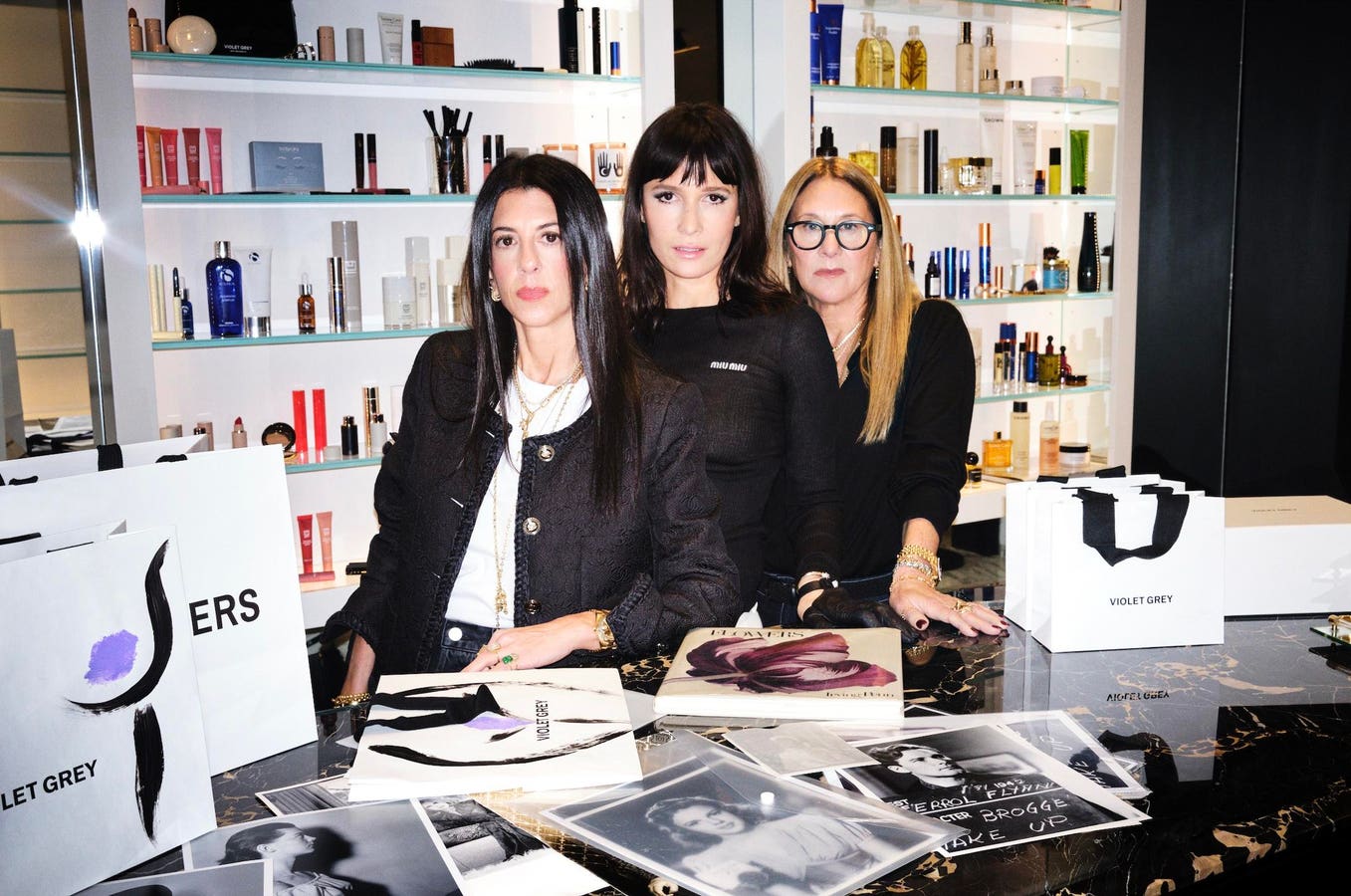
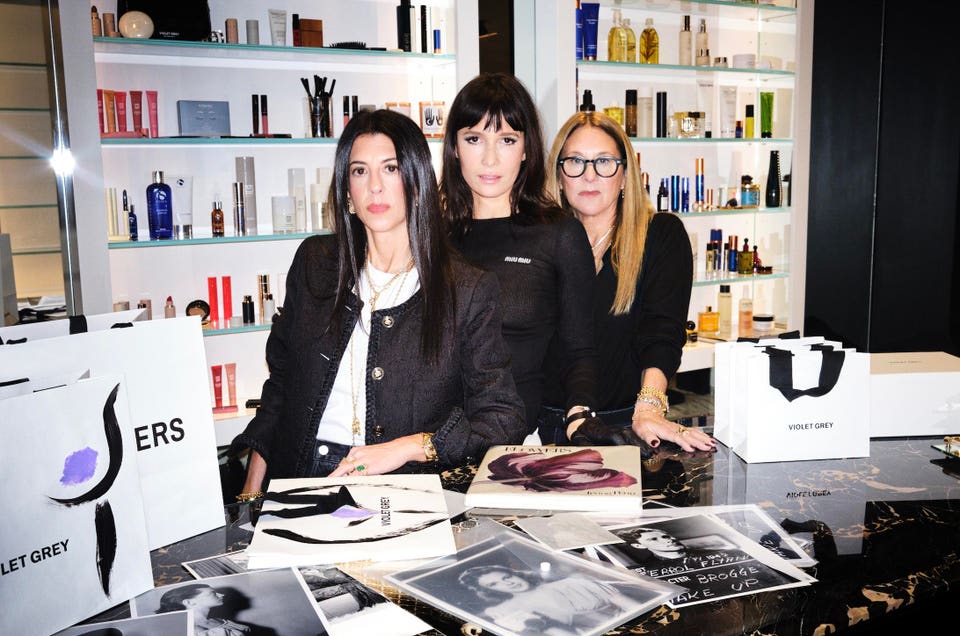
Cassandra Grey and team, Photo Credit: Courtesy of Violet Grey
Photo Credit: Courtesy of Violet Grey
At a time when beauty launches are constant and attention is scarce, Violet Grey is doubling down on something more powerful than scale: curation.
Founded by Cassandra Grey in 2012, Violet Grey launched as a content-meets-commerce platform designed to bring editorial authority to beauty retail. Built around its now-signature “Violet Code” — a rigorous vetting process led by industry insiders — the platform became known for its tightly curated mix of emerging brands and established luxury, as well as its ability to elevate niche products into must-haves among makeup artists, editors, and consumers alike.
The company was acquired by Farfetch in 2022 for $50 million, though Farfetch shuttered its beauty division the following year amid broader financial challenges.
In September 2024, Grey repurchased the business alongside private equity investor Sherif Guirgis, who now serves as CEO, with Grey remaining on the executive board.
That next chapter also includes a strategic push into physical retail.
Violet Grey recently landed in London through a curated installation at Harvey Nichols, marking its first international retail move. The once digital-first beauty destination is also expanding across the U.S. with upcoming locations in East Hampton, Dallas, and Los Angeles.
Rather than flooding new markets, Violet Grey is approaching expansion with the same rigor it applies to product selection—prioritizing curation, exclusivity, and cultural alignment.
Among the brands Violet Grey has curated — and in some ways, helped put on the map — are Crown Affair and Sofie Pavitt Face, both built on tightly edited, high-performing formulas.
Earlier this spring, the luxury retailer introduced Bob Beauté to the U.S. market through an exclusive retail partnership, another sign that the retailer is not just a place to shop and discover beauty, but more and more, a launchpad for what comes next.
In an era defined by rapid distribution, exclusivity has become a strategic lever for beauty brands rather than a limitation.
I spoke with Tracy Kline, Group President at Violet Grey, and Gine Margrethe, founder of Bob Beauté, about the brand’s launch, the future of curated beauty, and why restraint is becoming luxury’s new power move.
“This era of rapid distribution and DTC launches is exactly what makes product exclusivity exciting,” says Kline. “When you can get everything everywhere, finding something special that perhaps only a limited number of people have access to, makes that thing feel that much more compelling.”
“It’s like a fragrance you can only purchase at a single hotel,” adds Kline. “You know that if you don’t get it now, you might never have the opportunity again. It also creates an association between the product and the place where you purchased it. When we secure an exclusive, customers don’t just think about the brand when they use it. They think about Violet Grey, too.”
The Bob Beauté launch reflects the beauty retailer’s evolving role: not just curating products, but curating entry into the market.
Bob Beauté has built a devoted following in its first year for its elevated, minimalist approach to beauty — one rooted in formulation and intention.
For emerging brands and especially international ones, this kind of debut functions as both validation and positioning.
“Violet Grey has built a reputation around curation rather than scale,” says Margrethe. “Their edit is deliberate and performance-driven, which aligns with our philosophy.”
What sets it apart is not just what it sells, but how it introduces brands. It’s a retailer that builds credibility before scale.
Central to that process is the “Violet Code” — the retailer’s internal standard for selection. Products are vetted by a committee of industry experts for quality, performance, and what the company describes as “vanity appeal,” before earning the stamp of approval.
The result is a tightly edited assortment spanning skin care, makeup, hair, and fragrance, featuring brands like Augustinus Bader, Victoria Beckham Beauty, Dr. Barbara Sturm, Shu Uemura, and Chanel — many of which are used by top artists on set, on the red carpet, and beyond.
Unlike traditional retail expansion where brands chase doors, Violet Grey flips the model, by creating scarcity through exclusivity, trust through curation, and desire through editorial storytelling.
The result is a kind of pre-market conditioning, where brands are positioned as credible before they are widely available.
This is particularly critical in today’s oversaturated beauty landscape, where consumers are overwhelmed by choice and increasingly skeptical of hype.
“Founder credibility is just as important as product performance,” says Kline. “A founder’s authenticity comes through in both the efficacy of the product and the strategy for the brand’s growth.”
In many ways, that philosophy mirrors the reason Violet Grey matters more than ever right now.
As AI increasingly shapes how consumers discover products, the retail brand is doubling down on something machines can’t replicate: human taste.
“Beauty products are innately human and sensorial,” says Tracy Kline. “For everything AI is, it really can’t operate on those levels.”
“AI can’t say, ‘I’ve tried this moisturizer and compared it to others I love,’ or ‘this SPF didn’t irritate my eyes,’ or ‘I got through breakfast and lunch without this lip stain wearing off.’”
This human layer, embedded in the retailer’s proprietary “Violet Code” vetting process, has become one of its strongest advantages.
In a world of algorithmic recommendations, Violet Grey offers editorial authority rooted in lived experience.
At the center of Bob Beauté’s positioning and its alignment with Violet Grey is a growing shift toward efficacy and the rise of the “formula-first” beauty.
After a decade working with top beauty brands, Margrethe saw what she describes as a disconnect between positioning and performance.
“There was too much noise,” she says. “A focus on quantity over quality. The idea that you need 17 layers to look good… I didn’t see that as healthy.”
Her response was to build a brand grounded in formulation integrity and restraint.
It also reflects a broader consumer shift toward fewer, better products, a mindset the American prestige customer is leaning into.
While Scandinavian beauty is often shorthand for minimalism, Margrethe reframes it as something more precise.
For Margrethe, that philosophy extends beyond product and into how the business itself is being built.
“Our strategy is controlled, strategic growth,” she says.
“We are building Bob Beauté as a long-term brand with cultural and commercial longevity,” she adds. “That requires selective partnerships, disciplined category expansion, and protecting the integrity of the product architecture.”
“Scale will come,” she adds. “But only where alignment exists. Intuition will tell.”
With launches like Bob Beauté, Violet Grey is reinforcing its position as more than a retailer. It doubles as a stage for emerging founders, and increasingly, a platform for brand-building.
In an industry flooded with launches, Violet Grey is proving that how a brand enters the market may matter just as much as the product itself.