




image:
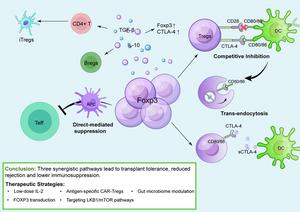
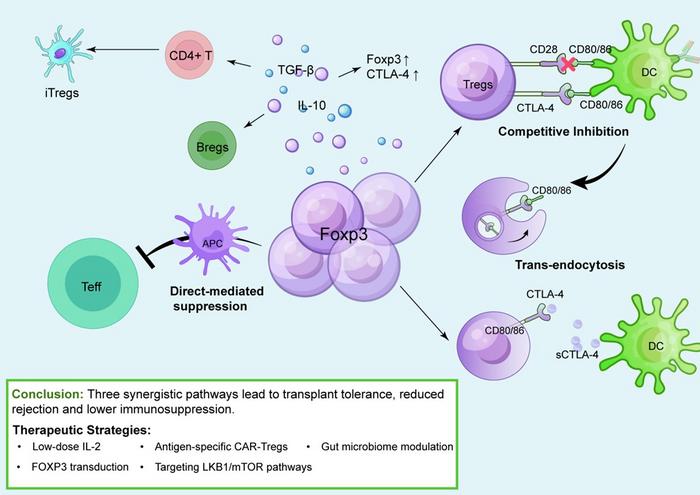
This figure illustrates the synergistic pathways by which Tregs establish immune tolerance, which are essential for preventing allograft rejection. Key mechanisms include: (1) the direct suppression of effector T cells (Teffs); (2) the modulation of antigen-presenting cells (APCs) through CTLA-4-mediated trans-endocytosis of costimulatory molecules; and (3) the formation of an immunosuppressive microenvironment via cytokines (e.g., IL-10, TGF-β) and metabolic disruption. Furthermore, the figure highlights promising therapeutic strategies aimed at leveraging these pathways, such as low-dose IL-2, antigen-specific CAR-Tregs, and FOXP3 overexpression, to promote durable graft survival
Credit: Professor Xiao-Kang Li from the National Center for Child Health and Development, Japan; and Dr. Shaowei Li from Taizhou Hospital of Zhejiang Province, China
Image source link: https://link.springer.com/article/10.1007/s44466-026-00037-1
Organ transplantation remains the cornerstone treatment for end-stage organ failure. While conventional broad-spectrum immunosuppression effectively controls acute rejection, it fails to address chronic rejection and carries long-term side effects including infection, malignancy, and metabolic disorders. Achieving donor-specific immune tolerance while minimizing global immunosuppression has become the central goal of transplant immunology.
Regulatory T cells are recognized as master arbiters of immune homeostasis within the complex transplant immune network. Rather than acting through a single pathway, Tregs employ a coordinated set of precision mechanisms to build a robust defense against graft rejection.
Published in Volume 2, article number 23 of the journal Immunity & Inflammation on April 30, 2026, Professor Xiao-Kang Li’s team first summarizes the universal mechanisms by which Tregs function in solid organ transplantation. Through the secretion of inhibitory cytokines (such as IL-10 and TGF-β), induction of effector T cell apoptosis, and modulation of dendritic cell function, Tregs establish durable immune tolerance both locally and systemically. This multi-dimensional regulatory toolbox provides the fundamental biological basis for addressing common challenges of rejection across different organs including the liver, kidney, and heart. Understanding these universal principles represent the first step toward precise immune modulation.
How can Tregs be made more controllable, more targeted, and more readily available for large-scale clinical application? The review then systematically traces the technological evolution of Treg therapy from bench to bedside, revealing a paradigm shift from conventional approaches to cutting-edge genetic engineering.
The initial phase involved polyclonal Tregs. Early research focused on expanding autologous Tregs ex vivo. While safety was established, this approach faced limitations including insufficient specificity and challenges in expansion efficiency. The next phase brought CAR-Tregs (chimeric antigen receptor-engineered Tregs). The introduction of CAR technology equipped Tregs with a “navigation system,” enabling them to precisely recognize graft antigens and exert potent local immunosuppressive effects.
The most recent revolutionary breakthrough involves “off-the-shelf” universal products. The field is now at a critical stage where gene-editing technologies such as CRISPR-Cas9 are being used to create hypoimmunogenic Tregs. By knocking out human leukocyte antigen molecules, these engineered Tregs can evade the recipient’s immune system, enabling standardized, scalable “off-the-shelf” availability. This stepwise technological evolution is driving transplant medicine away from a highly personalized and complex surgical procedure toward standardized, accessible cell drug therapy.
“Future breakthroughs in transplant immunology depend on integrating universal technology platforms (such as universal CAR-Tregs) with a deep understanding of organ-specific immune microenvironments,” the authors point out. By combining the targeting capability of CARs, the convenience of off-the-shelf products, and the power of synergistic immune regulation, Treg therapy will become a precisely tailored translational medicine strategy designed to provide durable, stable immune tolerance for patients across the full spectrum of solid organ transplantation, opening a new era of “immunosuppression-free” transplantation.
This comprehensive review maps the complete paradigm shift from passive immunosuppression to active tolerance induction. By integrating basic mechanisms, organ-specific microenvironment differences, technological iterations, and clinical translation, it provides both theoretical support and practical pathways for improving long-term outcomes in solid organ transplantation. “As gene editing, cell engineering, and precision immune regulation technologies become increasingly integrated, Treg cell therapy is poised to become a landmark breakthrough in transplant medicine, ultimately realizing the ideal state of low or zero immunosuppressant dependency,” the authors look ahead.
***
Reference
DOI: 10.1007/s44466-026-00037-1
About Immunity & Inflammation
Immunity & Inflammation is a newly launched open-access journal co-published by the Chinese Society for Immunology and Springer Nature under the leadership of Editors-in-Chief Prof. Xuetao Cao and Prof. Jules A. Hoffmann. Immunity & Inflammation aims to publish major scientific questions and cutting-edge advances that explore groundbreaking discoveries and insights across the spectrum of immunity and inflammation, from basic science to translational and clinical research.
Website: https://link.springer.com/journal/44466
About Professor Xiao-kang Li from the National Center for Child Health and Development, Japan
Prof. Li is the Director of the Transplantation Immunology Laboratory at the National Center for Child Health and Development in Japan. He also serves as a visiting Professor at Fudan University, Soochow University, and Central South University. His research focuses on immune tolerance, transplantation immunology, and gene therapy.
About Dr. Shaowei Li from Taizhou Hospital of Zhejiang Province, China
Dr. Li is an Associate Researcher in the Department of Gastroenterology at Taizhou Hospital of Zhejiang Province and a co-researcher at the National Center for Child Health and Development. His research focuses on transplantation immunology, AI-assisted early diagnosis of gastrointestinal cancers, and biomarker applications in gastrointestinal oncology.
Funding information
This research was supported by the Scientific Research Special Fund Project of the Zhejiang Cancer Foundation (ZJCF-2025-1-ZD-04), the Scientific Research Foundation of Taizhou Enze Medical Center Grant (24EZCG02), and the Zhejiang Provincial Department of Health (2024KY1788). This research was also funded by the Ministry of Education, Culture, Sports, Science, and Technology of Japan (21K08634, 23K14668, 23K08062, and 25K10525).
Journal
Immunity & Inflammation
Method of Research
Systematic review
Subject of Research
Not applicable
Article Title
From immunosuppression to active tolerance induction: an evolving paradigm of regulatory T cell based therapy in organ transplantation
Article Publication Date
30-Apr-2026
COI Statement
The authors declare no competing interests.
Disclaimer: AAAS and EurekAlert! are not responsible for the accuracy of news releases posted to EurekAlert! by contributing institutions or for the use of any information through the EurekAlert system.