




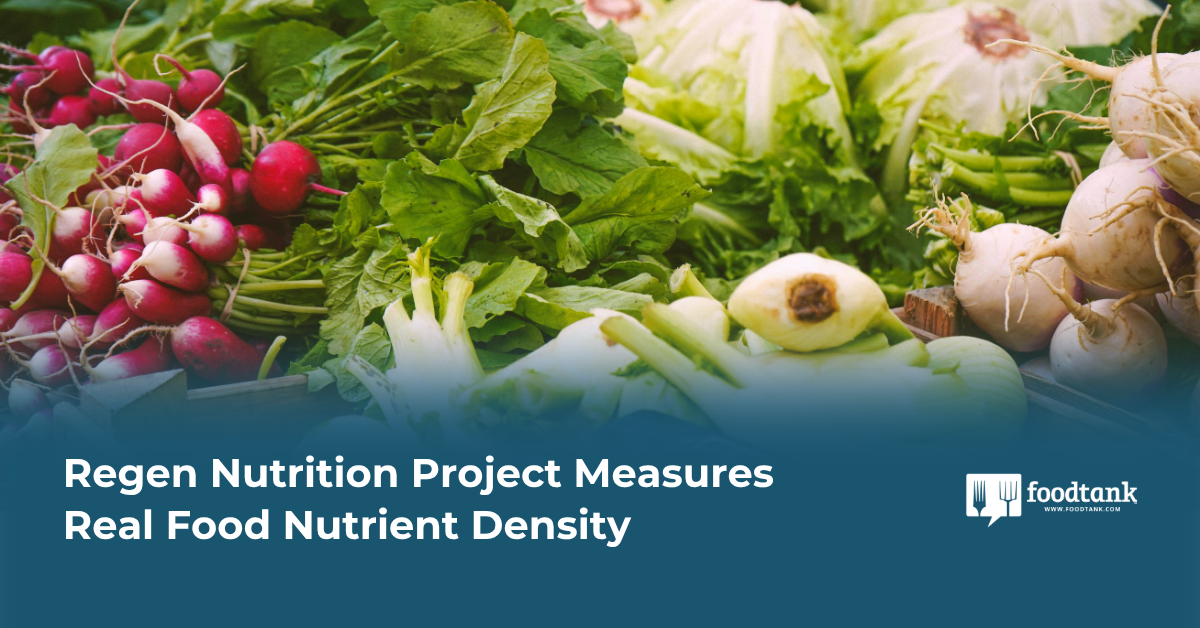
The Nutrient Density Initiative (NDI) and Edacious are leading the Regen Nutrition Project to explore how food production practices influence the nutritional quality of foods.
NDI teamed up with Edacious, a company that provides food testing and analysis, to launch the Regen Nutrition Project in 2024. The project invites NDI’s 50-plus members—including food companies and farmers committed to producing regeneratively—to test samples of their products at Edacious’ food lab.
Edacious’ food analysis technology compares the nutrient content of regeneratively-produced foods with conventional crops to help companies demonstrate the benefits of regenerative practices.
The data “will be critical for demonstrating that eco-friendly practices that build healthy soil and work in synergy with natural systems ultimately produce foods with higher nutrient density,” Mary Purdy, Managing Director of NDI tells Food Tank.
This is particularly important at a time when producers are facing skepticism that labels reflect real differences, Eric Smith, Founder and CEO of Edacious, says. “For producers, nutrition data is becoming a way to validate practices they already believe in—and to communicate that value credibly in the marketplace,” he tells Food Tank.
Edacious and the NDI also developed a Nutrient Density Data Explorer to visualize the nutrient data collected. It breaks down the nutrient content of the samples sent in by NDI members and compares them alongside conventional retail samples.
“We want it to be useful to farmers, researchers, brands, and policymakers alike: a tool that highlights how much variability actually exists in foods, where regenerative systems may be showing early signals of improved nutrient density, and where more research is needed,” Smith says.
Results from the Data Explorer show that regeneratively-produced samples have lower fat content, a better balance of Omega-6 to Omega-3, more protein, and no heavy metals, compared to conventional samples. The project has collected data on proteins in their pilot, and they are looking forward to expanding to grains and produce next.
According to a study in the journal Foods, commercial produce such as apples, oranges, tomatoes, and potatoes have lost up to 25 to 50 percent of their nutrient density in the last 50 to 70 years. And research from the Institute of Environmental Sciences reveals that the climate crisis further threatens nutritional quality.
“As concern about health continues to rise, this evidence becomes a powerful lever for changing purchasing decisions, not only at the consumer level, but also among those with significant purchasing power, including institutions, food service and food is medicine, providers, and retailers,” Purdy tells Food Tank.
Smith makes clear that the goal of the project isn’t to create “perfect foods.” It’s “to shift the conversation toward transparency, context, and continuous improvement, so that nutrition becomes a measurable, valued outcome of how we grow and produce food.”
Articles like the one you just read are made possible through the generosity of Food Tank members. Can we please count on you to be part of our growing movement? Become a member today by clicking here.
Photo courtesy of Meizhi Lang, Unsplash