




In Solo Show, we ask Black artists to curate a list of three treasured works that they’ve encountered or made, and to reflect on how their practice connects to a broader art lineage.
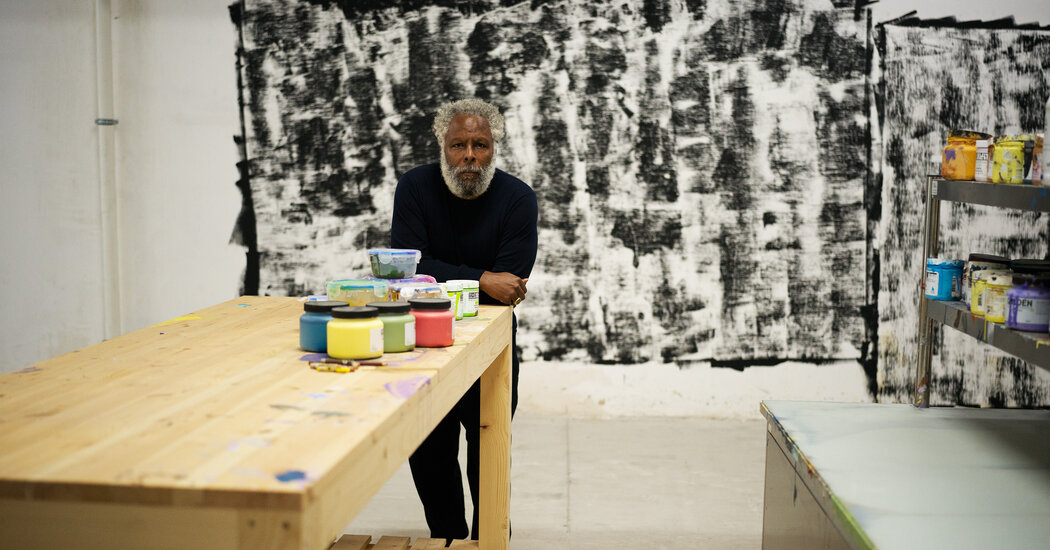
Is it possible to hear a painting? The artist Reggie Burrows Hodges thinks so. “There’s a musicality that lies within my work, a time signature,” he says. He considers his arrangement of figures, in particular, to be rhythmic. “Things speed up,” he says (a crush of bodies pressed together in the stands to watch a tennis match), or “they slow down” (a lone woman in a towel, stepping out of a bathtub). In one painting, a gathering of Black people dressed in white even resembles piano keys. Hodges, 60, has said that he aims for black to be the largest compositional element in his work. He starts by covering the whole surface of his canvas with the color before layering on the soft, gentle outlines of a portrait or domestic tableau, one usually inspired by Compton or New York, two of the places where he spent his early, formative years, or by one of the spots he’s lived since — Maine, Vermont, Canada, Angola or Malta, where he temporarily relocated in 2024. Here, Hodges, whose first European solo exhibition will open this weekend at the Malta International Contemporary Art Space in Floriana, discusses three artworks that are meaningful to him.
The first work that inspired himJacob Lawrence’s “The Migration Series, Panel No. 13: The crops were left to dry and rot. There was no one to tend them.” (1940-41)
My first experience with Jacob Lawrence’s work was through books — I came across this panel from his [60-part] “Migration” series in an art book at my mother’s house. Then, before I turned 14, I went to the Los Angeles County Museum of Art and saw his work in person. I had an inclination toward art from a young age — my father was a decent draftsman — and Lawrence represented something that drew me in: the ability to express profound ideas simply. There’s a straightforward flatness to his work and a stark use of shape and color that allowed him to tell a story about the migration of Black people — people who look like me — in a deeply human and universal way.
A work he returns to again and againCaravaggio’s “The Beheading of Saint John the Baptist” (1608)
I arrived in Malta two years ago with no plan. Then I saw this painting in the Oratory of Saint John’s Cathedral in Valletta [the island’s capital city]. I was interested in how Caravaggio’s legacy and life in Malta were expressed in the painting. It was made during his exile in Valletta, and is his largest work and the only one he ever signed. I was also drawn to his contrasting use of light and dark. I said to myself, “This is what Caravaggio made when he was here. What are you going to do?” It was daunting. Later I returned to the piece not with the idea of remaking it but of paying homage to Caravaggio [while depicting] circumstances that felt true to me. My work “Mama Jama” (2024) has some echoes of “The Beheading”: There’s blood on the surface of the pool, and I bring in the maiden who’s holding the chalice. It’s also the biggest painting I’ve made to date.
A work of his own that he’s excited about“Labor: Limoncello” (2025)
This painting was inspired by two weeks of unbelievable Sahara winds blowing murky dust across the Mediterranean and into Malta, including Floriana. You were moving through a haze, fighting through it, and the sand and dust caught in those winds led to a particular quality of light being cast across the town. The dust reduces air quality but also enriches the ecosystem with minerals like iron, and it magnifies the intensity of the sunsets. An undercurrent that runs through all of my work is the idea that gritty, less visible [forces] are integral to the creation and maintenance of something beautiful. My “Labor” series [explores how] spectacular buildings and landscapes are built on the backs of humans — people carrying stone, working the land — even when those people have no ownership or agency over what they’re making. Labor is essential to the spectacular.
This interview has been edited and condensed.