




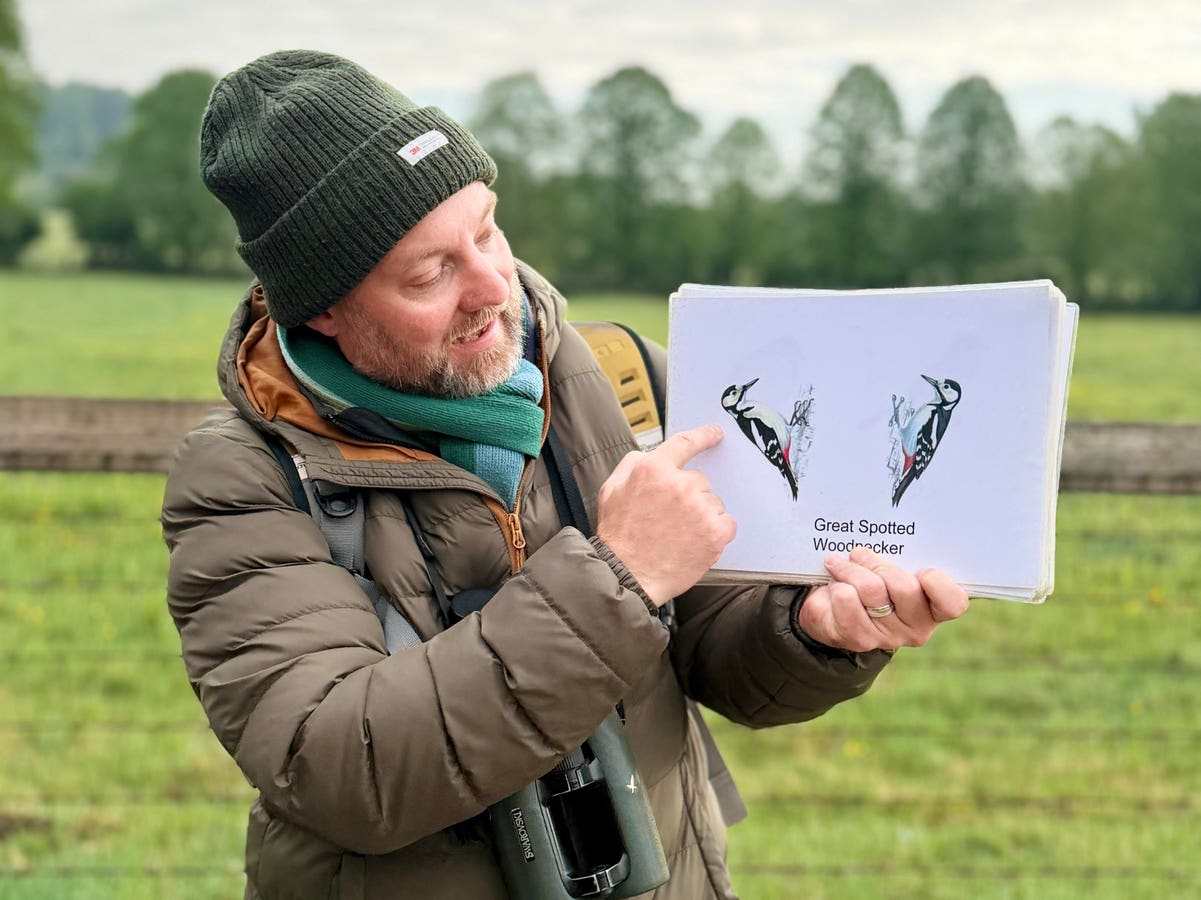
Ornithologist, naturalist, and wildlife guide, Dr. Ed Drewitt leads a birding tour during the dawn chorus in the Cotswolds.
Wendy Altschuler
It’s early. 6:00 a.m. Wellies are pulled on and I’m out the door to meet ornithologist, naturalist, and wildlife guide, Dr. Ed Drewitt. I’m geared up for the dawn chorus for a birding tour, organized by Active England, where we walk from Upper Slaugther to Lower Slaugther, following the River Eye in England’s Cotswolds, an Area of Outstanding Natural Beauty.
Drewitt’s hobby has always been birds. “My grandma would feed the starlings and sparrows, and we would go to the duck pond to feed the ducks,” Drewitt says. “I also had teachers that really encouraged my interests and gave me the confidence to think about it. A lot of bird songs I learned through my teenage years.”
The Wild Side of the Cotswolds
The British Trust for Ornithology has released a report showing a sharp decline of several species of birds in Britain including a loss of millions of house sparrows, starlings, skylarks, and chaffinches.
“We’ve lost about 17 million birds in Britain in the last 30 or 40 years,” says Drewitt. “House sparrows are down about 50 percent.”
Agricultural and traditional farming practices might be to blame. “All of these species that use to be quite common are declining fast because of the intensification of farming—herbicides, pesticides, and fertilizers are not leaving enough food, habitat, or space for our native species,” says Drewitt.
Drewitt goes on to say that some of these species are also growing. “The Chiffchaffs have actually increased over the years,” Drewitt says. “With the protections of birds of prey, we’re seeing more kites, buzzards, and peregrines; and robins and wrens, which are generalists, are still doing well. It’s the specialists that aren’t doing so well—the ones that require very specific habitats.”
“But I’m an optimist,” Drewitt says. “At the moment, the UK government are starting to fund farmers to farm for wildlife. Whether that’s planting hedgerows or ponds, or working with landscape conservation, hopefully things will get better.”
The Cotswold stone can be seen throughout the villages.
Wendy Altschuler Across the Cotswolds by Foot and Feather
We walk past the 12th-Century St Peter’s Church and into a woodsy area. Drewitt stops to point out an ash tree that he says is about 200 years old. “When they get to this age and onwards, they develop all sorts of wonderful holes and hallows, which are really good for owls and woodpeckers and bats. This tree is really good for nature.”
We wander further and see old oak trees at the top of the hill. “Their leaves provide home to the most number of invertebrates and insects of any tree in Britain,” says Drewitt.
We pause to cup our ears and listen for a goldfinch. I search for its red face and yellow-emblazoned wing with my binoculars. “Oh, a Mandarin duck is flying, just on the right,” Drewitt says. “We have a naturalized population in the UK. They’re shy ducks. And on the left I can hear a robin doing its contact call—just doing a bit of ticking. If you cup your ears, you can hear tick-tick-tick. That’s a robin calling rather than singing, talking to another robin, probably got a nest in there.”
Drewitt pulls out a small blue wand to play back the sounds of specific birds so we can match them to what we hear in the wild. I’m beginning to be able to distinguish between the different sounds, and I can see how this is a wildly popular activity for not only bird enthusiasts, but also, hikers and walkers who are curious about nature and wildlife.
Listening and looking for birds along the River Eye in the Cotswolds.
Pam LeBlancThe Morning Burst of Birdsong
As the Cotswolds are an agricultural zone, I ask Drewitt what is particularly special about this area for bird watchers. “You have a lot of clusters of farmers that are doing positive things for nature, and you also have landowners like the Calcott Manor that are doing positive things (the manor’s re-wilding program includes wildflower and tree planting, bee hives, and organic farming practices); but one of the key things is that you’ve got farmland species like yellowhammers and corn buntings that are declining nationally but are doing well here.”
The walk continues past a 19th-Century water mill and honey-hued stone cottages lined with flower boxes and draping wisteria and ends where we started. Walking with a purpose, with an expert who is passionate about flora and fauna, has made the adventure feel meaningful.
On a multi-day tour through the Cotswolds with Active England, there’s much more on the horizon to experience and I’m looking forward to seeing-and hearing-many more bird species on trails full of feathered wonders.
“There are also really nice ancient woodland areas around the Stroud Valley and other parts of the Cotswolds with wildflowers and trees that are 400 years older or more,” Drewitt says.