




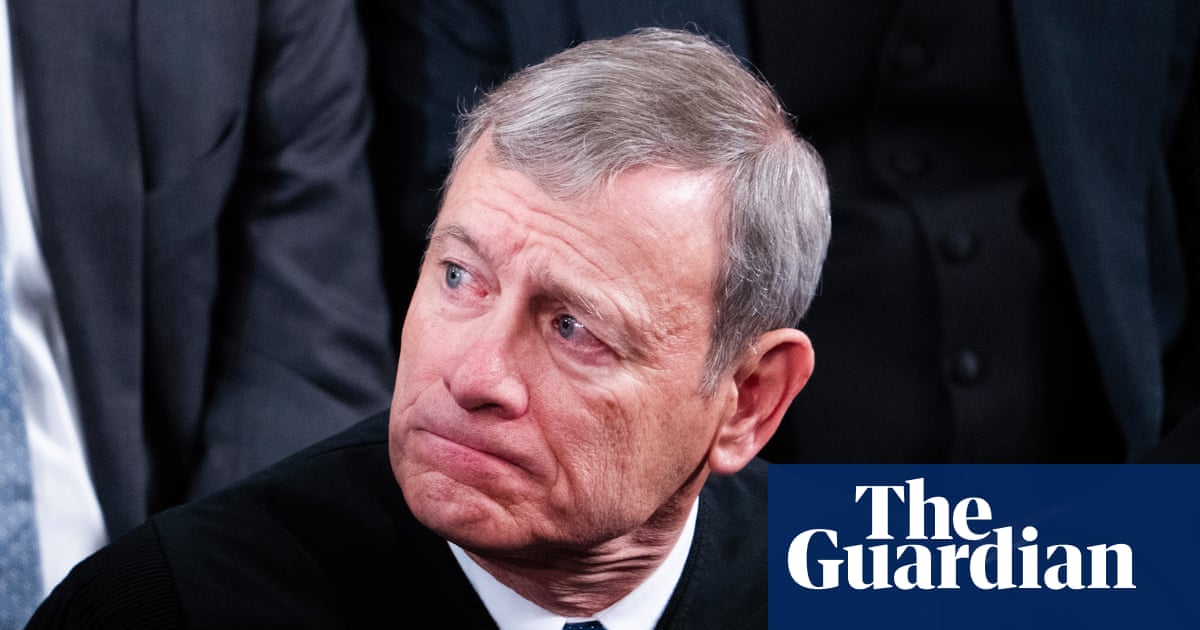
US chief justice John Roberts has insisted supreme court judges are not “political actors” amid outrage over its recent decision undermining the Voting Right Act, and other moves that have benefited Donald Trump and his allies.
“I think, at a very basic level, people think we’re making policy decisions, we’re saying we think this is how things should be, as opposed to what the law provides,” Roberts told a conference for judges and lawyers in Hershey, Pennsylvania, on Wednesday, according to the Associated Press. “I think they view us as purely political actors, which I don’t think is an accurate understanding of what we do.”
The supreme court is “simply not part of the political process”, Roberts claimed. He acknowledged, however, that some of its decisions may spark controversy. “One thing we have to do is make decisions that are unpopular,” he said, according to the AP.
The chief justice, a conservative nominated by Republican George W Bush in 2005, also reiterated his condemnation of threats against lower court judges. “That’s not appropriate and it can lead to very serious problems,” he said.
Roberts leads a court on which conservatives have held a six-justice majority since 2020, and handed down a series of decisions that have upended longstanding precedent and, in Trump’s second term, allowed many of his policies to take effect, at least temporarily.
Last week’s decision on the Voting Rights Act has greenlit a scramble by Republican-led states to enact new congressional maps that will break up districts drawn to elect Black lawmakers, who tend to be Democrats. That may amount to a major blow to the party’s long-term chances of controlling the US House of Representatives.
The court has also expanded use of a fast-track process known as the “shadow docket” to temporarily pause lower court rulings against the Trump administration, including his mass deportation policies and gutting of federal departments.
During Joe Biden’s presidency, the Roberts court handed down landmark rulings overturning the constitutional right to abortion, and giving presidents some immunity for official acts.
The justices have not been entirely supportive of the Republican’s second-term agenda: in February, it found that many of the tariffs Trump had imposed were illegal.
But there have nonetheless been signs that the court’s split decisions on high-profile issues have raised tensions with the three liberal justices.
In an order this week allowing Louisiana to begin redrawing its congressional maps in light of the court’s decision against the Voting Rights Act, Ketanji Brown Jackson, a justice who was appointed by Joe Biden in 2022, dissented, calling the move “unwarranted and unwise”.
“The Court unshackles itself from both constraints today and dives into the fray. And just like that, those principles give way to power,” Jackson wrote.
That prompted a rebuke from Samuel Alito, a justice who, in a concurrence joined by fellow conservatives Clarence Thomas and Neil Gorsuch, described the arguments laid out by Jackson as “trivial at best, and … baseless and insulting”.
Get in touch
Contact us about this story
The best public interest journalism relies on first-hand accounts from people in the know. If you have something to share on this subject, you can contact us confidentially using the following methods:
Secure Messaging in the Guardian app
The Guardian app has a tool to send tips about stories. Messages are end to end encrypted and concealed within the routine activity that every Guardian mobile app performs. This prevents an observer from knowing that you are communicating with us at all, let alone what is being said.
If you don’t already have the Guardian app, download it (iOS/Android) and go to the menu. Select ‘Secure Messaging’.
SecureDropIf you can safely use the tor network without being observed or monitored you can send messages and documents to the Guardian via our SecureDrop platform.
Our guide at theguardian.com/tips lists several ways to contact us securely, and discusses the pros and cons of each.
Show more