




Image Credit: TR Consumer Forum/TRBusiness
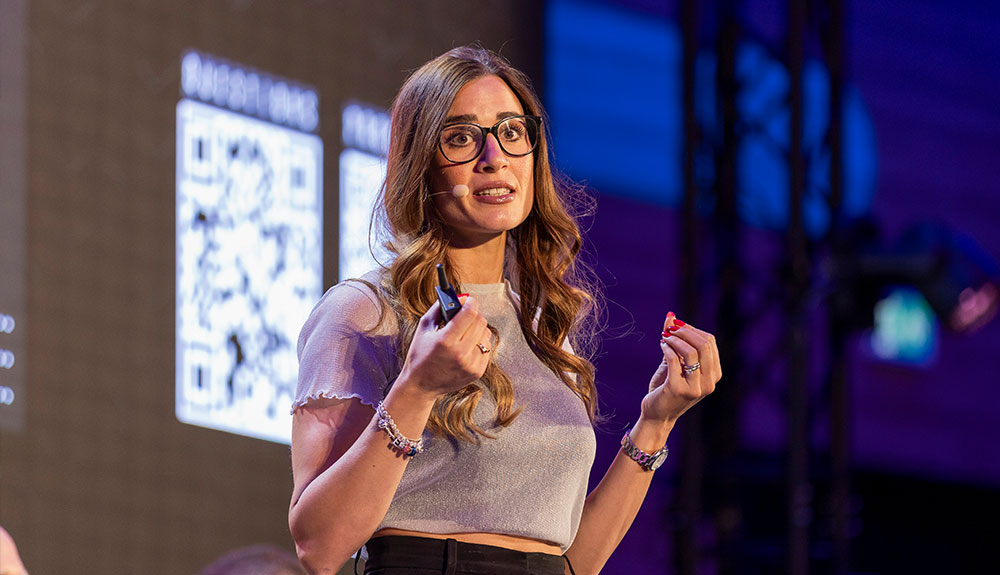
Anna Marchesini, Head of Business Development, m1nd-set.
Curious, deal-driven, self-oriented and pre-informed – we paint a picture of today’s duty-free beauty buyers in Asia Pacific thanks to the latest data from m1nd-set.
For all those operating in the travel retail beauty space across Asia Pacific (APAC), taking a deep dive into the mindset of the region’s beauty consumers, and how their shopping habits and expectations are evolving, is essential for gaining an edge in an ever-crowded marketplace.
Just like other categories, the landscape is undergoing a major transformation, shifting from transactional sales to experience-led activations, with airports welcoming a new wave of increasingly innovative initiatives, from the recent multi-sensory Estée Lauder & Diane Von Furstenberg exclusive pop-up at Singapore’s Changi Airport to the first L’Oréal Travel Retail Asia Pacific and Skinceuticals Hydrafacial hotel spa for tourists in Hainan, which made its debut in February.
Strong conversion
With the rise of the ‘glocal’ consumer (globally informed locals) and an increasingly diverse and fragmented marketplace, pinpointing the levers that drive conversion is paramount. To help retailers and brands maximise opportunities, m1nd-set has carried out research into the key ways to attract and convert beauty shoppers in the region. Firstly, the 2025 insights show that there is evidence of a strong funnel, despite average traffic.
Image Credit: m1nd-set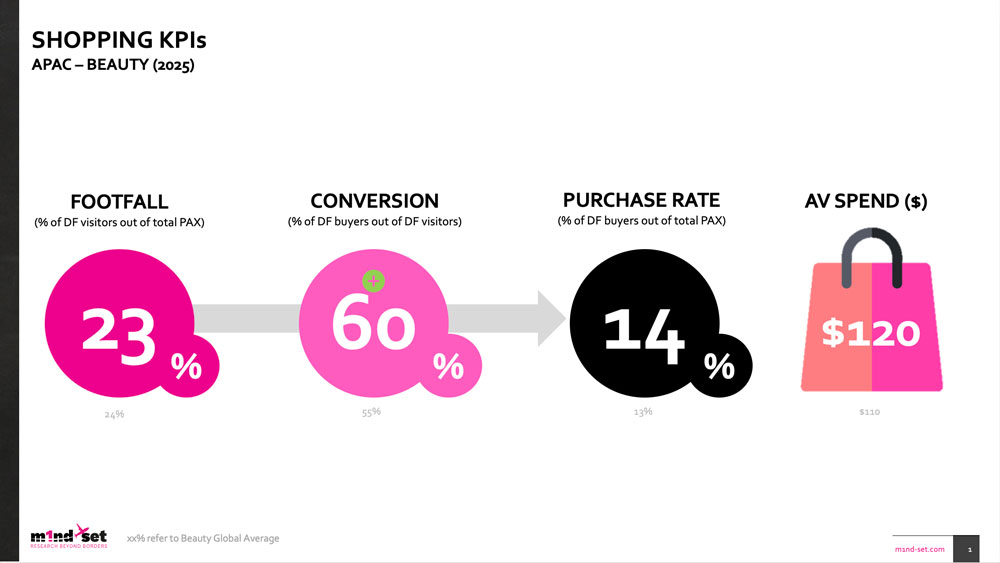
“A total of 23% of passengers enter the duty-free beauty zones, which is still slightly below global levels (24%) – however, conversion is very strong at 60%, compared to a global average of 55%, showing high purchase intent once inside,” said Anna Marchesini, Head of Business Development, m1nd-set.
Reassuringly, APAC beauty buyers display a solid overall purchase rate of 14%, against a global average of 13%. Plus, their basket size is elevated at $120 versus the global figure of $110, confirming strong value per shopper.
Image Credit: m1nd-set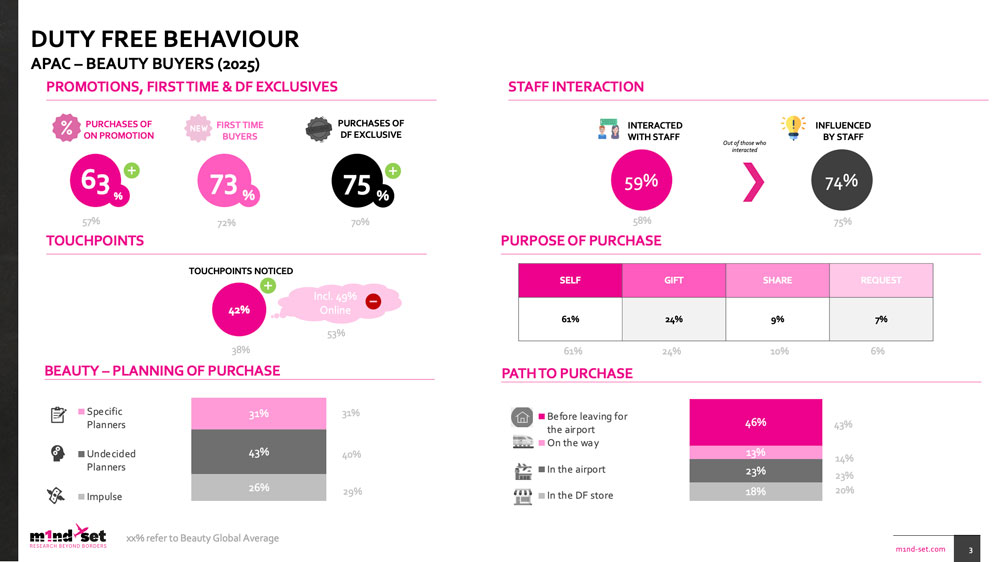
In terms of what they look like, a self-treat, leisure-led shopper is dominating the landscape.
“Indeed, 61% purchase for themselves, reinforcing a personal indulgence mindset,” confirmed Marchesini. The core profile sees female (58%), leisure travellers (76%), journeying in standard class (72%). There’s also a skew towards millennials (45%) and Gen X (34%), with – and this may come as a surprise considering industry-wide efforts to court younger consumers – an average age of 41.
Hybrid path to purchase
The data also points to APAC beauty shoppers being highly reactive to offers and discovery.
Image Credit: m1nd-set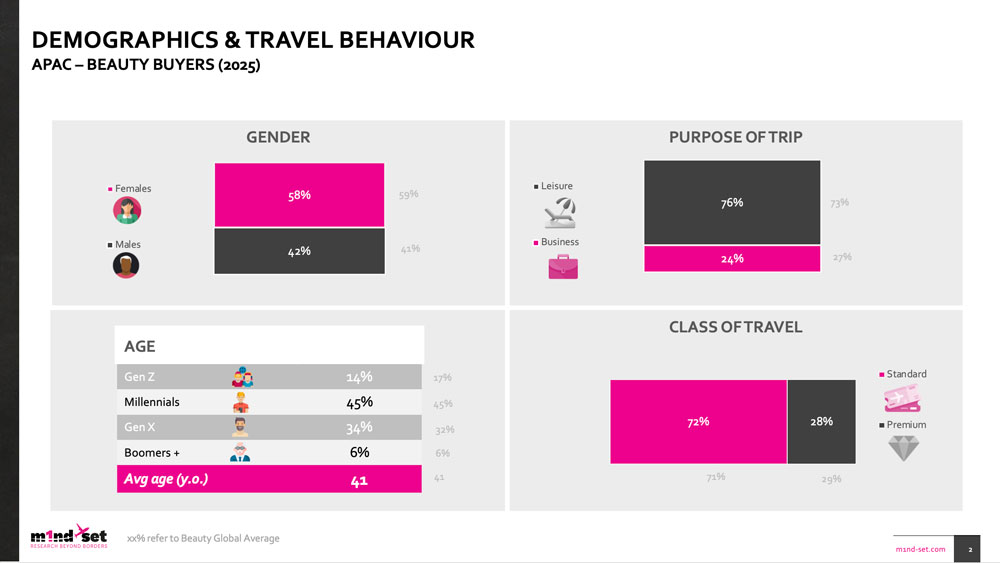
“A total of 73% are first-time buyers, indicating strong openness to newness,” explained Marchesini. “Furthermore, 63% purchase on promotion and 75% choose exclusives, indicating clear deal sensitivity. Additionally, 42% notice touchpoints, showing marketing still plays a key role.”
Delving into further detail shows that APAC beauty buyers are flexible when it comes to planning, but their decision-making process starts early, with 43% undecided and 26% impulse-driven, demonstrating high in-store flexibility.
Image Credit: m1nd-set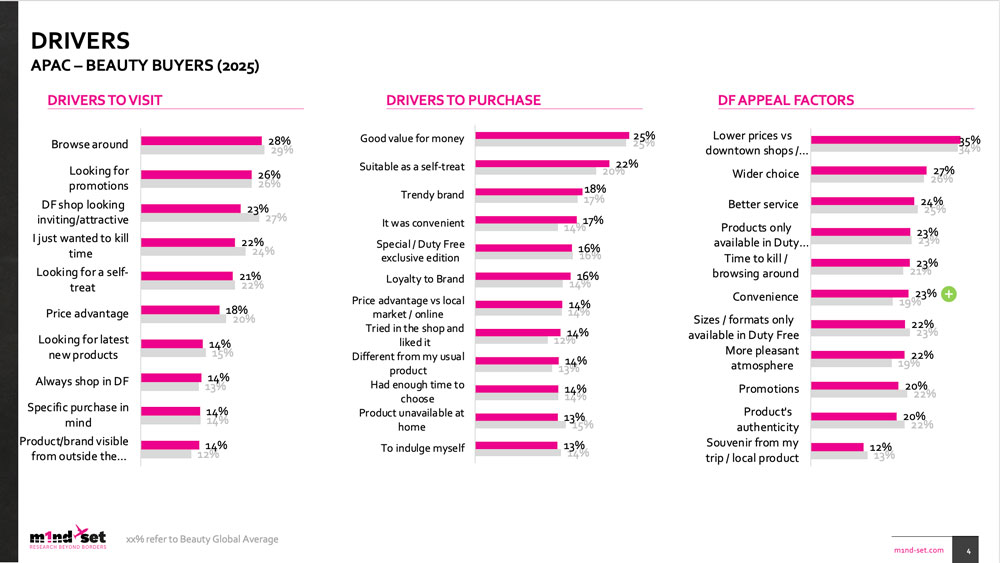
“Yet 46% start their ‘path the purchase’ journey before leaving for the airport, showing a relatively high degree of pre-trip influence,” pointed out Marchesini. “Only 31% are fully planned, indicating a hybrid path to purchase.”
Influenced by staff
Staff interaction also plays an impacting role, with 59% interacting with staff and, out of those who did cross paths with beauty ambassadors, 74% were influenced.
Looking at duty-free appeal factor convenience stands out at 23% versus the 19% global average, reinforcing how, as beauty activations continue to evolve into more experience-led activities, making it as easy as possible for time-pushed travellers to pick up and pay for their desired products must always be front and centre.
This feature first appeared in the May 2026 issue of TRBusiness magazine.
READ NEXT: Chef Akira Back: Airports present “huge untapped opportunities” for F&B
READ NEXT: TFWA Asia Pacific: Hyunjin Kim on AI’s travel retail revolution
READ NEXT: Global DF&TR sales est. at $75.9m in 2025; APAC claims 40.2% market share
Like what you’re reading? Follow TRBusiness on Linkedin: