




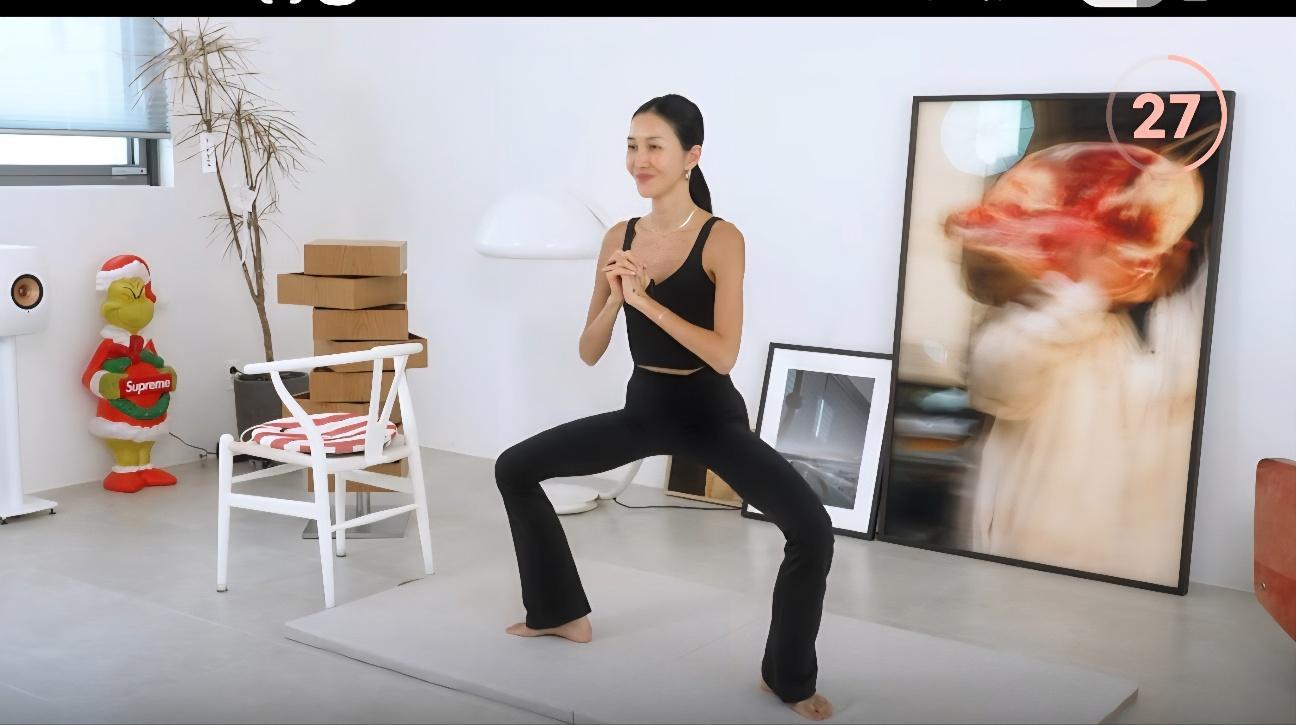
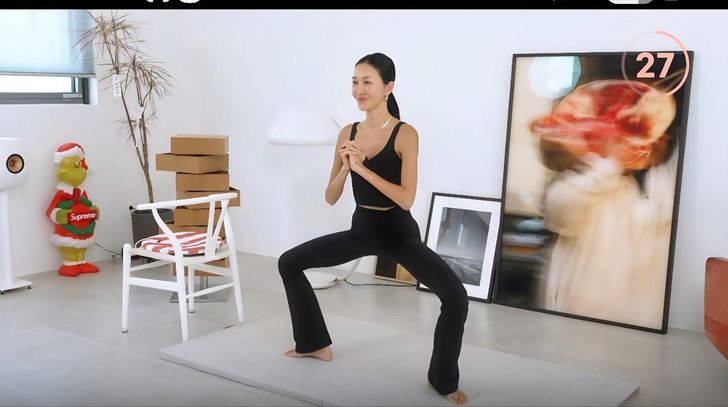
Former ballet dancer Yoon Hye-jin demonstrates the grand plie pulse move on her YouTube channel. Captured from YouTube
Click here for more articles by Kormedi.com.
Former ballet dancer and TV personality Yoon Hye-jin recently revealed a ballet-inspired lower body exercise she says helps create toned legs and a lifted glute line.
On her YouTube channel, “Yoon Hye-jin’s What See TV,” she shared a home workout routine focused on strengthening the inner thighs and improving hip shape through ballet basics.
“Learning proper form from the beginning is important if you want smooth, elegant leg lines,” Yoon said. “I’ll show you a lower body routine using ballet movements that target the deep muscles of the legs and improve the hip line. It’s based on basic exercises that ballerinas practice every day.”
The first move she introduced was the grand plie pulse, a deeper variation of the ballet plie in which the knees bend outward while the body lowers further toward the floor. The move is designed to strengthen the inner thighs.
“Beautiful leg lines come from building the inner thigh muscles,” Yoon explained. “If the outer thigh muscles become overly bulky, the legs can look uneven and lumpy.”
To do the exercise, stand with your feet turned outward in a frog-like stance and bend your knees while keeping your torso upright. From there, pulse your hips up and down in short, controlled movements for one minute.
Yoon emphasized several key points:
– Keep the pelvis and spine upright.
– Engage the core throughout the movement.
– Avoid pushing the hips backward.
– Lower the body deeply while maintaining balance.
– Hold the hands comfortably in front of the chest.
“Don’t fully straighten the legs at the top,” she said. “Stay low and keep bouncing in small pulses. You should feel your inner thighs and glutes trembling.”
She also stressed squeezing the inner thighs together as if “wringing them inward” to fully activate the adductor muscles.
The grand plie pulse heavily activates the adductors — the inner thigh muscles responsible for pulling the legs toward the body’s center. These muscles play an important role in walking, climbing stairs and maintaining balance.
According to the American Academy of Orthopaedic Surgeons, weak adductor muscles can reduce pelvic and hip stability, potentially causing the knees to collapse inward during movement.
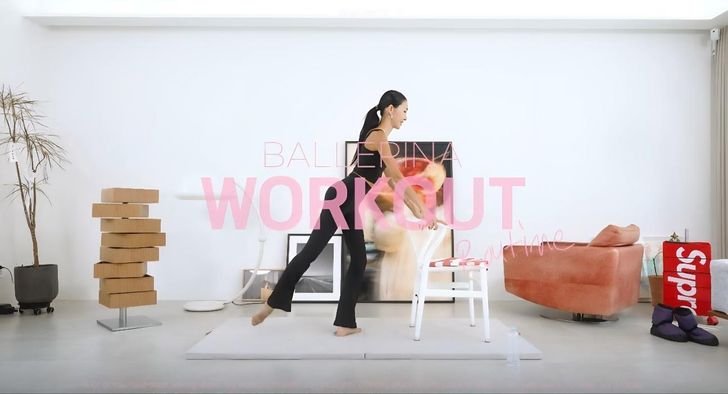
Former ballet dancer Yoon Hye-jin holds the back of a chair while demonstrating her lower body workout routine. Captured from YouTube
Strengthening these muscles may be especially beneficial for office workers who sit for long periods, women recovering after childbirth, and people who do activities requiring lower body alignment, such as running, Pilates or dance.
Studies published in the Journal of Strength and Conditioning Research have also reported that squat- and plie-style exercises can increase activation of the adductors and glute muscles, helping improve lower body stability.
However, people with knee pain or hip joint problems should avoid descending too deeply and consult a professional before attempting the exercise.
Experts say improving leg shape is not just about repeatedly targeting one muscle group. Flexibility, posture correction and body fat management also play key roles.
Habits such as prolonged sitting, crossing the legs and poor walking posture can contribute to pelvic imbalance and changes in lower body alignment.
Aerobic exercises like walking and cycling can help reduce body fat and create a more balanced lower body appearance. Stretching the hamstrings, calves and hips before and after workouts may also reduce muscle tightness and improve mobility.
Foam rolling and stretching can further ease muscle tension and increase range of motion in the joints, particularly in the front thighs, calves and glutes.
When the glutes and thigh muscles work together effectively, they help stabilize the lower body while standing and walking, contributing to smoother overall leg lines.
This article from Kormedi.com, Korea’s top health care and medical portal, is translated by a generative AI system and edited by The Korea Times.