


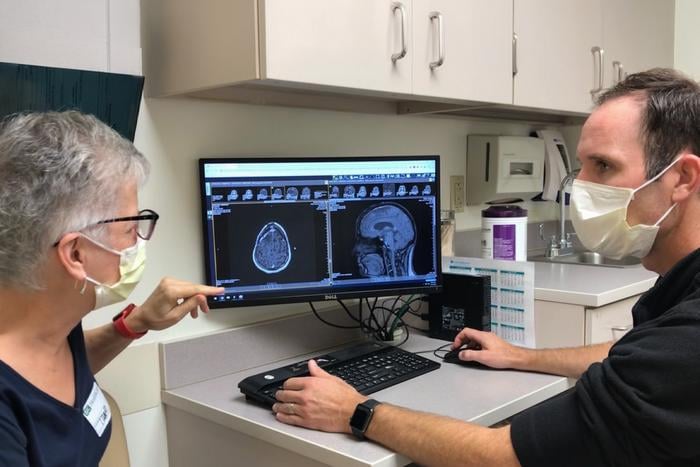
It was a Sunday morning at a youth camp in rural Missouri, and Kim Garland was forgetting things. Not the ordinary lapses of a busy volunteer in her sixties, but stranger gaps: words she should have had, names that simply weren’t there, headaches that came and went like weather. Her daughter-in-law noticed first. Within days, a scan at a St. Louis emergency room revealed what was causing it: a mass roughly the size of a small avocado, sitting in her brain. The subsequent biopsy confirmed glioblastoma, grade 4. The most aggressive primary brain cancer there is.
For most people who receive that diagnosis, the trajectory is grim and, until recently, almost entirely fixed. Surgery, radiation, chemotherapy, recurrence. Median survival runs somewhere between 12 and 18 months. But in the three years following Kim Garland’s diagnosis in 2021, researchers at Washington University School of Medicine in St. Louis were quietly testing something different: a vaccine built from the specific molecular fingerprint of her own tumour. Today, nearly five years on, she remains cancer-free.
The results of that phase 1 clinical trial, published today in Nature Cancer, represent what the researchers describe as a first for glioblastoma. Nine patients received bespoke DNA vaccines, each one encoding up to 40 molecular targets unique to their individual tumour. Two-thirds of participants were still alive at twelve months, compared with the roughly 40 percent that standard treatment typically achieves. A third survived past two years, at a time when historical data suggests only around one in ten would. The approach does not yet constitute a cure. But it does something glioblastoma has stubbornly resisted for decades: it gets the immune system to actually notice the tumour.
A Cold Tumour Made Hot
Glioblastoma is what immunologists call a “cold” tumour. Its microenvironment, the cellular neighbourhood surrounding the cancer cells, is extraordinarily good at suppressing immune activity. It recruits immunosuppressive cells, damps down signalling, and effectively renders itself invisible to the T cells that would otherwise hunt it down. Prior attempts to crack this using checkpoint inhibitors, the class of drugs that has transformed treatment in melanoma and lung cancer, have repeatedly failed in large randomised trials. The tumour simply doesn’t respond.
Tanner Johanns, the oncologist who led the trial, had a different intuition. “We chose a DNA-based platform because it would allow us an opportunity to target more cancer proteins than any vaccine had targeted before,” he said. “Our thinking was that if we could generate a broader range of immune responses against those proteins then it may lead to a more potent vaccine compared to other vaccine platforms with more limited protein targets.” The reasoning was partly probabilistic: glioblastoma, like all tumours, evolves under immune pressure, shedding the targets the immune system has learned to recognise. If you can simultaneously train immunity against forty targets instead of twenty, the tumour has a great deal more to hide.
What makes this technically possible is the DNA platform itself. Earlier neoantigen vaccines, including the peptide-based approaches trialled in melanoma, are constrained by synthesis costs, solubility problems, and production time. DNA plasmids can carry considerably more genetic information. Each patient’s vaccine was manufactured during the six weeks of radiation therapy following surgery, so that by the time patients had recovered, their personalised treatment was waiting.
Forty Targets Per Patient
Getting to forty targets per patient required careful thinking about tumour biology. Glioblastomas are spatially heterogeneous: one region may carry mutations absent in another. A vaccine built from a single biopsy could miss targets entirely. So the team, working with computational biologists Obi Griffith and Malachi Griffith on the neoantigen prediction pipeline, sampled tissue from three or four distinct tumour regions during surgery. On average, this increased identifiable variant targets by 45 percent compared to sampling just the least-mutated region. The vaccine was, in effect, a molecular map of the whole tumour, not a single patch of it.
The immune response that followed was, by most measures, substantial. In all but one of the patients assessed, circulating T cells showed marked activation against the neoantigen targets. The exception was a patient receiving dexamethasone, a steroid commonly used to manage brain swelling, which is known to blunt immune responses. In patients who showed the strongest T cell activation, survival was correspondingly better: there was a meaningful positive correlation between CD8 T cell activity after vaccination and overall survival from the time of surgery, suggesting the vaccine was doing biological work rather than generating technically positive results that don’t translate.
The picture was perhaps clearest in one patient who underwent a second surgery after vaccination, allowing the team to examine the tumour microenvironment directly. Before vaccination, CD8 T cells were barely present: around 50 per square millimetre of tissue. After, that figure had risen to 181, a statistically significant increase. New T cell clones appeared that hadn’t existed before, and two of those simultaneously expanded in the bloodstream, suggesting a coordinated immune response moving from periphery into tumour. Whether it would have been sufficient to clear the disease is another matter; this patient ultimately died from recurrence in the opposite hemisphere, a region the vaccine hadn’t been designed to target.
The Patient Who Remained
Then there is Kim Garland. The trial recruited nine patients with the MGMT unmethylated subtype of glioblastoma, which is particularly refractory to chemotherapy because the tumour cells actively repair the DNA damage that temozolomide is supposed to inflict. All nine had, in one sense, already run out of standard options before they enrolled. Garland received her vaccine injections starting around ten weeks after surgery, every three weeks for the first nine weeks, then every nine weeks thereafter. Her scans subsequently showed some ambiguous changes that briefly raised concern, the kind of radiographic noise that often accompanies aggressive cancer treatment. But the concern resolved. She is still here.
Gavin Dunn, a neurosurgical oncologist at Mass General Brigham and a senior author on the paper, placed the result in context that is guarded but candid. “Cancer vaccines have a long history, and the development of personalized neoantigen-targeting therapeutic vaccines now represents a highly compelling approach in glioblastoma and in other cancers,” he said. “These programs require a high degree of integrated teamwork, and we are fortunate to have collaborated with many dedicated team members in this effort.” The trial enrolled just nine patients. No randomised control. Statistical significance was not reached on survival comparisons, which the authors acknowledge openly. What the trial does establish is safety, immunogenicity, and a signal; each of those things has been elusive in glioblastoma before.
Johanns and his colleagues are already running a follow-on trial that combines the vaccine with a PD-1 checkpoint inhibitor from the start of treatment rather than at recurrence, which is the sequence that produced the most suggestive results in the tumour microenvironment data here. The manufacturing pipeline needs to get faster: the median gap between completing radiation and receiving the first vaccine dose was ten weeks, longer than the four-week target the team had set for itself. Comparable DNA vaccine platforms in liver cancer have achieved six-to-eight-week turnarounds. Closing that gap is, in practical terms, probably the next important milestone.
Scott Garland said that before the trial, he and Kim were living week by week, not daring to plan much further. They’ve booked a long-delayed vacation this summer. They’re spending time with their fifteen grandchildren. “What we’re hopeful for is that through research like this, someday, when another person hears the words ‘you have glioblastoma’ as their diagnosis, it will not cause as much anxiety,” he said. Whether that day comes depends on whether the immune signals found here, in nine patients in St. Louis, hold up across larger and more varied populations. But the immune system, it seems, can be taught to recognise what the tumour worked so hard to hide.
https://doi.org/10.1038/s43018-026-01163-w
Frequently Asked Questions
Why has it been so hard to treat glioblastoma with immunotherapy when it works so well in other cancers?
Glioblastoma creates an unusually hostile microenvironment for immune cells, actively recruiting immunosuppressive cells and dampening signalling that would otherwise attract T cells. Checkpoint inhibitors, which have transformed outcomes in melanoma and lung cancer, have repeatedly failed in large glioblastoma trials because the tumour’s immune-suppressing machinery overwhelms the drug’s effects. The personalized vaccine approach attempts to overcome this by training a broad, multi-target immune response before the tumour can adapt and hide.
What makes this vaccine different from the cancer vaccines that failed in glioblastoma before?
Earlier neoantigen vaccines for glioblastoma targeted at most 20 tumour-specific proteins per patient, and were typically built from a single tumour biopsy, missing the spatial variation across different regions of the tumour. This DNA-based platform can encode up to 40 neoantigens drawn from multiple biopsied regions, giving the immune system a much wider range of targets to recognize. The idea is that even if the tumour sheds some targets under immune pressure, enough remain for the response to continue.
Could the steroid drugs commonly used to manage brain swelling undermine the vaccine?
The trial data suggest they can. The one patient who showed no measurable immune response to the vaccine was receiving dexamethasone throughout the vaccination period, a steroid known to suppress immune activity. This is a practical problem because brain swelling is common in glioblastoma and often requires treatment, but it points toward using alternative anti-inflammatory agents like bevacizumab to control symptoms without blunting the immune response the vaccine is trying to generate.
Is it possible to know whether the long-term survivor was cured by the vaccine, or just unusually lucky?
With a single patient in a nine-person trial, it is genuinely impossible to separate the two, and the researchers acknowledge this directly. What the data do show is that this patient generated a strong T cell response to the vaccine neoantigens, and that new T cell clones appeared in tumour tissue after vaccination; the biology is consistent with vaccine-driven immune control. Whether that mechanism was decisive, or whether her tumour biology was simply more favourable from the start, requires far larger trials to disentangle.
Quick Note Before You Read On.
ScienceBlog.com has no paywalls, no sponsored content, and no agenda beyond getting the science right. Every story here is written to inform, not to impress an advertiser or push a point of view.
Good science journalism takes time — reading the papers, checking the claims, finding researchers who can put findings in context. We do that work because we think it matters.
If you find this site useful, consider supporting it with a donation. Even a few dollars a month helps keep the coverage independent and free for everyone.
Related