



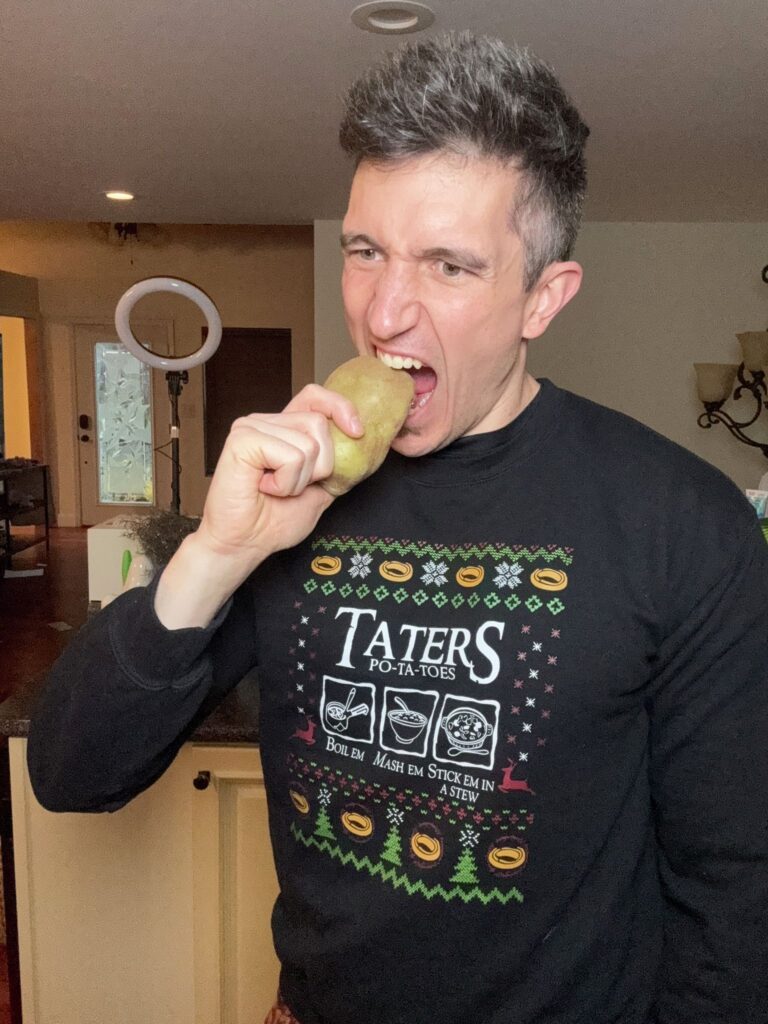
Liam Layton of Delmar is known on social media as The Plant Slant, offering takes on recipes and nutrition dialogue in an accessible way.
Courtesy of Liam Layton
Liam Layton of Delmar is known on social media as The Plant Slant, offering takes on recipes and nutrition dialogue in an accessible way.
Courtesy of Liam Layton
Liam Layton of Delmar is known on social media as The Plant Slant, offering takes on recipes and nutrition dialogue in an accessible way.
Courtesy of Liam Layton
Liam Layton of Delmar is known on social media as The Plant Slant, offering takes on recipes and nutrition dialogue in an accessible way.
Courtesy of Liam Layton
Food fads, diet culture in every flavor and influencers attempting to influence what you eat are not new. An Albany native is working to curb the “this is bad for you” culture in food by balancing what we crave with more nutrient-dense options.

Liam Layton has a total of nearly 5 million followers on Instagram and TikTok. Many of his videos test recipes that are described as healthful, and he gives his take, including being flexible with ingredients, not demonizing additives and injecting a good dose of humor and sarcasm. Many of his fans have taken to tagging him in cooking videos that feature beans — a personal favorite ingredient of his — or cottage cheese, a protein darling of the day.
Article continues below this ad
Layton was born and raised in the Albany area, growing up near what is now Scene One Spectrum 8 Theatres on Delaware Avenue. After graduating from Albany High School and pursuing a degree in polysomnography (associated with sleep science) from Hudson Valley Community College in Troy, he moved to Ohio for a decade, starting a degree in nutrition. Layton moved back to the Capital Region, settling in Delmar with his wife and daughter in 2025 and is working to complete his nutrition degree at Russell Sage College.
His approach to food and content creation under the “Plant Slant” moniker? “I try to make eating healthier attainable without losing your mind. Realistic and, hopefully, fun.”
So bring on the bean hat and the insert-quip-here-out-of-10 rating, and learn a bit more about Layton.
Make the Times Union a Preferred Source on Google to see more of our journalism when you search.
Add Preferred Source
This interview has been edited for length and clarity.
Article continues below this ad
Q: I’ve watched your videos personally for a few years, but only recently clocked the Price Chopper- and Hannaford-branded items in your recipe videos. Are those the shops you usually go to?
A: Yeah, sort of. I go to the Hannaford here in Delmar. I usually get coffee at Uncommon Grounds, go to Hannaford, grab what I need and film whatever bean or cottage cheese video I’m going to make.
Q: Speaking of beans and cottage cheese, as someone in the food content creation sphere, I feel like every few months there’s a different trend. Cottage cheese and beans seem to be one of those things people constantly tag you in. How do you speak to trends in your videos?
A: You kind of need to, as a content creator, if you want to be successful. I’m not saying you have to do trends, but it makes sense to participate in them a little bit. Beans have been trending more recently because people are making videos like, “I ate a can of beans today and it fixed my eczema,” or autoimmune disorders, or whatever. Cottage cheese has been everywhere for like two years because it’s cheap and high in protein.
Article continues below this ad
Those are really the categories there: versatile, cheap, lots of protein. Protein has been trending for a long time now. Everything has to have protein. Cottage cheese is trending because of that.
Q: As someone making recipes, how much do those macros like protein play a role in your content?
A: Fiber is everything now. I’ve seen so many colorectal cancer stats lately. Cancer deaths overall have been going down because we’re catching things earlier and treatments are improving, but colon cancer is an outlier, especially among young people. Low fiber intake is one of the factors people are talking about.
Article continues below this ad
I’ve been talking about fiber since I started this around 2021 or 2022, so I’m actually really happy to see it getting more recognition now.
Protein is important too because it’s very satiating and can help people lose weight, which is something a lot of people are trying to do. But now I’m trying to help people understand that fiber can not only help with weight loss but can also reduce your risk of colon cancer.
Q: Let’s go back a little bit. Were you always nutrient-conscious? In some of your more budget-friendly videos, you mention utilizing food banks and donation programs. What’s your background with food and growing up in the Capital Region?
A: My parents had me young. My mom went to Russell Sage — which is funny, because now I’m there finishing my undergraduate nutrition degree. We were broke, (on) food stamps, all that stuff. I’ve had food stamps at other points in my life, too. So a lot of my life has been “work with what you’ve got.”
Article continues below this ad
My mom was really health-conscious, though — even more than me sometimes. That rubbed off on me a little. As I got older, I thought maybe I could help people eat healthier because I think I’m kind of built for social media. I’m weird and out there and extroverted enough for it.
Q: When you first broke into content creation, did you know you wanted to focus on food?
A: No, actually. At first, it had nothing to do with nutrition. I grew up watching “MADtv” and skit comedy. I still have some old skits I made that I think are pretty funny.
Article continues below this ad
Then I started going to Ohio State University for nutrition, and I started making some nutrition content. That did a little better, and people liked it.
That was during the era when debunking videos were really popular. People in grocery stores say carrageenan (a natural thickener often used in dairy products) is evil, and I’d be like, “Nah, seaweed is fine.” That started doing really well. Then people wanted recipes. So I started making recipes and realized my whole thing became helping remove food fears and helping people add nutrient-dense foods into their diets in simple ways.
Q: One thing I love about your content is how approachable it is. You don’t let perfect be the enemy of good.
Article continues below this ad
A: Exactly. People are like, “I don’t have cilantro, so I guess I can’t make this.” And I’m like, “Use another herb. Leave it out. Use your common sense — you got this.”
I try to make it approachable and fun. Maybe it turns out great, maybe not, but it’ll probably be good enough. If you’re always trying to make everything perfect, you’ll drive yourself insane.
The average American diet is something like 60% to 70% ultra-processed foods. A lot of influencers want people to optimize every little thing, but if someone goes from 70% ultra-processed foods down to 40%, that’s a massive difference.
Same with exercise. If someone goes from zero exercise to 10 minutes a day, that’s huge. Is it perfect? No. But the health benefits are massive compared to where they started.
Article continues below this ad
That’s my whole shtick: small, manageable changes that make a big impact without making people miserable.
Q: Do your followers tell you they’re seeing benefits from that mindset?
A: All the time. People tell me they lost weight, feel better, move more or just don’t fear food anymore. That’s exactly what I want. I’ve had people say, “I lost 50 pounds watching your content and it didn’t feel hard.” That’s the goal.
People obsess over things like carrageenan, food dyes, “natural flavors,” whatever. Like the $1-a-bottle-protein shakes and compare them to the $7-a-bottle shakes. And I’m like: If it’s cheap, convenient, helps you hit your protein goals and tastes good to you, drink it.
Article continues below this ad
People compare affordable protein shakes to these obscure, expensive “perfect” ones. But realistically, most people are choosing between a protein shake and soda or chocolate milk — not between two specialty health products.
Q: Has your own relationship with food changed over time?
A: Definitely. I used to fall into the anti-seed oil stuff and extreme leanness culture. I’d eat dry, baked chicken dipped in mustard because it was low-calorie. I got very lean, and people praised me for it, which reinforced it. But it wasn’t a healthy relationship with food.
Article continues below this ad
Now I’d rather have balance. I still eat healthy, but I also want actual pizza sometimes — not a “high-protein pizza” made out of chicken crust. People say, “You’ll never know the difference.” And I’m like: Yes, I absolutely can tell.
I’d rather enjoy food and still be healthy than obsess over being shredded all the time.