




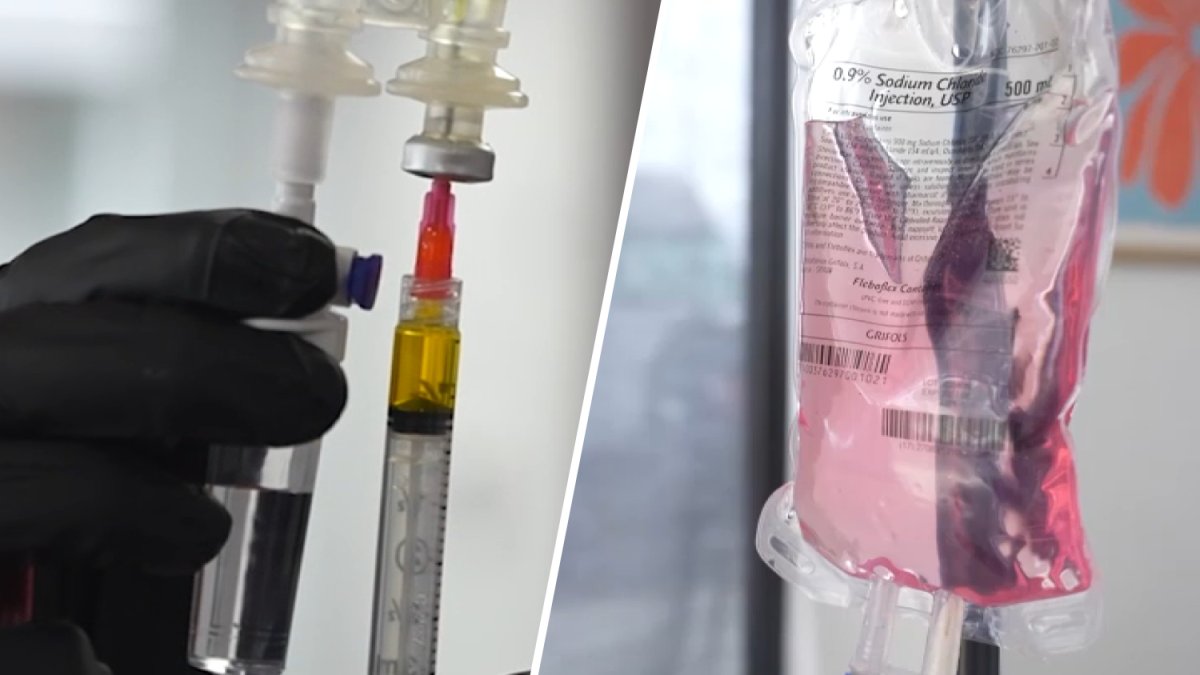
From vitamin drips for immunity to a pick-me-up after a night out, IV therapy businesses have boomed in Massachusetts.
At Boston-area drip bars and through mobile IV companies, registered nurses administer hydration infusions, vitamin shots and specialty IV treatments marketed for everything from immunity support to recovery and anti-aging.
“When I first started, it was definitely a lot more of the hungover people,” said Courtney Ferreira, a registered nurse who works at IV League. “More people doing it for wellness these days, just to keep up with their health, their immune system.”
Ferreira, who primarily works in an emergency room, said she has worked at IV League for about seven years. Treatments at the business range from basic hydration bags to higher-end NAD drips.
“Right now they range anywhere from like $79 for the basic bag with a B12 shot all the way up to $500 for our NAD drips,” Ferreira said.
NBC10 BostonNBC10 Boston
Some clients seek energy boosts or hydration, while others come in looking for skin-related benefits.
“Their skin is the big one right now,” Ferreira said. “Especially because some of the things we offer, like glutathione and even the high dose vitamin C, it fights free radicals. That fights aging.”
The trend has also gone mobile.
Alex Dold, a registered nurse and founder of the mobile IV business Miss Drip, travels to clients’ homes, offices and businesses to administer treatments during their busy schedules.
On one recent visit, Dold met with Studio78 pilates studio owner Hailey Hoffman ahead of her bachelorette weekend in Newport, Rhode Island.
“You know, as I’m getting older, the drinks definitely hit a little harder,” Hoffman said.
Most adults don’t know how much water they should drink in higher temperatures. Andie Lee Gonzalez, licensed registered dietitian and scientist at Abbott, shares what you need to know about staying hydrated during a heatwave.
Hoffman is an IV regular, though, too, particularly because of her active lifestyle.
“I was finding that I was feeling a little tired after teaching a lot of heated classes,” Hoffman said.
Dold said safety protocols are critical, and that businesses operating in Massachusetts must follow medical standards and work under physician oversight.
“Nurses are able to give the IV infusions, but we need to be partnered closely with a medical director for all of the oversight for prescriptions,” Dold said.
Clients often complete medical screening forms before treatment, since people with certain heart or kidney conditions may not be good candidates for IV therapy.
“We do health histories on everybody when they come in,” Ferreira said.
Ferreira also encouraged consumers to research providers before booking appointments.
“Don’t just go there just because it’s cheap or things like that,” she said. “Google reviews and things like that definitely speak for themselves.”
Dr. Ali Raja, executive vice chair of emergency medicine at Mass General Brigham, said the scientific evidence behind many wellness claims tied to IV therapy is limited for otherwise healthy people.
“If you’re not deficient in vitamins, if you don’t have some sort of metabolic disorder, if you’re not chronically sick, giving large doses of vitamins doesn’t actually translate to any benefit,” Raja said.
He said hydration itself can make people feel better, but that it may be difficult to separate that feeling from the effects of vitamins.
“It’s really hard as a person to differentiate the feeling good you get when you get hydrated versus the vitamins actually doing anything, which is really unlikely,” Raja said.
Still, many customers say they feel a noticeable difference after treatment, and it’s why so many continue returning for another round.