



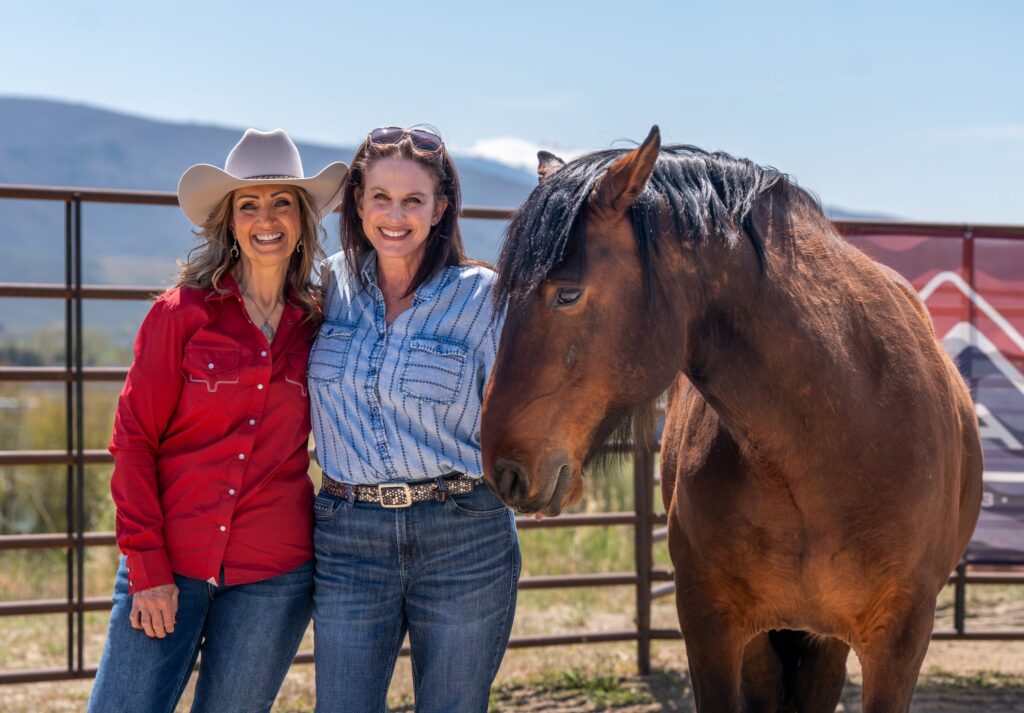
When thinking about how to bring Krisanna Sexton’s award-winning documentary “Rescued Hearts” to Park City, Liberty Sanctuary Founder and Executive Director Debra West knew she needed some help.
So, she reached out to colleagues in other equine-based wellness organizations, including Equellness Center Executive Director Alejandra Lara and Horses for Mental Health Co-founder and President Lynn Thomas.
West also looked to Beila Edelman of Beila Edelman Coaching, an equine-facilitated wellness coach, who works with her at Liberty Sanctuary, a nonprofit that works locally and nationally to rescue horses from slaughter.
Equellness Center
 Equellness Center Executive Director Alejandra Lara stands with Chipotle at her facility in Silver Creek. Credit: Photo courtesy of Alejandra Lara
Equellness Center is a nonprofit that fosters mental fitness and personal growth through equine-assisted services and wellness programs, and Lara is no stranger to the power of horses.
“I grew up with horses, and they were part of my every-day life,” she said. “I grew up south of Chile in the mountains on a cattle ranch. We lived far away from other people, so I would take off on my horse early in the morning and come back at night, sometimes without even getting off the horse for lunch.”
During the summers, Lara’s cousins, aunts, uncles and grandparents would visit the ranch, and she would watch the interactions of her horses with her family members.
“I was very curious about why the same horses would respond differently to different people,” she said.
When Lara moved to Park City, she had read books about the science of horses-and-human connections, which started her on this journey to found the Equellness Center.
“There is some cowboy wisdom that says, ‘The horse knows when you’re scared,’ and these books help me understand the science about why,” she said.
Five years ago, Lara established Equellness, which is a play on words that means equine-assisted wellness, as a nonprofit.
“We started from scratch with a new team, and what I’m excited about is we have incredible facilities right here in Park City,” she said.
The facilities, located at 7370 Silver Creek Rd., utilizes nature in its programming.
“The views of the mountains from here in Silver Creek are just spectacular, so, where we are located contributes to the calmness and grounding that we work to create here,” she said. “We have a labyrinth you can walk with a horse, and we have other small trails. We have meditation benches all around. We have a firepit where you can do group processes, and in the future we’ll have an art barn.”
Equellness Center is non-clinical, which allows Lara to focus on wellness, rather than the medical.
“Because of that, we open the doors to more people, and I’m excited about the team I’m building, who will have more impact on more people as we grow,” she said.
One of the center’s largest programming demographics is children, according to Lara.
“We offer summer camps that get filled up pretty early in the year,” she said. “We have after-school programs and another offering called Equellness Kids.”
All programming is based on social and emotional learning and resilience skills, Lara said.
“Thos skills are focused on awareness of self, relationships, self-management, social awareness and responsible decision making,” she said. “Those match beautifully with the horses, and we use art projects and nature-based games.”
Parents have noticed changes in their children after they come home from the camps, Lara said.
“Months later, the parents will tell us how their kids are still using the tools that they learned here as they go through the stresses of school and their social lives,” she said.
The Equellness Center also offers programming for veterans.
“These are very close to my heart because I am a veteran mother myself,” Lara said.
She just finished facilitating a female tactical platoon from Afghanistan who works with the U.S. troops.
“Those sessions are very intense but also very beautiful,” she said. “The horses’ peace is something they take with them. It’s heart-opening. It brings joy. It brings calmness and a sense of self-leadership, which is something they are working on as they start to develop trust as civilians.”
Peace House, the local nonprofit that works to stop domestic violence in Summit and Wasatch counties, also works with the Equellness Center.
“They send us families, and we work with horses to strengthen their bonds, provide them with self-regulation tools and build joy,” Lara said. “Also, when I work with the ladies, we work on building trust, setting boundaries and gaining self confidence.”
Finally, the Equellness Center works with private clients, according to Lara.
“We have some beautiful processes we do with the horses to calm the nervous system down, and then we help them learn how to take that peacefulness they feel here into their work and home lives,” she said.
Future programming includes the Toolbox for Recovery and the Aging Adult Community.
“Toolbox for Recovery will be a three-level, six-week program, and I’m really excited for Aging Adult program,” Lara said. “We have a growing aging community in Park City, and what we do is form groups and communities with them so they can mentor younger populations and spread their wisdom with horses through processes that develop resilience and hope.”
Lara considers her work at the Equellness Center sacred.
“It is, I feel, my life’s calling, and I’m so grateful to have found a way to serve the community and spread peace and nature,” she said. “I think about horses being the spirit of nature, and if we are in the right relationship with them as sentient beings, we will know what it is to be a part of nature.”
Horses for Mental Health
 Lynn Thomas is the co-founder and president of Horses for Mental Health, a nonprofit that works to “bring attention, resource and credibility to equine-assisted services for mental health and personal growth.” Credit: Photo courtesy of Lynn Thomas
Horses for Mental Health is a nonprofit that works to “bring attention, resource and credibility to equine-assisted services for mental health and personal growth.” And it does so through collaboration with nonprofits, donors, ambassadors, corporations and supporters, according to Lynn Thomas, a licensed clinical social worker and Horses for Mental Health co-founder and president.
Thomas, however, didn’t come from a horse background.
“What drew me in was witnessing the profound change clients experienced in just one session,” she said. “I was amazed by what horses brought to the process of transformation.”
Thomas was awed by how these large, powerful animals helped people let their walls down.
“Even though horses can feel intimidating at first, they often create a sense of safety, calm and authenticity that helps people connect more honestly with themselves and face difficult things more openly,” she said. “I saw how horses naturally provide feedback through their responses, helping untold stories surface in ways that feel organic and real. I often say horses are some of the best ‘story editors’ I’ve ever seen — helping people recognize what’s no longer working in their lives while also bringing out strengths and possibilities they may not have seen in themselves before.”
That experience changed the course of Thomas’ professional life and inspired her to help spread awareness and train professionals around the world in this work. So, she and Jacque Balmer founded Horses for Mental Health.
“Our vision was to create an advocacy nonprofit that could support programs around the world providing mental-health and wellbeing services incorporating horses,” she said. “These programs are doing life-changing work for both people and horses, often with limited resources and great personal sacrifice. We wanted to help more people understand that these services exist, how impactful they can be and how to access them.”
More programming — raising awareness, directing more funding and resources to programs, and bringing together businesses, individuals, industry leaders and influencers to create a louder, more unified voice for the field — emerged from that base, according to Thomas.
“That vision ultimately led to the Horses for Mental Health Campaign, held annually during May, Mental Health Awareness Month, to shine a light on these programs and the powerful impact horses are having in people’s lives,” she said.
The Horses for Mental Health Campaign is a peer-to-peer awareness and fundraising campaign, Thomas said.
“We bring together programs, industry leaders, businesses, advocates, influencers and celebrities to amplify the message of how horses and professional programs incorporating them are changing lives,” she said. “A major part of the campaign is storytelling. We produce award-winning video stories that highlight what horses bring so uniquely to mental health and wellbeing services, while sharing the real impact these programs are having on real people’s lives.”
Programs participating in the campaign engage supporters as fundraising ambassadors who help spread awareness and raise funds within their own networks and communities, according to Thomas.
“What makes the campaign especially unique is that 100% of the funds raised go directly to the donor’s chosen program,” she said. “Horses for Mental Health does not take a portion of those donations because our work is supported through sponsors and other advocates. Our role is to provide the platform, create resources and marketing materials, produce national awareness efforts, and offer training to help local programs strengthen their outreach and fundraising efforts, since many do not have the staffing or resources to do that on their own.”
Over the last four years, the campaign has raised more than $2.4 million to support participating programs.
“We are currently in the middle of our fifth annual campaign, with more than $356,000 raised so far this May in support of 130 programs across 36 states and six countries,” Thomas said.
Community members can get involved with the campaign by finding a local program to support through the Horses for Mental Health Campaign at horsesformentalhealth.org/campaign.
“People can reach out to programs directly, volunteer, share their message and donate to help them reach their fundraising goals,” Thomas said. “Every act of support, no matter the size, makes a meaningful impact for both the people and horses involved in this work. If you’ve never experienced this work before, we especially encourage you to connect with a local program and experience it firsthand. Seeing the impact in person is incredibly powerful and often deeply moving.”
After Thomas and Balmer founded Horses for Mental Health in 2021, they connected with Zoetis Equine, one the world’s leading animal health company, “who immediately understood the vision of supporting both human mental health and the wellbeing of horses,” Thomas said.
“They became our founding sponsor and have been incredible partners in helping us grow the Horses for Mental Health Campaign over the last five years,” she said. “Honestly, I’m still in awe and deeply grateful that what started as a heart project has grown into something impacting so many lives.”
Liberty Sanctuary
Not only does Liberty Sanctuary, located in Heber City, work to advocate and rescue horses from slaughter, it rehabilitates these animals and helps find them “forever homes,” said Executive Director Debra West.
“This is my crazy idea,” she said. “I bought this property and started developing the infrastructure for our own horses.”
Then West learned about the slaughter pipeline.
“I felt committed to try to bring some horses to Utah and educate the public and our legislators,” she said. “In our first year, Sen. John Curtis, known for his stance on protecting Utah land, sent a representative, and this past fall Congressman Mike Kennedy came to visit us.”
Liberty Sanctuary also launched a website, safeact.org, to get more signatures to legislators, West said.
“That has been responsible for sending then more than 10,000 letters from all 50 states,” she said.
Liberty Sanctuary currently houses 29 rescues, and one of them is a kind soul named Axel.
“Axel came to us in 2023, and he was part of our first rescue,” West said.
Liberty found Axel in Texas, where they ship horses to Mexico to be slaughtered for meat, she said.
“Most horses out of Texas you pay at least $1,000 to get them and then pay another $1,000 for transport,” West said. “It can be expensive, but we really champion the rescue cause and want to educate people.”
Because of Axel’s gentle disposition, West hasn’t put him up for adoption.
“He’s a favorite here, so we find other work for him to do,” she said. “He also kind of looks over the herd when he’s not working with us humans. He helps keep peace. He’s a quiet leader, and he protects his friends.”
While Searra Brandt is Liberty Sanctuary’s lead trainer who works to rehabilitate the horses, Beila Edelman, an equine-facilitated wellness coach and founder of Beila Edelman Coaching, helps connect the horses with humans in wellness and therapy sessions.
“She does something called Liberty Training, which is horse training, but all about connection that feeds into her coaching,” West said. “She works with the horses, but her aim is to help people with our horses.”
For a long time, since Liberty started rescuing horses, people asked West if she did equine assisted coaching or therapy.
“I said, ‘No,’ because when the rescues first arrive, they are so traumatized and terrified by humans that they don’t want to be anywhere near you,” she said.
While the ranch’s primary purpose is to get the horses back into the world at their forever homes, West began thinking about creating equine experiences for humans, and contacted Edelman.
“I met Deb through a friend while I was doing equine work in Arizona,” Edelman said. “We had on and off casual conversations, and I knew I needed to come out to Utah and meet the herd and meet Debra.”
Edelman didn’t plan on staying in Utah but changed her mind after learning about West’s mission and falling in love with the horses.
“I came for a weekend, and it’s still going on,” Edelman said with a laugh. “Now, we can actually bring people together with the horses.”
Edelman’s background in nursing and critical-care situations has helped with her work at Liberty Sanctuary.
“I learned to read the room and see what’s needed at the moment, and that gave me such a background and being able to hone into the horses,” she said. “So, when we do healing with horses, we teach and it’s all about the connection, the language and the bond. The horse can smell and sense things, and they can see just the smallest hints in body language of how you are feeling.”
People can set up sessions with Edelman.
“We’ll do a ‘discover call’ to see if we’re a good fit,” she said. “They sometimes come out to the ranch, or we’ll just do it on the phone.”
During that meeting, Edelman will help the client come up with their personal purpose.
“We really go deep into this exploration, and then we’ll bring horses into the picture,” she said. “Sure someone, anyone, who has an ongoing situation can sit in a therapist’s office or opposite me in the coaching chair for the longest time, but when they come to a majestic space with a horse, there’s this presence and the groundedness.”
One horse will act differently to meet people’s different needs, Edelman said.
“You come and bring your situation, whatever it is, and things unfold because the horses just know and communicate that with us,” she said. “Even if all you need is a little more balance in your life this is just a way to get into the natural world and have an intimate experience in the mountains with some horses, and our horses are ready to do that.”
Related Stories