




The first time I got lip filler, I went in mostly blind. Sure, I’d seen videos on YouTube and gone down various rabbit holes researching cosmetic procedures in college when I could barely afford lunch, let alone injections. But I didn’t entirely know what to expect. After I had my face pricked, I left the office with the most swollen, misshapen lips that looked straight out of a horror film and regretted it completely. I sobbed the whole way home, wondering what the hell I’d just done to ruin my face.
Two years later, I was finally convinced to try lip filler again, but with RHA, a new filler (at the time) that promised more natural results. I had a totally different and much better experience, and now I’m a devotee. I love the way RHA lip fillers harmonize my face and give me a plumper pout so I can feel like my most confident self. My way of screaming this from the rooftops, once and for all, was awarding RHA “best injectable filler” for Cosmo’s 2026 Holy Grail Beauty Awards.
I needed more space to wax poetic fully, so keep reading for everything you need to know about RHA, specifically how it’s different from other fillers on the market, plus my full review and a deep dive into exactly what happens at an appointment.
 What is RHA filler?
Well, first, let me explain dermal fillers. These injections help add volume to your face and neck using hyaluronic acid. That might sound familiar if you’re a skincare lover, as the ingredient is often used topically in products for hydration (it’s also naturally found in your own skin). It’s a humectant, meaning it pulls water into your skin to improve moisture and plumpness. When it’s injected into your skin, though, it adds immediate volume.
Just like there are different types of botulinum toxin (Botox, Xeomin, Daxxify, etc.), there are various brands of filler out there, too, all of which differ slightly in their formulations. Teoxane RHA (Resilient Hyaluronic Acid, or RHA for short) is a collection of fillers owned by Revance Aesthetics. And it’s actually the first and only line of fillers that’s FDA-cleared for the treatment of wrinkles, not just adding volume.

Why it won a 2026 Holy Grail Beauty Award:
Natural look and feelOf every filler I’ve tried, RHA looks the most natural and really works with my skin.VersatilityWith four filler types, you have options to get the results you want.EfficacyRHA is the only filler approved to actually help get rid of wrinkles, not just add volume.
Most fillers aren’t stretchy enough to handle all the movement in your face, which is why they can look a bit stiff, especially if placed directly into areas like your nasolabial folds or around your mouth. But the whole point of RHA is that it’s dynamic: When it’s injected, the formula mimics the structure of hyaluronic acid in your skin already, allowing it to adapt to your facial movements. This makes them look significantly more natural.
Two years ago, I visited the Revance Aesthetics headquarters in Nashville and a dermatologist explained the difference between RHA and other fillers like a straw. Other fillers are like a plastic straw. If you bend it, there are creases, and it never fully goes back to normal; eventually, it can break. RHA, though, is like a silicone straw. You can shape it over and over again, and it’ll move with you, always settling back to normal. That’s exactly what RHA does on your face. It moves easily without looking stiff or bumpy. Dermatologist Diane Berson, MD, who did my injections this time, loves how it feels: “I love the feel, as a physician and as a patient,” says Dr. Berson. “It basically moves with your skin and blends in with expressions.”
There are actually four types of RHA to choose from (this is why it’s called a “collection”). Your doctor will be able to help you choose the exact one that’s right for you, but to give you an idea.…
RHA 1, also called RHA Redensity, doesn’t necessarily add volume; it just helps define and smooth your skin. It’s often used for very superficial lines or around delicate areas like your mouth, eyes, and neck.RHA 2 actually adds volume, but it’s the thinnest filler they offer, making it great for lips and teeny-tiny wrinkles in the upper face.RHA 3 has more body, which is why it’s often used in nasolabial folds (the vertical lines from your nose to mouth), as well as in the perioral lines around your upper lip, but it’s also often used on cheeks.RHA 4 is the thickest filler the brand offers, and it can be injected deeper into the dermis to help reduce strong, static wrinkles or add volume to your mid-face, like your cheeks.About my lips
I’ve had RHA before, but my last appointment was over a year and a half ago, meaning most of my filler had dissolved by then. I definitely think that my lips are more plump now than they were, say, 10 years ago, so perhaps there’s still some leftover filler in there.
But I missed my lips being a smidge poutier. I have rounded, soft facial features throughout (hence why I don’t have fillers anywhere else on my face; I currently naturally produce enough hyaluronic acid and fat in my cheeks to sustain me for a while). But my lips are the one area I lack volume, and a bit more would help define them and create some more symmetry. I didn’t want anything too strong though. My goal with any cosmetic procedure is to look as natural as possible. Ideally, my mom wouldn’t even notice that I got something done. That’s my barometer.
The process
There wasn’t really any prep before my appointment. A win for the lazy everywhere! I just showed up, really. I did try to hydrate as much as possible before (something I do before any skin treatment or procedure to reduce puffiness).
When I got into the chair, the first thing we did was numb all around my mouth. My lips and the skin around them were coated in a thick layer of lidocaine cream for about 20 to 25 minutes. If you can, I’d recommend going to your appointment as early as possible to maximize numbing time. Spoiler alert: These injections hurt.
Once my lips were numb, Dr. Berson came in for a consultation. She asked a lot of questions: whether I had filler before (yes), what I wanted (lip filler that looked natural), whether I’ve tried RHA (yes), what I liked about my current lips (the shape), and what I wanted to change (more volume in the bottom and to help how downturned my smile is).
She suggested doing RHA 2 in my lips so that she could inject around the corners of my mouth to lift my smile slightly, but if I wanted a much more natural, soft look, we could do RHA 1. Immediately, that’s one of the biggest things I love about RHA. It’s so customizable to help you get the exact look you want. I was okay with adding some more fullness, so I went with 2.
They completely removed the numbing cream and wiped down my lips with alcohol to clean off any residual makeup that could be lingering on my face. She did one side at a time, which I appreciated. This really cut down on the pain. The needle is small but mighty. Is it the worst pain I’ve ever felt? No. But my eyes were definitely watering when she injected into my Cupid’s bow (the worst of it, truly). But it only takes about 15 to 20 minutes in total before she sat me up and cleaned me off (be warned, there will be blood; if you’re sensitive, definitely tell the doctor ahead of time).
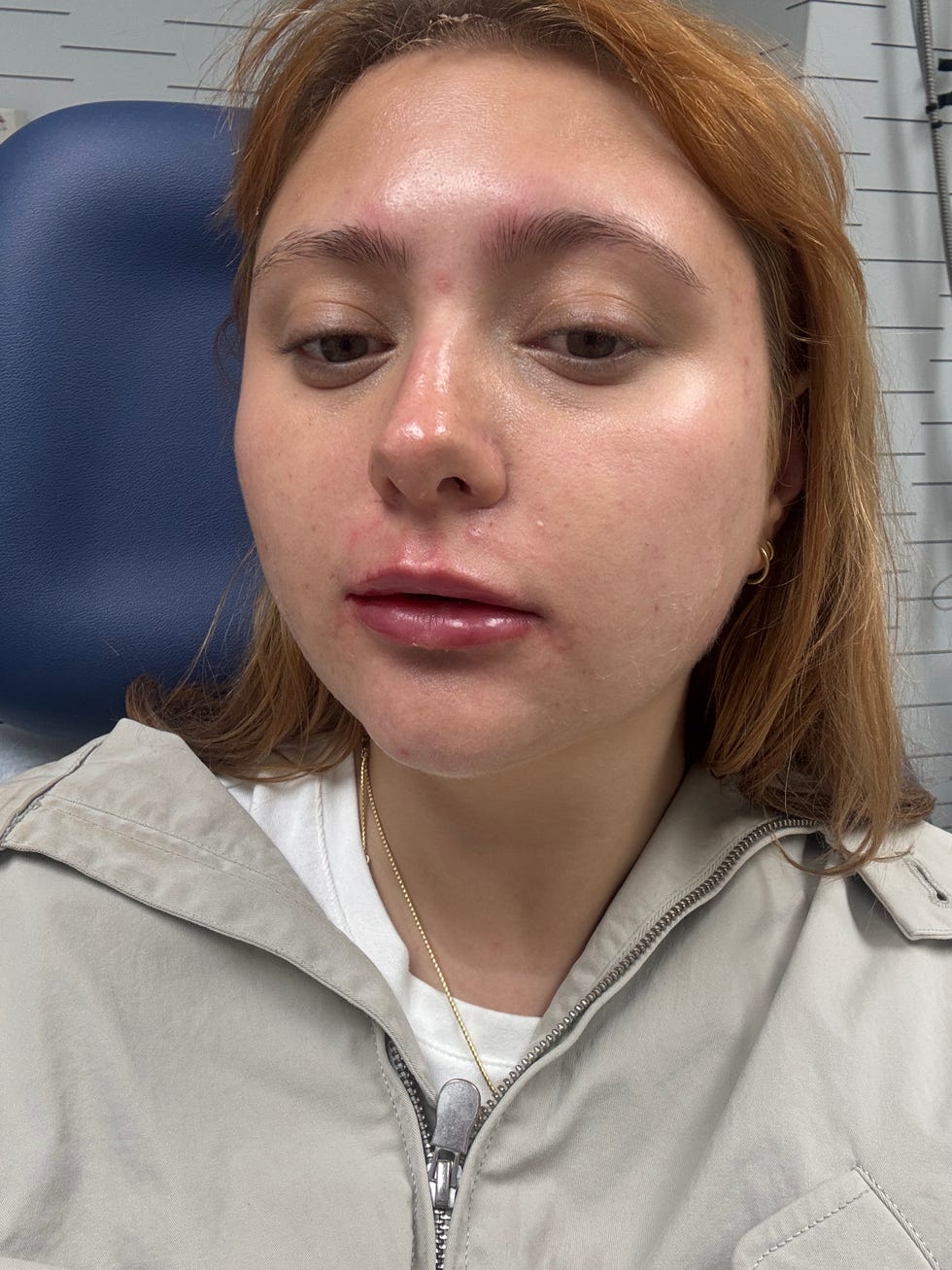
Immediately after injections (as well as a few pricks of Daxxify in my 11s, lol).
Aftercare
I left the appointment and Ubered home to avoid showing off my ultra-swollen lips to the world. They were tender but nothing unbearable. My lips were still a bit numb the whole night, because the actual injection also has lidocaine in it. I lay in bed with a bag of frozen fruit on my face and slowly sipped some water and stuck with a simple meal of buttered noodles that I could spoon into my mouth easily. But otherwise, it was chill.

V tender lips on the way home.
The next morning, I looked like I got stung by a hundred bees. My lips were more than just plump—they were swollen. But this is completely normal, according to Dr. Berson. I ice-rolled my lips a few times and didn’t wear makeup that day, just a bit of simple lip balm (La Roche-Posay’s Cicaplast Lip Balm is great). I also had a tiny bit of bruising on my bottom lip, but nothing too intense.

Eight hours after injections.

The next morning (wore a hat to the office to hide some of my bruising, but I easily could have been at work the next day without looking too wild).
That evening, I finally put on some makeup for an event (Dr. Berson recommended waiting 24 hours, which I did), and a dermatologist promptly complimented my skin when I walked in. “Oh my gosh, my lips are so swollen, I just got RHA,” I told her. But she assured me that it probably felt worse than it looked IRL. Assuring!
Two days later, the swelling really started to go down, and I could start to see what my lips actually looked like. I stayed hydrated and only used Tylenol, not Advil, to help reduce inflammation. I also stuck on my TheraFace Red Light Mask a few times to hopefully calm things down, and I think that helped too.
My results and review
It’s been five days, and my lips look really good. They’re soft, pillowy, and defined. But they don’t look stiff or wonky when I talk—a huge factor in how much I love the results I get with RHA. It just looks like my lips, just fuller, not necessarily like I got lip filler, you know?

Beth Gillette for Cosmopolitan
A good injector is always a plus and why I always recommend people seek out a doctor (not a medspa, ideally) they trust who has a lot of before-and-afters they can show you for reference. But as I’ve tested a handful of other fillers, I can confidently say I see such a massive difference with RHA. I genuinely can’t imagine using any other filler now.


See how it moves as I make expressions? Some fillers just look so unnatural as you move your face. When you’re resting, it looks great. But the second you smile or turn your lips up or down, or god forbid, speak, it just immediately looks lumpy or like there’s something foreign in your lips. But I don’t get that with RHA. It feels good. Honestly, once all the swelling goes down and it settles, it just feels like my lips and is as if I hadn’t done anything to them.
And it always passes the test. My mom has never once asked if I did something to my face (unfortunately, other procedures and fillers have inspired such Qs, lol). But she did ask what I did. I posted on my IG Stories this week, and she texted me on the side saying that I looked really good. That’s the biggest win of all.
FAQs
How long does RHA filler last?
RHA can last anywhere from 9 to 18 months, but most people get about a year out of their filler. This all depends on how your body metabolizes plus what areas you get treated. Lips move a lot, so they last longer than your cheeks usually.
Does RHA filler look natural?
In my experience, yes, very. It’s the whole “resilient” thing. “It sort of moves with you,” says Dr. Berson, noting that the filler itself is malleable and doesn’t feel stiff from the time she injects it to how it feels in your skin. “If you smile, it blends in with your smile. You don’t have to worry about it forming a lump or sticking out when you make an expression.”
How much does RHA cost?
This entirely depends on where you live, what area you inject, and who does your injections. On average, though, a syringe costs between $600 and $1,000. For reference, my lips required only one syringe; cheeks can be anywhere from one to three syringes.
Why trust Cosmopolitan?
Beth Gillette is the beauty editor at Cosmopolitan with eight years of experience researching, writing, and editing stories on hair, makeup, and nails.

Beth Gillette is the beauty editor at Cosmopolitan, where she covers skincare, makeup, hair, nails, and more across digital and print. She can generally be found in bright eyeshadow furiously typing her latest feature or hemming and hawing about a new product you “have to try.” Prior to Cosmopolitan, she wrote and edited beauty content as an Editor at The Everygirl for four years. Follow her on Instagram for makeup selfies and a new hair ‘do every few months.