





Weight that creeps up through adulthood is a challenge—but for individuals who’ve experienced it since childhood, the idea of releasing those extra pounds can feel hopeless.
Christie Moon, 47, understood this intimately, and also intellectually. The behavioral counselor tells us, “Weight became an issue for me when I was a teenager. It was then that I recall seeing myself as ‘bigger’ than everyone else, and for me, that feeling just did not go away.” Moon says she was often compared to her sister for their difference in size. She adds, “It was hurtful and did not help with my body confidence … I felt such a sense of shame with my body size.”
Those pressures led her to struggle privately. “In my various attempts at weight loss, I never told anyone,” Moon says. “I felt that they would look at me with disappointment.”
Then in February 2025, a rock-bottom moment became motivation. The number on a scale at her doctor’s office, along with her family history of heart disease and type 2 diabetes, was a wake-up call. She’d been carrying nearly 50 pounds of pregnancy weight she hadn’t been able to shake since her son was born. The moment she made the decision to lose the weight was less of a resolution and more of a reckoning.
“I felt it in my bones,” Moon says. “There was no going back—this time, I was going to succeed. For me.”
Nine months later, she had shed more than 60 pounds. “I lost a bit more than my pre-pregnancy weight and was elated,” she says. Moon was also anticipating an upcoming surgery. “This was another reason why I went down … as I knew that with me being unable to exercise for eight (or more) weeks I would gain some of it back,” she says.
She credits her progress to a combined approach using a low-dose GLP-1 medication, a regular plan for movement and strength training, and the structure of the Mayo Clinic Diet—a program she chose specifically because of its clinical credibility. “Mayo Clinic does nothing that is not backed by science, research, and education,” Moon says. “I wanted a plan created by the world’s top specialists.”
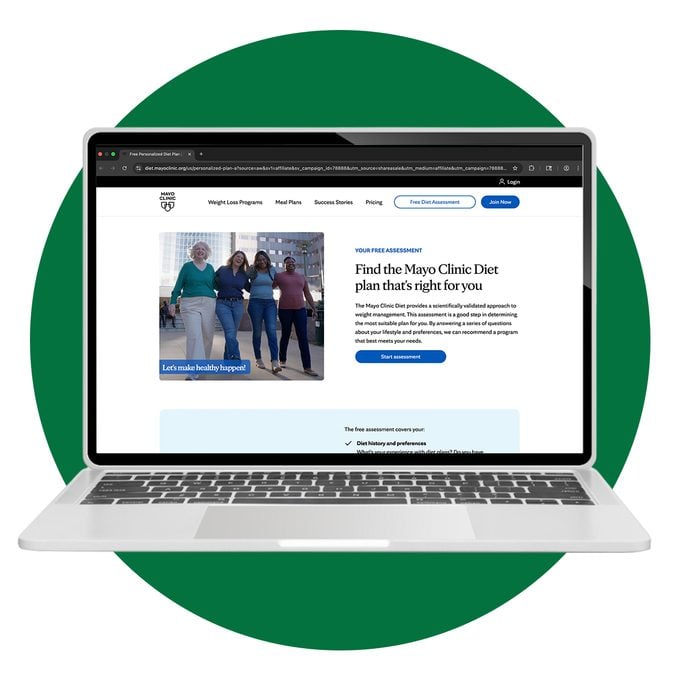 Via diet.mayoclinic.org
The Mayo Clinic Diet uses evidence-backed research to help participants build sustainable habits.
What is the Mayo Clinic Diet?
The Mayo Clinic Diet is a program grounded in more than 60 years of clinical research, developed by physicians, registered dietitians, and behavioral scientists at Mayo Clinic. The program is accessible to anyone directly through the Mayo Clinic Diet’s website and digital app—no physician referral required. The app itself is free but the cost to participate in the diet is $49.99 for a single month, though users can save by committing to a longer subscription.
Unlike other diets built around point systems or rigid calorie counts, the Mayo Clinic Diet emphasizes building sustainable habits around whole, nutrient-dense foods. In the words of Tara Schmidt, M.Ed., RDN, the program’s lead dietitian: “What sets the Mayo Clinic Diet apart is that it takes a comprehensive, evidence-based approach that addresses nutrition, physical activity, and behavior changes together. We teach people how to build sustainable habits. The goal is lifelong health and knowledge, not a short-term number on the scale.”
Schmidt explains that the Mayo Clinic Diet was developed and reviewed by the health system’s registered dietitians with adherence to the Mayo Clinic Healthy Weight Pyramid as the foundation. “That pyramid emphasizes unlimited fruits and vegetables, [as well as] whole grains, lean proteins, and healthy fats, in portions that are both nutritionally sound and practically sustainable,” Schmidt says. “We offer specialized plans because we know people have different health needs and food preferences. Each plan is reviewed for caloric adequacy, macronutrient balance, and real-world usability.”
Those specialized meal plans address a range of needs, including options for those managing diabetes, those on GLP-1 medications, Mediterranean-style eating, and higher-protein approaches.
Moon opted for what she describes as a “freeform” approach, working within the program’s framework while following a pescatarian diet her primary care provider had recommended to help lower her cholesterol—eventually adding chicken and turkey as well.
Schmidt says during the initial phase, members typically lose six to 10 pounds in the first two weeks. After that, the program targets a steady, sustainable pace of one to two pounds per week. This is in line with clinical guidelines for healthy, lasting weight loss.
Schmidt also shares that users are discovering “downstream effects” from their weight loss. “We hear consistently about improvements in blood sugar control (including lower A1C levels in those with prediabetes or type 2 diabetes), reductions in blood pressure, improved cholesterol profiles, better sleep, more energy, and reduced joint pain,” she says. “Sustainable weight loss at even 5% to 10% of body weight can meaningfully reduce the risk of cardiovascular disease, stroke, and type 2 diabetes, and we keep that clinical framing central to everything we do.”
The app, the habit tracker, and the weekly weigh-in
For Moon, the Mayo Clinic Diet app was a big factor in what facilitated her progress. The feature she credits most is the Habit Optimizer: a score-based tracker that rewards users for healthy food choices and completed exercise. “It has been very motivating for me to reach my daily goal,” she says.
It takes around 10 minutes to download and register with the app. Schmidt says, “Some of the features members find most valuable include personalized meal plans with simple recipes, a food logging tool that makes tracking feel manageable rather than tedious, and habit trackers that reinforce the healthy habits we ask members to focus on during the first two weeks.” The app also offers expert articles, video content, and access to coaching for accountability.
Moon consistently logged her food, checked in for weekly weigh-ins, and watched the graph of her weight trend steadily downward. Although the program does not offer GLP-1 prescriptions, she says that GLP-1 specific support plan was critical to her success. “I firmly believe that without the GLP-1, I would not have lost weight,” she says. “It was tremendously helpful in taking away the food noise and cravings.”
Mindset shifts that mattered as much as the diet
In her work as a counselor, Moon helps others navigate the very emotional and psychological barriers that weight loss surfaces. She knew what they face. “I have a whole pile of workout videos from over the years,” Moon says. “None of them assisted me with staying motivated. I would step away from those videos thinking I wasn’t good enough.”
She reframed her approach entirely, with some support from the plan. She focused on the good that she was gaining, rather than what she hadn’t achieved yet, saying, “I changed my mindset and focused on movement and strength training and [I] am loving it.”
Moon had two other breakthroughs that she implemented at the beginning of her journey. First, she was learning to ask for help. “I told all of my support system,” she says. “I realized they would be there to help—not to judge.”
Secondly, Moon recorded the differences she was making for herself. She says, “For the first time ever, after many attempts at weight loss, I took a before-and-after photograph. I did not look at my before picture until after I had lost my goal weight—and I was in awe of my progress.”
The Mayo Clinic Diet outcome COURTESY CHRISTIE MOON & THE MAYO CLINIC DIET
Christie Moon
In total, Moon lost over 60 pounds through her treatment plan. In late 2025, she underwent her surgery that required her to stop the GLP-1 medication. She regained approximately 20 pounds—which she attributes in part to the enforced inactivity of her recovery period, even as she continued eating the right foods.
She is candid about what that stage revealed. “I initially wondered if I could stay off the GLP-1,” she says. “However, I am finding this is not the case for me.”
Schmidt notes that the science of weight regain after GLP-1 discontinuation is well established, and says the Mayo Clinic Diet is designed with exactly this kind of long-term, evolving relationship with health in mind.
“We’re always transparent that individual results vary,” Schmidt says. Members managing chronic weight conditions often need ongoing support rather than a single intervention. The Mayo Clinic Diet’s breadth of tools is intended to meet them wherever they are in that journey.
Moon has since enrolled in Mayo Clinic’s Weight Program, hoping to return to a low-dose GLP-1. “The Mayo Clinic Diet permanently transformed my life,” she says. “It helped me see that healthy food is great food. It helped me accept myself as I am—and that accepting support for such a sensitive topic is more than okay.”
Moon now feels she has the tools—including the Mayo Clinic Diet Facebook community—to keep going. “The Mayo Clinic Diet permanently transformed my life,” she says.
If the Mayo Clinic Diet feels out of reach
With many Americans experiencing budget constraints, Schmidt shares where most anyone can start.
“I never want cost to be a barrier to better health,” she says. “My first piece of advice is always: Start with what you already have. Fill half your plate with vegetables and fruits (even frozen or canned options are nutritionally excellent and budget-friendly). Swap processed snacks for whole, plant-based foods. Drink water instead of caloric beverages. These changes can be affordable and can move the needle significantly.”
For daily wellness updates, subscribe to The Healthy newsletter and follow The Healthy on Facebook and Instagram. Keep reading: