




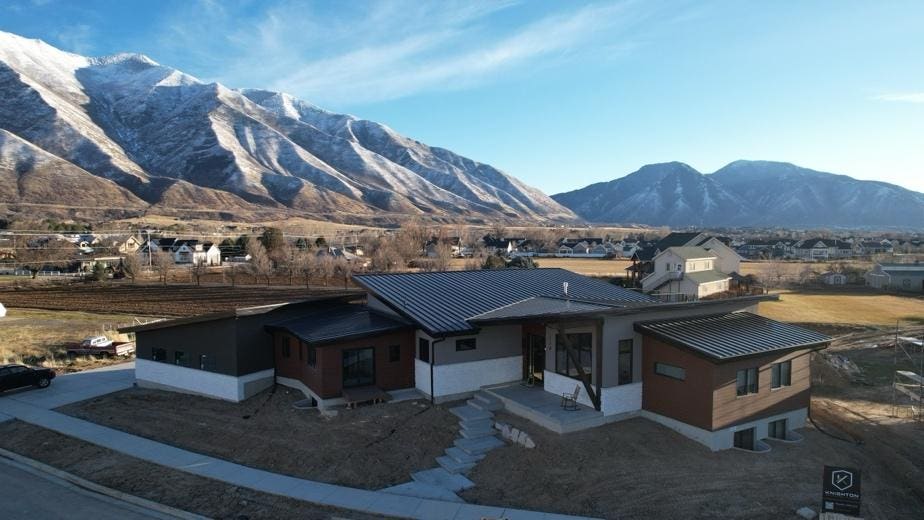
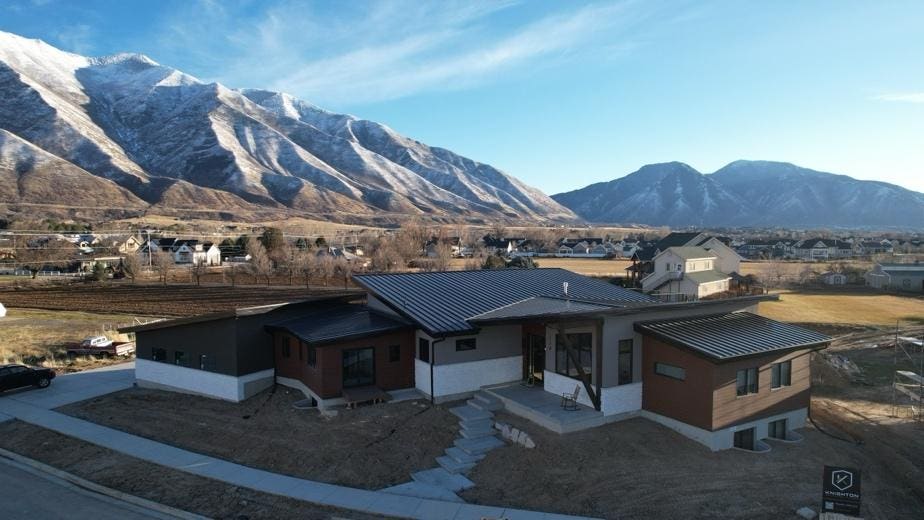
Architect Jeff Knighton designed his Mapleton, Utah home focused on wellness after mold-related health issues reshaped his approach to the exterior envelope.
Jeff Knighton, Knighton Architects
The Global Wellness Institute tracked wellness real estate at $584 billion in 2024 and predicts it will hit $1.1 trillion by 2029. While those dollars certainly validate the importance of this trend, how exactly is it changing how we imagine where we live?
That rethinking takes a lot of work, including program and process change from architects, designers, builders, developers, manufacturers, and regulators.
Brian Johnson was inspired to do just that and founded the Healthy Building Alliance.
“The healthy building industry has some of the brightest, most passionate professionals in the world — but they’ve been working in isolation,” he said. “Builders who understand building biology rarely connect with the architects designing the homes. Environmental consultants aren’t in the room when materials are being specified. Manufacturers creating genuinely non-toxic products can’t find the professionals who would specify them. And homeowners who want a healthier home have no trusted place to turn.”
The Alliance connects all of those stakeholders who can make healthy homes possible. It will make the invisible aspects of health and wellness at home more visible to the industry and to homeowners.
Wellness Market Momentum
Blue Heron created science-backed home design packages that are personalized, wellness focused to achieve health related goals.
Blue Heron
The demand for wellness is evident in the dollars being spent on it, but Johnson noticed that the industry isn’t prepared to meet that demand in a coordinated way yet.
“There has been a confluence across the world and generations—a change in medicine from treatment to prevention,” said Eric Lent, who serves as the chief revenue officer of Blue Heron, a luxury design-build firm in Las Vegas. “It has come to a flashpoint.”
Blue Heron is one of a small group of firms that is advancing health and wellbeing from a design and architectural standpoint.
“When we think about health and wellness, it starts with the land,” said Tom Hoban, the president and CIO of Kitson & Partners, developer of wellness-focused master planned community Babcock Ranch. “You can feel it because you are surrounded by nature. If you have not been there, no explanation will do. If you have been there, no explanation is necessary.”
The impact of nature is a science backed approach and is what home buyers are looking for today. Babcock Ranch delivers it with 100 miles of trails and vistas to help connect to nature and to help disconnect from the demands of the world.
Through work at his design and construction firm, SENERGY360, Johnson clearly saw that building a home that supports or undermines your health is not part of the visible features.
“They happen inside the walls, above the ceilings, inside the mechanical systems, and within the materials themselves,” he said. “A home can look beautiful, finished to perfection, high end finishes, and still be quietly failing the people living in it. We’ve seen it repeatedly in the field. Homes that achieved high levels of green certification yet contained poor moisture detailing that created hidden mold risk. Materials that off-gassed VOCs into a sealed, well-insulated building.”
Unhealthy homes will pass most certifications on performance, but still fall short on moisture management, vapor control, air quality, EMF reduction, circadian lighting, and water filtration.
“You cannot design your way to a healthy home on paper,” Johnson said. “It has to be built correctly in the field, system by system, verified at every stage. The invisible work is where health is either built in — or left out.”
The Alliance will work on creating a shared language that is clear, credible, and accessible so professionals across disciplines can understand and talk to each other, plus homeowners can understand what they’re buying. The Alliance is developing the HBA CARES framework that will stand up as a field-verified standard to certify the design, the build and the performance.
“When a homeowner sees an HBA CARES certified home, they will know that every major system — air, water, materials, energy, lighting, electrical — was evaluated, coordinated, and verified by professionals held to a defined standard,” Johnson said.
Science-Backed Wellness Solutions For Visible Results
Blue Heron created a suite of packages that provide science-based and personalized approaches to how homes are designed, built, and lived in.
The first is Vitality Core with features focused on air, water, circadian, EMF, and acoustics. Next, is Sleep Sanctum focused on better acoustics, thermal, blue-light control, and bedding innovation for optimal sleep. Next is the Recovery Suite with details such as a sauna, cold plunge, red light, breathwork, and mobility. Radiance has biophilic vistas, natural light mapping, and neuro aesthetics. Finally, the Metabolic Studio features strength zones and adaptive fitness.
While these solutions come at a premium, that’s the typical course of product development.
“Any technology in history starts at a premium segment and as the market embraces it, it finds ways to create efficiencies and bring cost down,” Lent said. “We will do that as we introduce them and the market accepts them and they are scaled. Trying to create a base of empirical data to validate what we are doing.”
These packages pair with biophilic design practices that are only noticed if they were pointed out, such as seamless indoor and outdoor transitions, and structure positioning for optimal sun and wind protection.
While the home wellness solutions are invisible, so are the risks that they prevent.
““The real risk is what you can’t see,” said Jeff Knighton, who is the principal architect at Knighton Architecture.
After his family suffered health issues from mold in a rental property, he built a new home with products that would avoid any future issues. After deep research, he decided to use the integrated wall system HydroBlok for its water resistance and durability.
As an architect, he’s seeing the importance of this trend not just for his own family but for all the other projects he’s involved in.
Building consultant, Steve Easley, also recommended HydroBlok for another custom home build that benefited from the important wellness feature of noise reduction. Again, as an invisible feature, it provides strong benefits including better sleep, lower stress levels, better productivity, and more privacy.
Future Wellness Opportunities
The future is an opportunity to make the invisible visible in the right stage of the project and delivering it to the homeowner in ways they feel and don’t see, which will mean standards and cross-industry collaboration.
“As we look to create the future of home, we recognized it is new territory and we also recognize that the industry needs to come together to spearhead this change and it is incumbent on us as industry leaders to make progress and bring it to others across,” Lent said.
Bringing this to scale will create new market dynamics.
“Builders can begin to compete on health performance the way they currently compete on square footage or finishes,” Johnson said.
Wellness trends are a strong business opportunity, which is a great reason to pursue them, but building healthier homes also is the right thing to do.