




Make Time Wellness is bringing women’s brain health into places where millions of women already shop. The three-year-old company, co-founded by Emma Heming Willis and Helen Christoni, recently launched on QVC and at Target, two milestones that mark a new stage for the brand and for a category its founders say has barely spoken to women at all. The brand’s hero product, Make time for Brain, Body & Beauty, was a finalist for Best New Supplement for the Mind NEXTY Award this year.
Getting airtime on QVC and shelf space at Target is no small feat for a young, founder-led supplement company. Make Time Wellness represents the first cognition formula to be sold on QVC, the 40-year-old television channel that specializes in home shopping, after a two-year vetting and compliance review. “You really get to educate your customer thoroughly on air, which I really appreciate,” Heming Willis says.
Meanwhile, the Target launch gives Make Time Wellness a different kind of reach. It places women’s brain health into an everyday retail environment where shoppers already go for wellness, beauty and household staples. “I shop at Target,” Heming Willis says. “I think that Make Time is going to look so great on that shelf.”
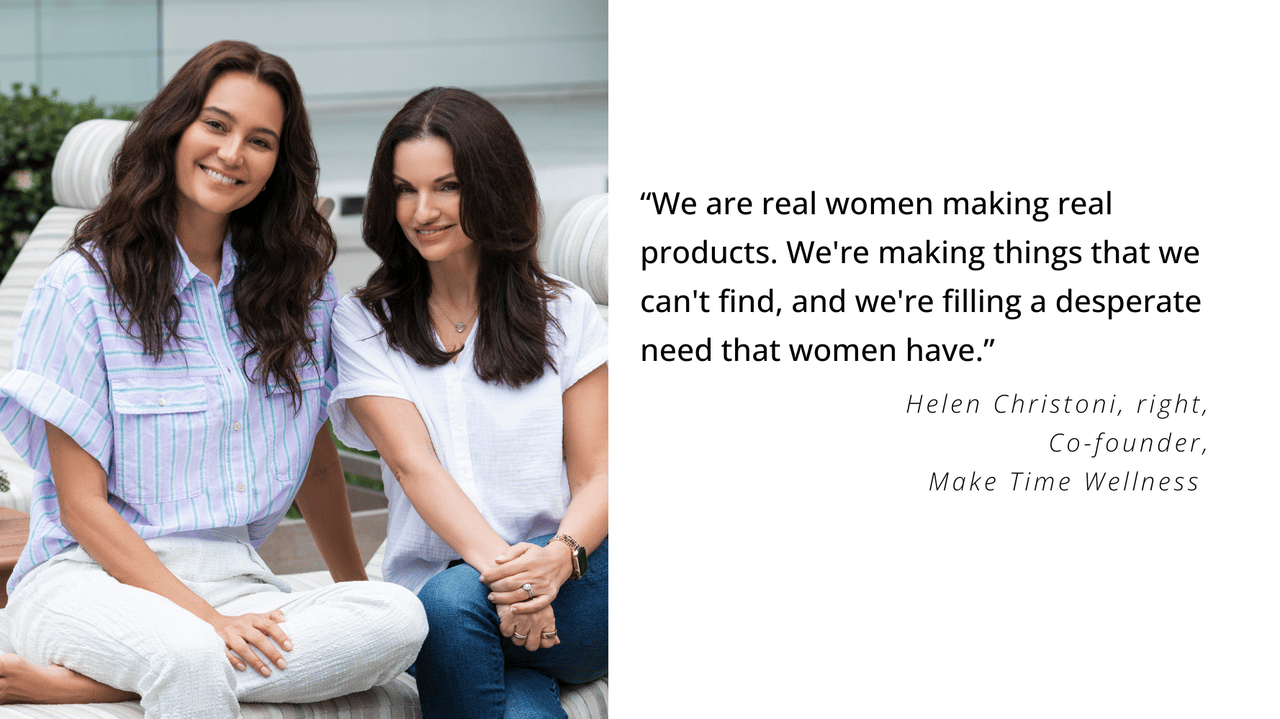
Emma Heming Willis, left, and Helen Christoni, right, co-founded Make Time Wellness to support women’s cognitive health beginning at age 30. (Credit: Make Time Wellness)
Personal entry points into women’s brain health
Heming Willis and Christoni co-founded Make Time Wellness amid the former’s public navigation of husband Bruce Willis’s aphasia and frontotemporal dementia diagnosis. But years earlier, Heming Willis faced her own cognitive struggles—which a doctor dismissed as “mommy brain” and lack of sleep.
She later sought out a brain health doctor, made lifestyle changes and began taking supplements. The regimen was effective but difficult to maintain. After meeting over Zoom during COVID-19 and becoming fast friends, Heming Willis confided in Christoni. “I was telling Helen, ‘This fog is lifting, I’m feeling really good, I’m a lot more energized than I was, but I can’t sustain taking all of these supplements multiple times a day,’” Heming Willis says. “I said I would love to be able to take everything and put it into a gummy or a drink powder. And Helen was like, ‘Oh, this is totally in my wheelhouse. We could absolutely do that.’”
Professionally and personally, Christoni was the right person to co-found Make Time Wellness. Her career spans CPG, wellness, beauty, supplements and environmental health, giving her the product development background and network to translate Heming Willis’s brain-health plan into something realistic for women. Before Make Time Wellness, Christoni had worked on a superfood project that showed her how hard it can be to make functional products people actually want to consume. “If I can make superfood taste good, I thought, ‘We can completely do this,’” Christoni says.
But Christoni’s role in Make Time Wellness is not only technical. Like Heming Willis, she came to the work with personal stakes. She had seen dementia take her grandmother and mother-in-law, and endured the loss of her daughter, Bella, to mental health issues. In Make Time Wellness, Christoni found a place to channel all that emotion. “It’s purpose-driven and being of service to women,” she says. “It makes it not work. I also found myself in a position where I had tremendous capacity and bandwidth, where, pre that event, I didn’t. So, I have this great outlet in which to pour all that love and passion and compassion and all the stuff that was Bella’s before.”
‘Filling a desperate need that women have’
Heming Willis’s experience served as the foundation for Make Time Wellness’ flagship Brain, Body & Beauty drink. Christoni says that came to life by examining what Heming Willis had been taking and considering what could be useful for women more broadly. As a result, the company now offers Brain, Body & Beauty, Beauty Sleep, NAD+ with rhodiola, and a menopause and brain health formula. The brand also recently introduced Brain, Body & Beauty stick packs for convenience and travel.
Across the line, the product strategy starts with what Heming Willis calls a “brain first” lens. As the founders studied brain health supplements, she says, they found products and messaging were geared largely toward men. “No one was speaking to women about their brain,” Heming Willis says. “Any product that we are going to bring to market is always going to be brain first.”
Christoni agrees. “We are real women making real products,” she says. “We’re making things that we can’t find, and we’re filling a desperate need that women have.”
That need, the founders say, is far from abstract. Christoni points to the cognitive changes women can begin noticing decades before older age, as well as women’s elevated risk for Alzheimer’s. “We start losing our short-term memory at the age of 30, with all of our hormonal fluctuations wreaking havoc on our brain health,” Christoni says. “No one really knows about this, and so we just want to get women having this conversation.”
That conversation includes supplements but does not stop there. Heming Willis says Make Time Wellness is meant to educate women around the broader pillars of brain health. “‘Make time’ is one of our pillars, as well as making sure that you’re sleeping, your nutrition, you’re socially connecting with others,” she explains. “All of that is what takes care of your brain health. It’s not just one thing.”
That view also explains why the brand intentionally avoids the language of “self-care.” For Heming Willis, the buzzphrase has become too commercialized and associated with toxic positivity, which she eschews. “It’s one of the no-nos that we even have in our brand book—we’re not using the term ‘self-care,’” she says. “This term has been so overused and taken over by the beauty industry.”
Instead, the founders chose a name that functions almost like an instruction: Make Time. “I want to do things that actually feed my soul,” Heming Willis says. “I think that it’s about being actionable, intentional, as opposed to this self-care thing.”
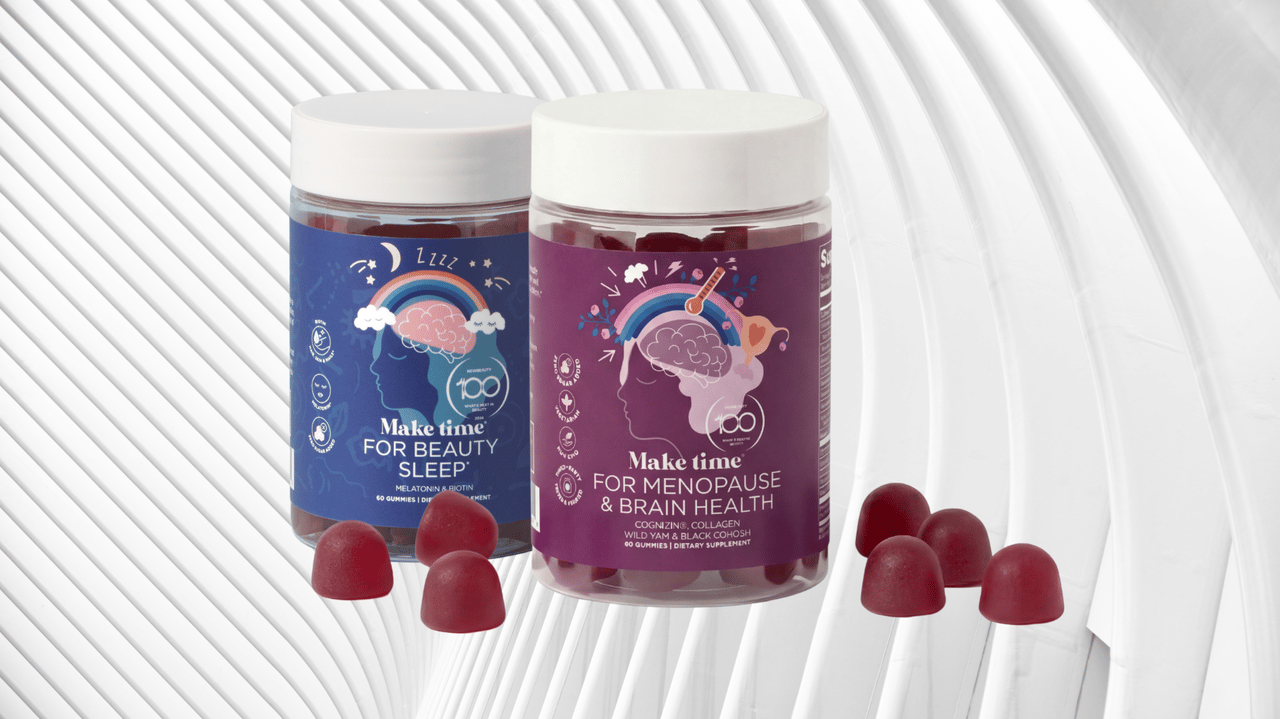
Women’s hormonal changes can affect short-term memory as early as age 30. Make Time Wellness wants to educate women about brain health.
Balancing a serious topic with lightness
Make Time Wellness’ founders want to make brain health feel approachable. That means talking about cognition alongside beauty, energy, sleep and menopause, while offering products supported by the evidence. “We are having this sometimes light, fun conversation about a really serious topic,” Christoni says. She and Heming Willis attend 5Ks, hold “experiential events,” ensure their packaging tells a story and also fold in the beauty piece that women value. Along the way though, “we’re backing it up with science.”
To that point, Make Time Wellness works with food scientists, compliance teams, co-packers, GMP processes, third-party testing and clinically studied ingredients. The company manufactures its products in the United States from globally sourced and clinically studied ingredients.
That rigor also shapes what Make Time Wellness chooses not to make. Heming Willis recalls walking Natural Products Expo West this year and seeing protein in nearly everything. Trends matter, she says, yet they are not what guide Make Time Wellness. “It’s important to see what’s on trend, what people are gravitating to,” Heming Willis says. “But we really are focused on what feeds the brain. That’s our lens, and not so much what’s trending.”
Despite the QVC and Target momentum, the founders say they are moving carefully. “We are really a founder-driven brand, bootstrapped,” Christoni says. “We have been here for every part of the journey. There’s no [venture capital]. We’re not working with any [private-equity funds] at this point. We’ve kind of begged, borrowed and still got here through a lot of hustle.”
Heming Willis says their small-team structure works because she and Christoni know where each is strongest. “We’re a nimble team,” Heming Willis says. “There’s only so many of us. Helen is all business. I’m creative. We are a great team because we know our lanes.”
That discipline continues to shape the company. Make Time Wellness has new products planned for next year, which the founders aren’t ready to divulge. For 2026, they remain focused on current customers, retail execution and answering women’s questions as the category grows. “I think it’s really important that we crawl before we walk, walk before we run,” Heming Willis says. “There is interest. People want us on our shelves. They want to have that conversation with their customer, but we need to just be mindful.”
The brand also has a give-back program in which 5% of proceeds go to Hilarity for Charity, the Emma and Bruce Willis Fund or neither, depending on what customers choose at checkout. For Heming Willis, that piece reflects the larger intent behind the company. “We’re very purpose-driven, and it really is a passion project,” she says. “I am really, extremely passionate about brain health and educating women. We want to get the world talking seriously about women’s brain health, because we’re so much more at risk, and women don’t know that.”
For Christoni, the work carries a similar sense of responsibility. “Having this great outlet to help and be of service and do something that’s important will hopefully be a legacy for both of us,” she says.