

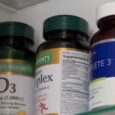



Many influencers say stacking supplements can improve sleep, cognitive health and performance.
Courtesy of Anastasiia Voloshko/Getty Images
The patient said he took 60 supplements a day.

Dr. Kay Bael Siglos, a family care doctor, was aghast.
Article continues below this ad
Siglos, of Trinity Health of New England, treats young patients who take supplements while training for athletic events, but this was a 50-year-old man who disliked traditional medication. He was “so embarrassed” about his supplement habit because among the conditions he was trying to address was low-libido, Dr. Siglos said.
Low libido, anxiety, aging skin and workout preparation or recovery are among the reasons social media influencers tout “stacking supplements,” or layering the consumption of vitamins and minerals, sometimes with drinkable blends. Such stacking practices have become a “$200 billion global habit,” according to Vogue. Whether it’s sea moss and peppermint oil or creatine and Omega-3 fatty acids, some Americans are spending more than $1,000 a month on such supplements and injections, according to the Wall Street Journal. The popular biohacker Dave Asprey spends $3,000 a month on supplements, according to GQ.
“I have a couple of young, active people who are doing weight lifting or marathons who are taking creatine, protein powders, greens powder, which is very popular now,” said Siglos, who said she is a “big supplement user” herself. The Rocky Hill practitioner said she researches each supplement, asks about a patient’s diet, physical activity and medication list to determine whether the regimen is safe and effective.
Article continues below this ad
Make CT Insider a preferred source on Google to see more of our journalism when you search.
Add Preferred Source
Others, like Christopher Barrett, a dietitian-nutritionist at Hartford HealthCare, are more wary. “They’re looking for something that a supplement will not be able to give them,” said Barrett, who is concerned about the lack of FDA regulation of most supplements. “They’re selling the individual a dream. They use very emotionally charged verbiage to make them buy it, like ‘Are you feeling anxious?’ ‘Are you feeling bloated? Do you want to live longer?’”
Yale New Haven Health urges skepticism regarding claims on the benefits of supplements, some of which can cause liver damage. Tumeric, for example, often touted as a remedy for arthritis and low energy, can cause liver damage, said Dr. Joseph K. Lim, a hepatologist and gastroenterologist at Yale New Haven Health. “It’s estimated that 20 percent of drug-induced liver injuries in the U.S. are related to herbal and dietary supplements,” Lim said.
The FDA has also warned that certain supplements, including NAD+ , a molecule that helps cells make energy, and glutathione, an antioxidant — promoted by social media for mental clarity and glowing skin — can cause health problems.
Article continues below this ad
Americans spend approximately $60 billion annually on dietary supplements. Roughly half of all U.S. adults consume them, according to the National Institutes of Health.
Courtesy of Magone/Getty Images
Although about half of all American adults—including 70% of those age 65 and older—take a multivitamin or another vitamin or mineral supplement regularly, according to Johns Hopkins Medicine, many social media influencers, and even doctors like Dr. Mark Hyman and Dr. Andrew Huberman, who have their own following on social media, promote or even sell “stacking” supplements to target physiological states or optimize performance. Huberman believes stacking peptides improves sleep, skin health and cognitive function, according to his website. Hyman advocates stacking supplements to bridge nutritional gaps and optimize long-term health, according to his website.
This frustrates Dr. Jatupol Kositsawat, a geriatrician and internal medicine doctor at UConn Health, who said influencers can easily sway people into unhealthy choices. “If you listen to them for a half an hour you will become convinced of what they are saying,” said the assistant professor of medicine at the UConn Center of Aging. “Since (supplements are) not controlled by the FDA, you can say almost anything.”
Kositsawat tries to dissuade patients from taking multiple powders and supplements over fears of toxicity, he said. “I’m trying to discourage them because a lot of people come in taking a lot of vitamins because they believe in it,” he said. “I have one person who takes a multi-vitamin, vitamin D and calcium, and her (calcium) levels were too high,” he said. Too much calcium can lead to kidney stones, he said. “When you are young, you can stand a toxic substance. If they take these from a young age, they will have problems later in life. You can never replace food with vitamins because of the variety of micronutrients they offer.”
Article continues below this ad
Influencers, including some doctors, often promote the “stacking” of supplements to enhance recovery, longevity and skin health.
Courtesy of hudiemm/Getty Images
When doctors or dietitians recommend a supplement, it is usually to address a specific nutrient deficiency, such as vitamin D or iron, according to the National Institute on Aging.
Americans spend $60 billion annually on dietary supplements in 2025, according to the National Institutes of Health (NIH), up from $20 billion in 2005, according to Science Direct. Although the FDA does not approve dietary supplements or their labeling, it does regulate claims manufacturers make about them that are unsupported by evidence, according to The American Medical Association (AMA). For example, manufacturers of vitamin D and calcium can claim they reduce the risk of osteoporosis, according to the FDA, because there is substantial evidence supporting it.
Siglos, who said she avoids traditional medication, follows the recommendations of Hyman, a proponent of functional medicine, which aims to treat the root causes of disease, according to the Institute for Functional Medicine’s website. But Siglos draws clear lines, she said. “Some people don’t want to exercise and just want to lose weight,” she said, noting that such patients ask for berberine, which has become popular as a weight-loss drug, according to the National Association of Complementary and Integrative Health. In such cases, she urges exercise and improved diet.
Article continues below this ad
Others, including Barrett and Dr. Maria Piatac, a family medical practitioner at New Milford Hospital, said stacking certain supplements, especially those recommended by a physician or nutritionist for a deficiency, can be salutary, but are cautious about layering supplements because of possible interactions.
Some social media influencers advocate “stacking” supplements to optimize performance. Doctors advise caution.
Courtesy of Nadzeya Haroshka/Getty Images
“Stacking certain supplements can be beneficial,” Barrett said, noting that vitamin D helps with calcium absorption. Doctors often recommend such vitamins to address deficiencies. However, those who take calcium to “optimize their bone health” while taking iron may limit absorption of the iron, he said. “It can be counter-productive taking numerous supplements that interact with each other for minuscule benefits.”
Piatac agreed, noting that creatine helps with “short bursts of high-intensity activity.”
Article continues below this ad
“It has strong evidence for improving strength and exercise performance and is generally safe in healthy individuals,” except those with underlying kidney problems, she said. “Energy products carry more risk,” she said. “These account for about 72% of supplement-related palpitations, chest pain, and tachycardia, especially in young adults.”
Dr. Carolyn Fredericks of the Yale School of Medicine, a neurologist who specializes in diagnosing and treating patients with cognitive and behavioral concerns, is less comfortable. “From my perspective it’s really important to look at the quality of the evidence for these things,” she said, noting value of double-blind placebo-controlled studies. However, she said, “A lot of these reports are anecdotal or really not based on scientific evidence, and that makes me really worried.”
“People focus on wanting to be young forever,” Kositsawat said. “You can go overboard where you will do anything, take anything to look young.”
Article continues below this ad
Editor’s Note: Consult with your general physician prior to adding or making changes to your vitamin regiment.