




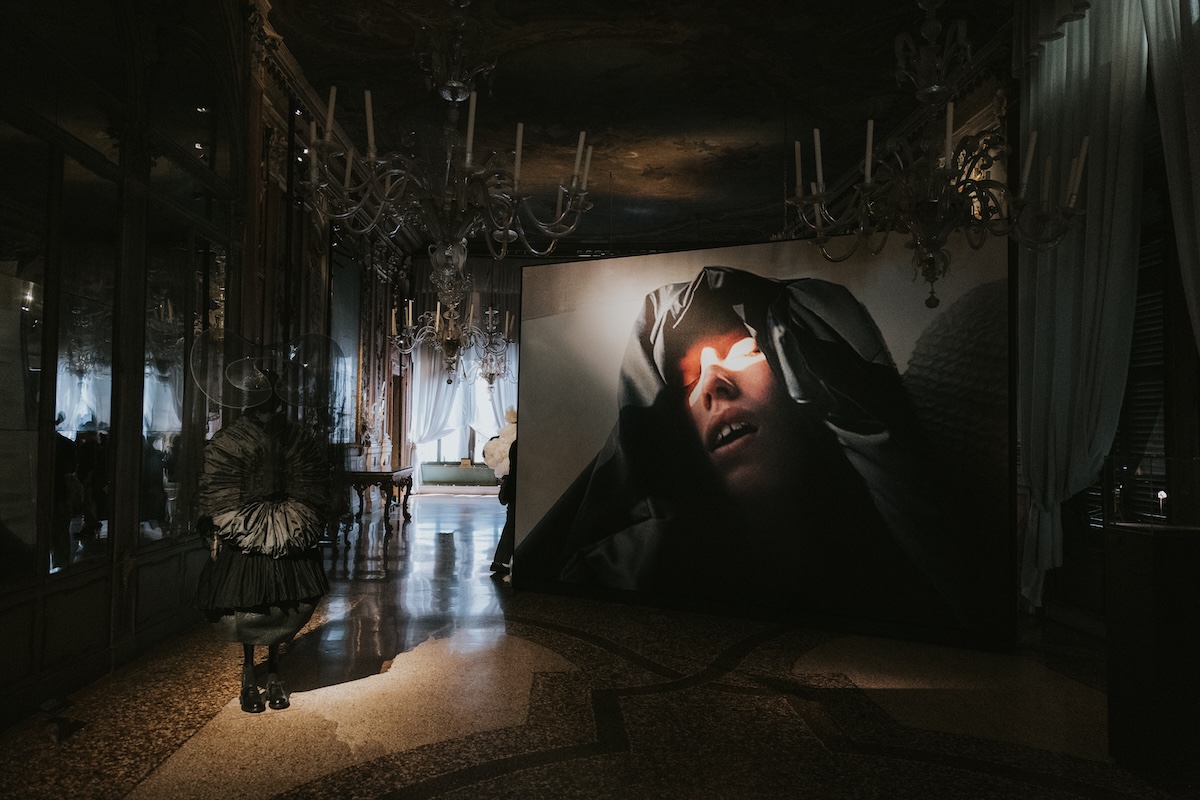
The Art Biennale was the reason for my recent trip to Venice, and one of the exhibitions I knew I wanted to visit was The Only True Protest Is Beauty, the inaugural exhibition at the new Dries Van Noten Foundation. When one of the boldest designers out there (if we consider his skill in combining patterns and colours) decided to step down as creative director of his own fashion brand, which he founded back in 1986, the fashion world was shocked, saddened, in disbelief. And then Dries Van Noten (together with his partner Patrick Vangheluwe) did something even better. (I still think that, as a designer, he is one of the best things that has ever happened to fashion).
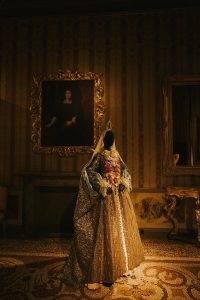
Photo: Ivana Vareško
When I stepped into Palazzo Pisani Moretta, I had a sense of the powerful presence of history, preserved to the level of a historical museum. Stucco, frescoes, gilding, ornamental details, everything felt excessive, almost unreal, eroded by time, but it was precisely in that exaggeration that the exhibition “The Only True Protest Is Beauty” found its meaning. And this was not about beauty in the classical sense you might expect from someone from the fashion world. This was a strange gathering of tensions, question marks, emotions, but arranged in some intuitive order after which I realised: there is so much more behind objects, items, behind what we would immediately declare beautiful at first glance. There is so much more!

Photo: Ivana Vareško
Fondazione Dries Van Noten describes the exhibition as a space in which beauty is a “catalyst for intensity, provocation and transformation”, and the entire presentation truly functions as a dialogue between fashion, art, glass, ceramics, photography and the space of the palace itself. More than two hundred objects are arranged throughout the rooms of the palace in such a way that they communicate with one another, collide and respond to each other. All the objects exist in relation to one another, while the stories and ideas of the curators guide you through that baroque, lavish palace that you want to tell it has gone too far, while in fact you are enjoying it.
The palace itself leaves an impression almost as powerful as the works. Palazzo Pisani Moretta is located on one of the most beautiful stretches of the Grand Canal, between Rialto and Ca’ Foscari, and belonged to the Pisani family from as early as the 15th century. Walls full of golden details, heavy chandeliers, painted ceilings, dark wood, silk and rooms that look as though they have remained frozen somewhere between several centuries.

Photo: Ivana Vareško
A particularly powerful detail in this historical layering is the very fact that, over the centuries, the palace hosted imperial and royal visits, as well as artistic and cultural figures who came to Venice in search of precisely this kind of theatrical beauty. Today, in this context, that historical “weight” of the space becomes part of the exhibition, as if every wall already has its own memory that enters into dialogue with the objects.
You move through the space intuitively, without a clear narrative, but with the constant feeling that something is opening up and destabilising at the same time. Dries Van Noten and Geert Bruloot curated the exhibition as an emotional landscape in which harmony and dissonance, opulence and decay, softness and unease alternate.
In a conversation with Vogue, Dries Van Noten said: “For me, beauty has always been important, but now it feels essential. Not as decoration, but as something deeper, more personal, something that helps people endure and keep going.” And that is exactly what can be felt throughout the entire exhibition. Beauty here is not simple or obvious at first (at least not always), but it can be dark and heavy, layered. One of the best moments for me was the encounter between the photographs of the conceptual artist Steven Shearer, a black sculptural piece by Rei Kawakubo and a couture dress by Christian Lacroix, all placed beneath a fresco by Jacopo Guarana depicting the victory of light over darkness. That layer of meaning, contradiction and symbolism is constantly present.
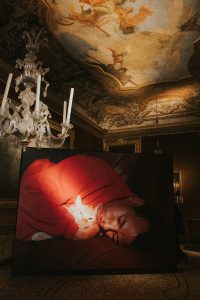
Photo: Ivana Vareško
In one room, glittering crystal glass stands next to centuries-old family objects belonging to the Pisani family, while a few steps away, a monumental sculpture by Peter Buggenhout made from discarded materials feels almost violent within that baroque beauty. And that is precisely when you realise that the exhibition is not trying to create harmony, but tension. In this context, the Lacroix couture jacket with its highly layered history also stands out. It is a piece that appeared on the cover of American Vogue in November 1988, the first issue edited by Anna Wintour. The photograph was taken by Peter Lindbergh, and the model Michaela Bercu wore a Christian Lacroix haute couture jacket embroidered with a cross, casually paired with Guess jeans.
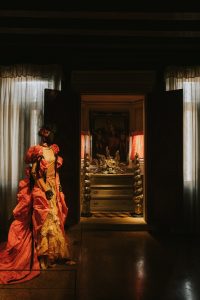
That cover marked a true turning point: couture was pulled out of closed salons and pushed into global culture. Suddenly, a 10,000-dollar jacket was no longer being worn in selected “golden” spaces, but on a young woman with a real figure and 50-dollar jeans. Couture, in a way, met everyday life and did not quite know what had hit it.
Van Noten told Vogue: “Beauty can be provocative and controversial, and I hope people will leave the exhibition looking at it a little differently than when they arrived.”

Photo: Ivana Vareško
What is interesting is the way, and the amount of space, with which the exhibition speaks about craftsmanship, not as nostalgia, but as something alive, current and necessary. In a time of speed, hyperproduction and artificial intelligence, it is almost moving to see how much attention is devoted to the trace of the hand, to material, gesture, the process of creation. “Artists, creators, artisans, I don’t draw strict lines between them. They are all, in their own way, trying to give meaning to things. Or at least make the questions more interesting”, Van Noten recently told Vogue on this occasion.
Related: A renowned fashion designer is opening an art space inside a Baroque palace
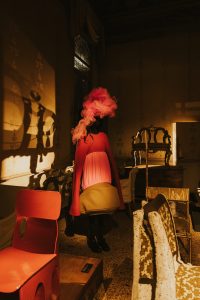
Photo: Ivana Vareško
I particularly liked the fact that fashion is not dominant here, even though this is the foundation of one of the greatest designers. Christian Lacroix couture pieces, Rei Kawakubo’s Comme des Garçons silhouettes and the works of Ayham Hassam feel more like sculptures or emotional objects than clothing. Everything is arranged so that fashion stops being a “fashion moment” and becomes part of a broader story about the body, identity, memory and emotion. The photographs of sleeping objects by the Canadian Steven Shearer and the self-portrait sculptures of the Czech artist Richard Štipl form a strong contemporary echo alongside the aforementioned fashion greats, intertwining hypnotically well with the rhythm of the historic palace.
“Beauty today is more complex, more layered. It can exist alongside sadness, contradiction, even regret.”, Van Noten said in an interview with Vogue.
Photo: Ivana Vareško
What defines Van Noten as a designer is a combination of contradictions: luxury and everydayness, strict construction and the freedom of fabric, historical references and a contemporary sense of ease. He feels close to us because of the way he dared to come closer to everyday life. And here, too, I had the feeling that he brought the world of fashion, of beauty that this time he approaches from different angles, closer to me so that I could feel it, and change my perception if it had been “flying” too high. At the same time, the installation and lighting are masterfully done. To end, sit by the Grand Canal, observe the world around you, soak up the sun and think about beauty. The beauty of life.