



What makes cancer an especially insidious disease is its ability to evade your own body’s defenses. Tumors have a host of tools at their disposal to hide from, suppress, and even manipulate your immune system in order to survive. Now, for the first time, cancer researchers have captured immune system cells engulfing mouse tumor cells on video. Their research, published in the Journal of Experimental Medicine, could open up new avenues for cancer treatments.
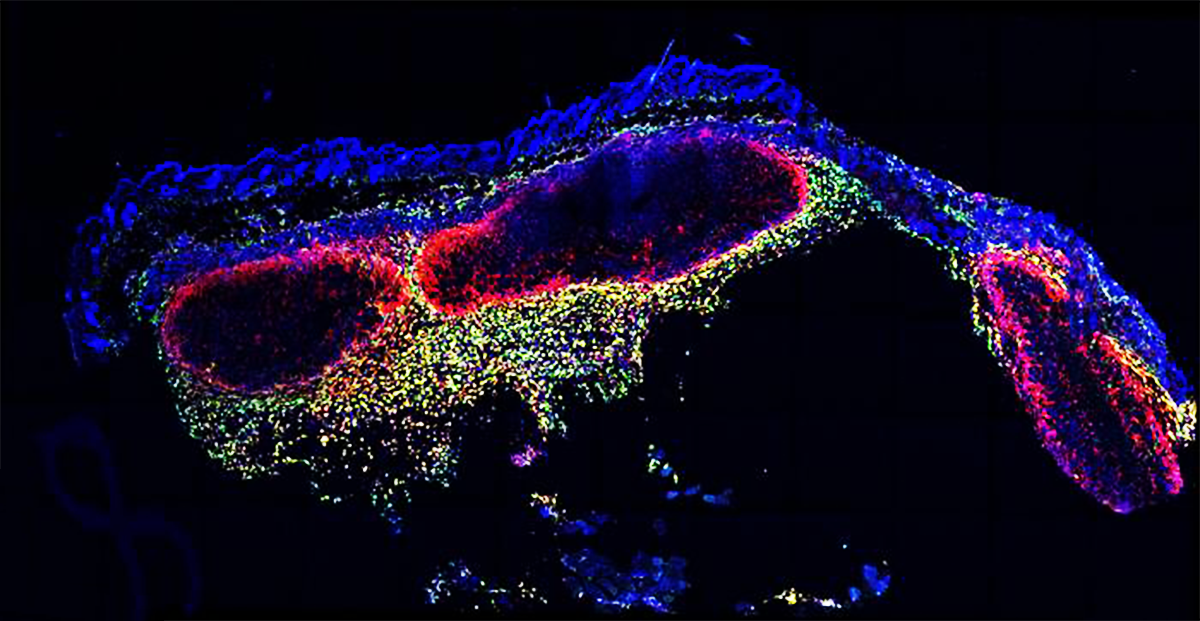
To capture the footage, immunologists used intravital two-photon microscopy—an imaging technique capable of recording the activity of living cells in thin slices of tissue. Examining skin-cancer cells from mice, they discovered macrophages surrounding tumor cells and nibbling away at the outer edges.
Credit: Phan Lab, Garvan Institute
“This is the first time anyone has captured a macrophage attacking and engulfing a live cancer cell in real time,” study author Yuki Keith of the Garvan Institute of Medical Research in Australia said in a statement. “We always suspected macrophages were doing more than we gave them credit for—now we have the video footage to prove it.”
Macrophages—the beat cops of the immune system—usually patrol tissues looking for interlopers and then gobble them up. After eating any foreign invaders, they can express a piece of the invader on their surface and rally other immune cells to repel the attack (effectively calling in the SWAT team).
Their role in cancer is a little murkier. As part of the immune system that cancer can co-opt, macrophages can actually promote tumor growth. In fact, up to 30 percent of a melanoma tumor’s mass can be made up of the immune cells. Once recruited into the tumor microenvironment, they can turn heel and suppress an immune response.
Read more: “Triggering the Body’s Defenses to Fight Cancer”
This latest research, which focused on a subset of macrophages that operate in the deepest layer of skin in both mice and humans, demonstrated that these specialized cells are on the front lines of defense, attacking cancer cells before other parts of the immune system get activated. “Critically, this attack appears to occur independently of T cells and B cells—the immune players most commonly credited with fighting cancer—which made the discovery unexpected, and genuinely exciting,” study co-author Tri Phan explained.
Now that they’ve identified a new immunotherapy lever to pull in the fight against cancer, the team is eager to exploit it. “If we can harness this population of macrophages, we potentially have an immune army already in place, ready to be mobilized,” Phan added. “Future treatments could involve developing targeted drugs that boost their numbers, or make them ‘hungrier’ or better at tagging cancer cells for killing.”
After all, shouldn’t our immune systems work for us? 
Enjoying Nautilus? Subscribe to our free newsletter.