






(© Prostock-studio – stock.adobe.com)
In A Nutshell
Researchers at Baylor College of Medicine tested a compound called NEt-3IB that works by restoring the eye’s own protective immune cells rather than simply suppressing inflammation.
In a mouse model of dry eye, NEt-3IB outperformed the steroid dexamethasone by both reducing harmful immune signals and boosting tissue-repair proteins at the same time.
Treated mice showed a stronger corneal barrier and healthier, more abundant goblet cells, the cells that produce the mucus layer keeping the eye’s surface intact.
NEt-3IB raised eye pressure less consistently than dexamethasone in early safety tests, though more studies are needed before any conclusions can be drawn about long-term safety in humans.
Dry eye disease affects tens of millions of Americans, causing burning, redness, and blurry vision that can make screen time or even a breezy afternoon feel miserable. Most treatments focus on managing symptoms or suppressing inflammation with drugs like corticosteroids, but those come with real downsides, including the risk of increased eye pressure with long-term use. Now, researchers at Baylor College of Medicine think they may have found a smarter approach by getting the eye’s own immune cells to do a better job of protecting themselves.
A study published in Investigative Ophthalmology & Visual Science tested a compound called NEt-3IB, a synthetic molecule that activates a specific protein inside immune cells, and found it could significantly reduce dry eye damage in a mouse model. Rather than simply suppressing inflammation, NEt-3IB appears to work by nudging a type of immune cell called a resident macrophage back toward its natural, protective state. In dry eye disease, those guardian cells get overwhelmed, and that balance breaks down.
NEt-3IB both dialed down harmful immune signals and turned up the helpful ones at the same time, something the steroid dexamethasone failed to do. That distinction could matter if future studies confirm the compound is safe and effective over longer periods, especially because steroid eye treatments can raise eye pressure in some patients.
Dry Eye’s Overlooked Immune Guardians
Resident macrophages are long-lived immune cells that take up permanent residence in tissues like the eye’s surface. More like maintenance workers than aggressive fighters, they clear debris, calm overreactions, and release signals that help tissue stay healthy. When dry eye sets in, these cells get outnumbered by a flood of inflammatory newcomers recruited from the blood.
Previous research from the same team showed that when resident macrophages are depleted before dry eye stress begins, the disease gets significantly worse, with more inflammation and greater loss of goblet cells. Goblet cells produce the mucus layer that helps tears stick to the eye’s surface, and without them, that surface degrades rapidly. A protein pathway inside resident macrophages, centered on a receptor called RXRα, was found to be especially active in those protective cells, making it a potential drug target.
NEt-3IB specifically activates that receptor and was designed to dissolve in water, a challenge for most molecules in its class. Converting it into a sodium salt form made it practical enough to formulate into an eye drop.
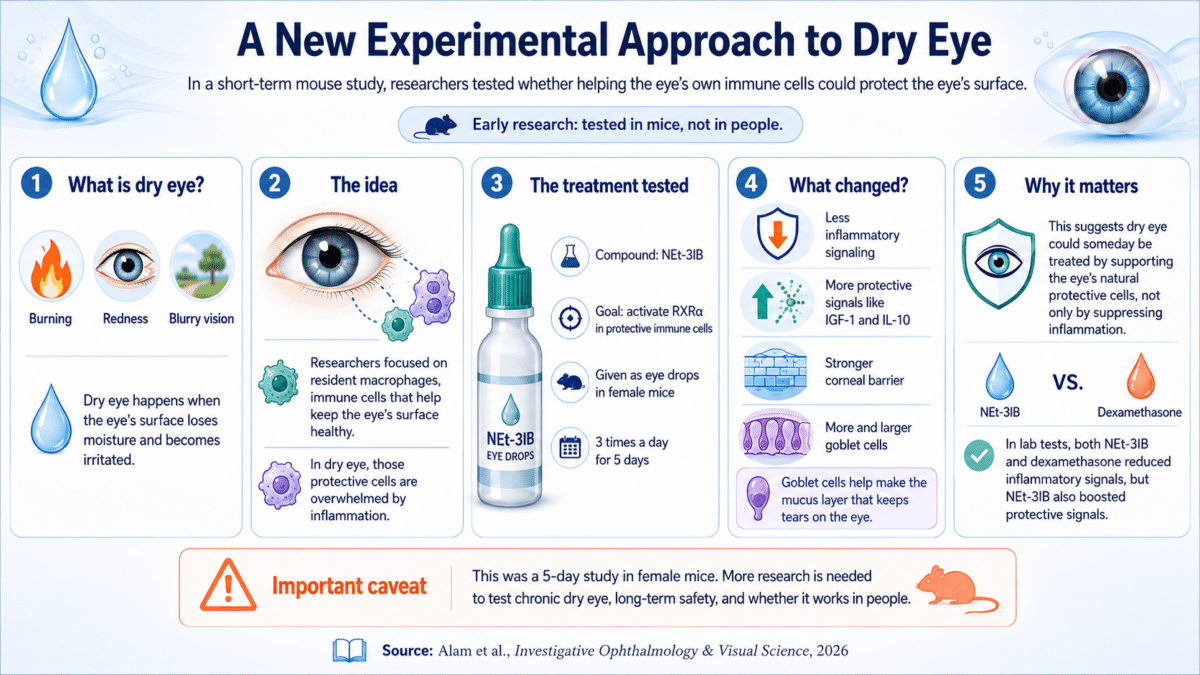
A new compound may treat dry eye by restoring the eye’s own immune cells, outperforming steroids in early mouse research. (Image by StudyFinds)
Mice With Dry Eyes Were Split Into Four Groups
Researchers exposed female mice to conditions that dry out the eye’s surface: low humidity, constant airflow, and medication that reduces natural tear production. Animals were split into four groups: no dry eye stress, five days of stress without treatment, a saline placebo drop, and NEt-3IB eye drops three times a day for five days. The team tracked gene activity inside individual immune cells, measured how well the cornea held up as a barrier, and counted goblet cells in tissue samples.
In a separate set of lab experiments, purified immune cells were exposed to a substance that triggers inflammation, then treated with either NEt-3IB at varying doses or dexamethasone. The team measured which genes were switched on or off and the proteins those genes produce.
NEt-3IB Protected the Eye’s Surface Where the Steroid Fell Short
NEt-3IB consistently did two things at once: it reduced activity in genes associated with inflammation and increased activity in genes tied to tissue repair and immune balance. In treated mice, the corneal barrier held up significantly better than in the placebo group. Goblet cells were more abundant and larger, and the volume of protective mucus proteins inside those cells was significantly greater than in all other groups.
When comparing the two drugs directly, both reduced inflammatory protein production, but NEt-3IB also boosted levels of proteins linked to tissue repair and immune regulation, including one called IGF-1 that helps maintain the health of the eye’s surface and is known to decline in tears with age. Dexamethasone did not produce that same effect.
A separate cell-transfer experiment added further evidence that this immune-cell protein plays an important role in protecting goblet cells during dry eye stress. When researchers transferred immune cells with a defective or chemically blocked version of the receptor, goblet cell protection disappeared entirely.
On eye pressure, a preliminary mouse safety comparison found that both drugs affected pressure, but dexamethasone raised it more consistently than NEt-3IB. More studies across doses and longer treatment periods are needed before anyone can say whether NEt-3IB carries a lower pressure risk than steroids.
Rather than overriding the immune system, NEt-3IB works with it, restoring the behavior of cells already built to protect the eye. Whether that approach holds up in chronic disease and in treating dry eye that already exists remains to be seen, but the early evidence gives researchers a genuinely different direction to explore.
Disclaimer: This article is based on a study conducted in mice and is intended for informational purposes only. It does not constitute medical advice. Consult a qualified healthcare professional before making any decisions about eye care or treatment.
Paper Notes
Limitations
The study was conducted in a mouse model of acute desiccating stress lasting five days, using only female mice, as the researchers noted that this model does not produce dry eye disease in male mice. Dry eye disease is typically a chronic condition, and further studies are needed to determine whether NEt-3IB is effective with prolonged administration or in treating already-established disease. Gene expression was evaluated at only one time point during desiccating stress, and the drug’s effects may differ at other points. The intraocular pressure comparison between NEt-3IB and dexamethasone used only a single concentration of the steroid, and the authors stated that other concentrations might yield different results. Additional studies are needed to fully evaluate the range of concentrations and longer durations of treatment for both compounds.
Funding and Disclosures
The study was supported by the Lions Foundation for Sight; National Institutes of Health grants EY11915 and U01 EY034692; NIH Core Grant EY002520; CPRIT Core Facility Support Award CPRIT-RP180672; NIH grant CA125123; NIH grants to the Single Cell Genomics Core at Baylor College of Medicine (S10OD018033 and S10OD023469); P30 Digestive Disease Center support grant NIDDK-DK56338; P30 Cancer Center support grant NCI-CA125123; NIH S10 grants 1S10OD02346901 and 2P30ES030285; an unrestricted grant from Research to Prevent Blindness; The Hamill Foundation; and the Sid W. Richardson Foundation. The paper lists patent-related disclosures for Jehan Alam and Stephen C. Pflugfelder; the other authors are listed as having no disclosures.
Publication Details
Authors: Jehan Alam, Yangluowa Qu, Jianming Shao, Ebru Yaman, Karen Zheng, Hiroki Kakuta, and Stephen C. Pflugfelder. Alam, Qu, Shao, Yaman, Zheng, and Pflugfelder are affiliated with the Ocular Surface Center, Department of Ophthalmology, Baylor College of Medicine, Houston, Texas. Kakuta is affiliated with the Laboratory of Bioorganic and Medicinal Chemistry, Okayama University Graduate School of Medicine, Dentistry and Pharmaceutical Sciences, Okayama, Japan. | Journal: Investigative Ophthalmology & Visual Science (IOVS) | Paper Title: ‘Rexinoid NEt-3IB Promotes Resident Macrophage Gene Expression and Mitigates Desiccation-Induced Ocular Surface Disease’ | Published: April 14, 2026 | Vol. 67, No. 4, Article 31 | DOI: https://doi.org/10.1167/iovs.67.4.31