




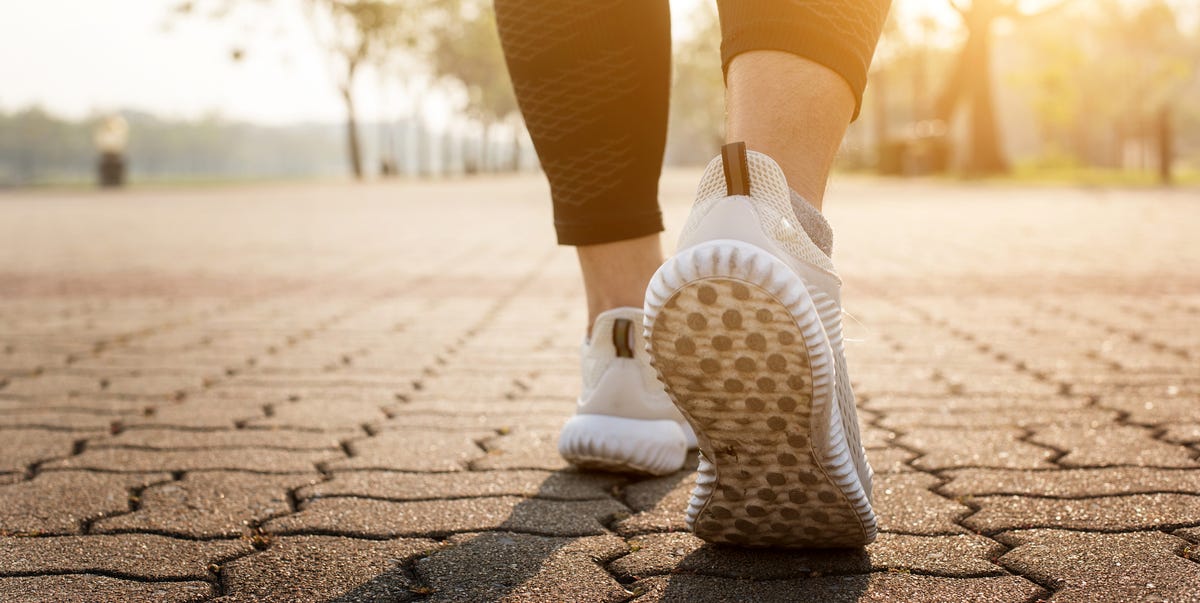
In the current fitness zeitgeist, walking is king. Of all physical activities, it’s one of the most accessible, thanks to its beginner-friendly nature and low impact on the joints. For most able-bodied people, walking is already part of daily life, so increasing your average step count can be a simple way to add a little more movement to your routine.
But how many steps a day do we really need to see meaningful improvements from walking alone? Naturally, that depends on how active you already are. I’ve always been fairly active, and my daily step count is usually well above the 10k mark. So, I wanted to challenge myself and see whether doubling that number for a month would lead to noticeable changes in my health and fitness.

Courtesy of Amy May Ellis
What I learntWalking 20,000 steps a day takes serious time
Whenever you try to increase your step count, you tend to hear the same advice:
Take the stairs instead of the liftGet off public transport a stop earlyWalk instead of drive for short journeys
But 20,000 steps isn’t a short distance, so those small changes weren’t going to cut it. Instead, I had to carve out dedicated time just for walking. I changed my commute so I could fit in 45 minutes of walking before I’d even had my morning coffee.
Without planning ahead, I wouldn’t have come close to hitting my daily goal. While fitness challenges can be fun, they can also be time-consuming, and they’re unlikely to work for people with busier schedules, greater commitments or working hours that stretch beyond a typical 9-to-5.
That said, NHS guidance suggests that even a 10-minute brisk walk can have meaningful health benefits, so don’t feel the need to jump from 5,000 steps to 15,000 overnight.
Sometimes life gets in the way – and that’s fine
During the challenge, I went away with friends for a long weekend. My priorities were exploring the area, spending time with people I care about and switching off.
As a result, I didn’t hit 20,000 steps once across the four days I was away – and I’m glad I didn’t.
To make it happen, I’d have needed to wake up early for extra walks or leave my friends by the pool just to chase a number on my watch.
 Courtesy of Amy May Ellis
Enjoying my holiday!
 Courtesy of Amy May Ellis
Prioritising relaxation
This is where fitness can become obsessive. There’s a difference between pursuing a personal challenge and feeling compelled to complete it because you’d feel guilty otherwise.
It’s important to think about health holistically. It’s not just about how you look, but how you feel. And it’s not only about physical health, but mental health too.
If a fitness goal starts to feel more like a burden than something enjoyable, it’s worth asking yourself what you’re actually gaining from it.
A routine makes everything easier
Once I worked out how long 20,000 steps actually took, and which routes I needed to take to hit that target, everything became much easier.
Walking to a more distant Tube station, getting outside multiple times a day and choosing to walk instead of taking the bus (within reason) were all habits that quickly stuck.
After a couple of weeks, it became second nature. As long as I was eating enough and not overdoing other forms of exercise, I never felt unable to hit my daily target.
What I did notice, though, was how much harder it became when my body needed rest. After a late night or poor sleep, reaching 20,000 steps felt significantly more difficult.
In those situations, I prioritised listening to my body. More often than not, I’d naturally make up the difference the following day when my energy levels returned, meaning my average step count balanced out over the month.
Running makes 20,000 steps much easier
I’m fortunate in that I already run regularly. Having recently completed my second marathon in Rome – and set a PB while doing so – running is already a big part of my weekly routine.
On days when I completed a 10k run (usually two or three times a week), reaching 20,000 steps became almost inevitable. The run alone accounted for roughly half of my daily target.
 Courtesy of Amy May Ellis
Rome marathon
 Courtesy of Amy May Ellis
Running on the track – an easy way to clock mileage
Obviously, that won’t be the case for everyone looking to increase their activity levels. But if you’ve ever considered trying running, it could be a useful way to accumulate more steps in less time.
And you don’t need to be knocking out 10km every session. Even a short, easy run can contribute a meaningful chunk towards your daily total.
The verdict
Increasing your step count is an easy, cost-effective (read: free) way to improve your overall fitness and cardiovascular health, particularly if you currently live a fairly sedentary lifestyle.
But 20,000 steps a day is no small undertaking. It requires time, planning and a conscious effort. It’s not a target that feels especially natural to maintain long term, particularly if you value flexibility in your social life.
If you’re considering walking more, I’d recommend increasing your step count gradually rather than dramatically changing your activity levels overnight. That way, you can build manageable habits that fit naturally into your routine.
The benefits of walking also extend well beyond physical fitness. It creates opportunities to socialise, whether that’s a hike with friends or a dog walk with family. It’s also a simple excuse to get outside, clear your head and break up an otherwise sedentary day.
Those mental and social benefits can be every bit as valuable as the physical ones – and you certainly don’t need to walk 20,000 steps a day to enjoy them.

Amy May Ellis (she/her) is the SEO Manager for Cosmopolitan UK, Women’s Health UK, Men’s Health UK, and Runner’s World UK. Her love for all things beauty, fashion, and wellness is evident in her work with these lifestyle and fitness brands. Providing content recommendations for everything from new gut health supplements to the latest fashion trend, Amy has a keen eye for detail and loves to spot trends before they fully flourish.