


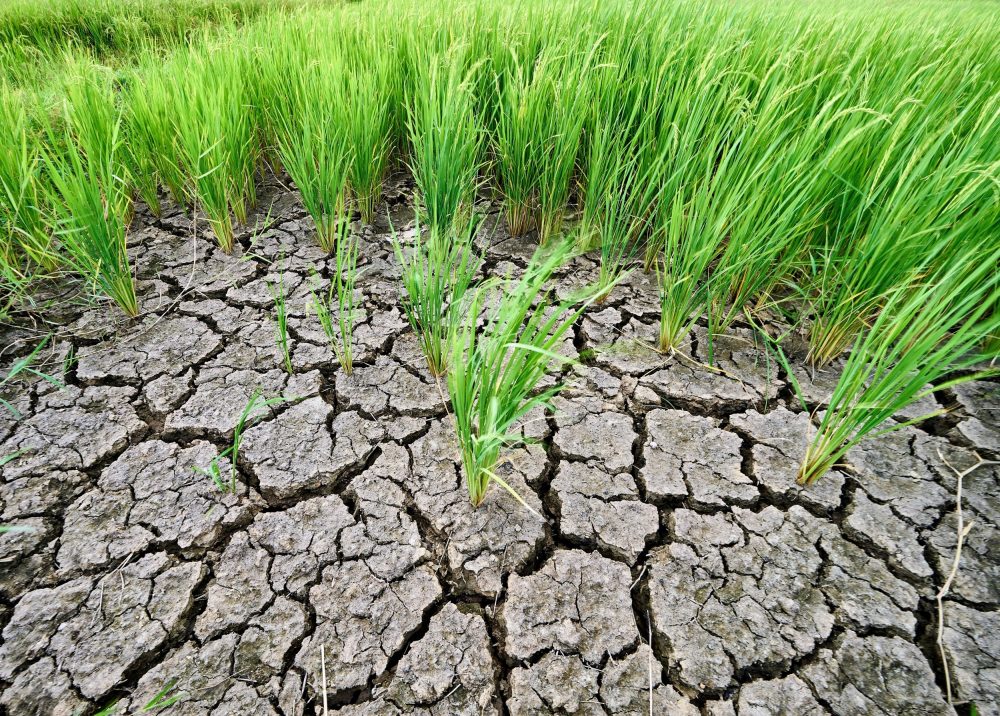
Farmers measure drought damage in lost yield – shrunken harvests and crops that never reach the market.
For a long time, this was the drought damage that scientists were most focused on as well. But now, a recent study has found damage that’s harder to spot.

The researchers found that drought doesn’t only shrink crops – it cuts the iron inside them.
Iron is reduced through a chain of events in plant roots that nobody had connected to nutrition before.
When the roots shut down
Every plant in a field reaches into the soil for iron – a mineral needed for growth that also ends up in the food we eat.
The new research reveals that when drought hits, the plant’s iron-gathering equipment powers down and its immune defenses ease off.
Both changes happen in the roots. The research was led by Connor Fitzpatrick, PhD, an assistant professor in the Department of Biological Sciences at the University of Calgary (UCalgary).
Fitzpatrick describes it as the plant dialing down its immune system and iron uptake machinery under stress.
That second part is the surprise. Lower iron uptake means less iron reaching stems, seeds, and the food people eat – a change driven by the plant’s own biology, not only by the drought.
A long-suspected helper
For years, scientists noticed something curious in the roots of stressed plants. A group of soil bacteria called Streptomyces reliably showed up in greater numbers during drought.
Across more than 30 plant species, the pattern held, so researchers assumed the plant was inviting them.
The thinking was that a plant under stress sends chemical signals, recruits helpful microbes, and those microbes ease the stress in return.
Scientists even gave it a name – the “cry for help” hypothesis. The theory made sense and had real evidence behind it, but this latest study pokes a hole in the story.
Streptomyces don’t surge because the plant calls them in – they surge because the plant’s own suppression of iron uptake and immunity opens space in the roots. Bacteria move in where competition suddenly disappears.
A deeply wired response to drought
The work began with Arabidopsis thaliana, a small weedy plant that Fitzpatrick calls the fruit fly of the plant world.
The team grew it in soils from 18 sites across the United States, ground varying widely in chemistry and climate.
Then, the researchers checked the same thing in crops people actually farm. Rice, tomato, and canola all showed the same pattern under drought stress – iron uptake dropping just as the bacteria flooded in.
Rice and tomato sit on opposite branches of the plant family tree, separated by roughly 160 million years of evolution.
A response surviving that long is deeply wired, not a recent accident.
No benefits for the host
The researchers expected that Streptomyces flooding in should benefit the plant. Some strains did help, boosting growth and restoring iron uptake. That much fit.
But the strains that helped plants were not the ones most likely to colonize the roots. Success had little to do with benefiting the host.
Instead, the winning strains were largely determined by competition among the bacteria themselves.
The plant ends up with tenants chosen by bacterial competition, not by any benefit to the host.
Whether a helpful strain wins comes down to chance – which is exactly why the “cry for help” idea doesn’t hold. A real cry for help brings reliable rescuers, not a random draw.
Drought changes plant functions
Pulling the findings together, the team identified a two-stage sequence. Drought makes the plant lower its iron and immune activity, opening the roots to Streptomyces broadly.
The bacteria then fight among themselves, and that competition decides which strains settle in.
This separates two things scientists had tangled together. The reason Streptomyces show up is the plant’s own retreat. After that, a separate contest, with its own rules.
According to Fitzpatrick, drought doesn’t merely stress a plant – it rewires how the plant manages nutrients and the microbial world around it.
The plant isn’t a passive victim. It’s an active participant in changes reaching all the way to what ends up on a plate.
Why it matters on your plate
Iron deficiency is the most widespread nutritional disorder on Earth, touching billions of people.
A great deal of dietary iron comes from plants, and a study on anemia worldwide traces much of that problem to diets low on the mineral.
Until this work, concern about drought focused mostly on yield – fewer crops from drier fields. This adds a second worry that few had measured – the crops that survive may carry less iron in the parts we eat.
Drought is getting worse. One paper tracking global trends found severity climbing sharply in recent decades, with drier regions growing drier and wet ones increasingly dry.
Fitzpatrick suggests two directions – breeding crops that sustain iron uptake under drought, or probiotic soil treatments built around the bacteria that actually help.
The plant’s self-sabotage is visible now, and that makes it something the field can target rather than an invisible loss nobody knew to look for.
The study is published in the journal Cell.
—–
Like what you read? Subscribe to our newsletter for engaging articles, exclusive content, and the latest updates.
Check us out on EarthSnap, a free app brought to you by Eric Ralls and Earth.com.
—–