




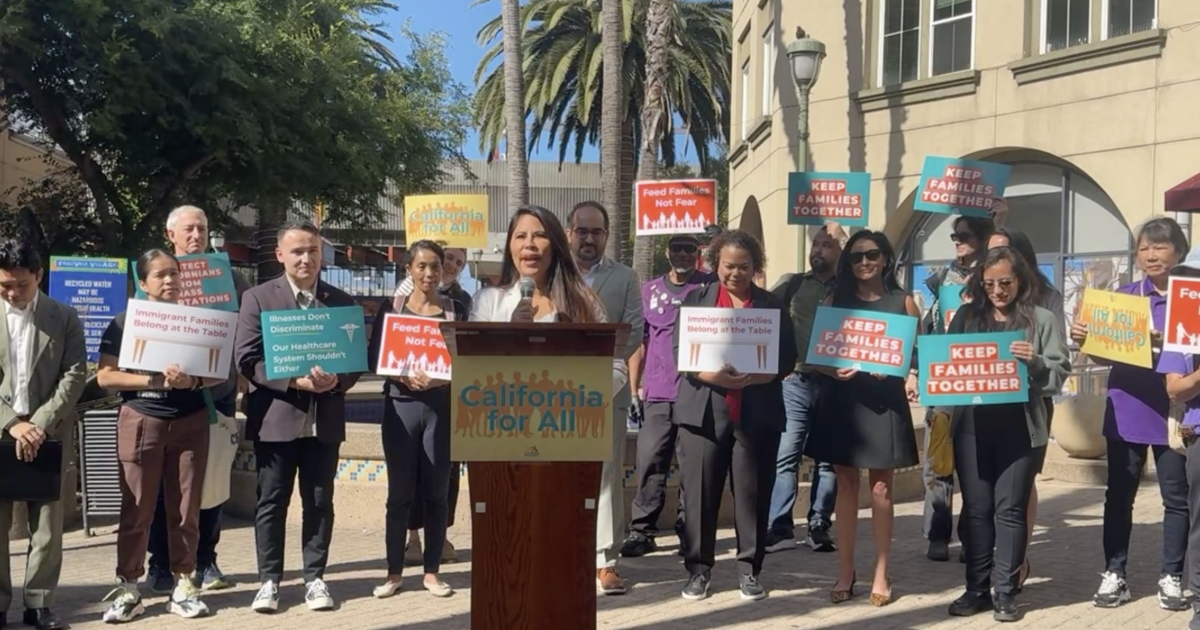

Assemblymember Liz Ortega speaking at a California Immigrant Policy Center press conference calling for state investments in immigrant support services on June 5. (Live stream screen grab)
With the deadline for the State Legislature to pass the next budget and send it to the governor just around the corner, leaders and activists alike are calling for targeted investment to support immigrant communities throughout the state.
The California Immigrant Policy Center (CIPC) held a press conference Friday morning convening lawmakers, activists, legal support providers and more to call on the Legislature to ensure the next budget has adequate funding for legal support services and seed money for immigrant entrepreneurs, as well as a reversal of Medi-Cal cuts for immigrants.
“Unfortunately what we’ve seen in last year’s budget and continuing into this year’s budget, both at the federal and state level, is abandoning our immigrant communities when they need safety, healthcare and access to economic opportunity,” said Masih Fouladi, executive director of CIPC. “As the fourth largest economy in the world, one that immigrant communities are the backbone of, we cannot do that to our communities.”
June 15 is the deadline for the Legislature to pass the budget bill after weeks of negotiation between both houses and the governor. Once passed and signed by Gov. Gavin Newsom, the 2026-27 budget will go into effect on July 1.
Newsom’s May budget revision painted a sunny picture of California’s financial outlook, with the governor touting a balanced budget and no deficit. A big reason why the budget will be balanced, however, is because the governor’s office is recommending the state expand healthcare cuts to undocumented immigrants that it approved in 2025.

In California, 1.6 million immigrants without legal status are currently enrolled in Medi-Cal. Photo by Brenda Verano
In the face of an $18 billion budget deficit last year, the Legislature, consisting of a Democratic supermajority, approved rollbacks to healthcare for undocumented immigrants. The cuts included an enrollment freeze for all undocumented adults, restricted dental benefits and a new proposed $30 premium for this population.
The May revision went even further, upping the premium to $50, reducing the asset limit for Medi-Cal and moving undocumented immigrants to a fee-for-service system that will likely decrease benefits and care.
CIPC, other organizations and Democrats in the Legislature now have their work cut out for them to convince budget leaders to fight against these cuts and invest in more support services.
Fouladi said they are now in a sprint for June 15, but the broader fight to cement immigrant rights is a marathon.
“If we fail to fund legal services, we will keep watching our neighbors disappear off the street … and if we don’t invest in immigrant entrepreneurs, our economy falters at a moment we cannot afford it to,” Assemblymember Mia Bonta (D-Oakland) said Friday.
She called on her Democratic colleagues in the Assembly to keep a provision of their proposed budget that would allocate $100 million in immigration legal services.
There is also a call for the budget to ensure $45 million over the next two years for the Social Entrepreneurs for Economic Development (SEED) grant, that supports immigrant entrepreneurs.
Making sure the call is heard, CIPC also planned three Friday town halls in the districts of Assembly Speaker Robert Rivas (D-Salinas), Assembly Budget Committee Chair Jesse Gabriel (D-Encino) and Senate Budget Chair John Laird (D-Santa Cruz).
“Every person sitting in that capitol in their air conditioned offices, with their safe jobs … know that our lives are on the line and we will not do anything but continue to fight back in this moment,” Bonta said.
Any new cuts to Medi-Cal access will only shift costs and make people sicker, said Dr. Theresa Cheng, an emergency physician and human rights lawyer.
Echoing what many health experts have said, Cheng warned removing immigrants from Medi-Cal will increase costs and visits coming out of emergency rooms and will likely result in preventable illnesses going untreated.
“I’m afraid for all of us when the Medi-Cal [cuts] take effect,” Cheng said. “These cuts not only harm immigrant communities and families but also destabilize our entire healthcare system.”
California became the first state to offer full-scope coverage for all undocumented adults in 2024, a historic expansion of healthcare. Then, just one year later, the state began rolling back.
“We made a promise that all Californians in this state would have access to health care,” said Assemblymember and Vice Chair of the Latino Caucus Liz Ortega (D-East Bay). “Everyone should have access to basic things in the fourth largest economy in the world.”
Centro Legal de la Raza in Oakland provides legal services to immigrants, a feat that is fast moving and quickly outpacing providers’ capacity, according to Executive Director Monique Berlanga.
In his May revision, Newsom proposed a $20 million allocation for these kinds of support services, an act that “acknowledges the need, but falls far short,” Berlanga said.
“The question before us is simple, when families face life-altering consequences of detention and deportation, will the state of California step up and ensure they have access to justice, or will we continue to abandon our community members?” Berlanga asked.