




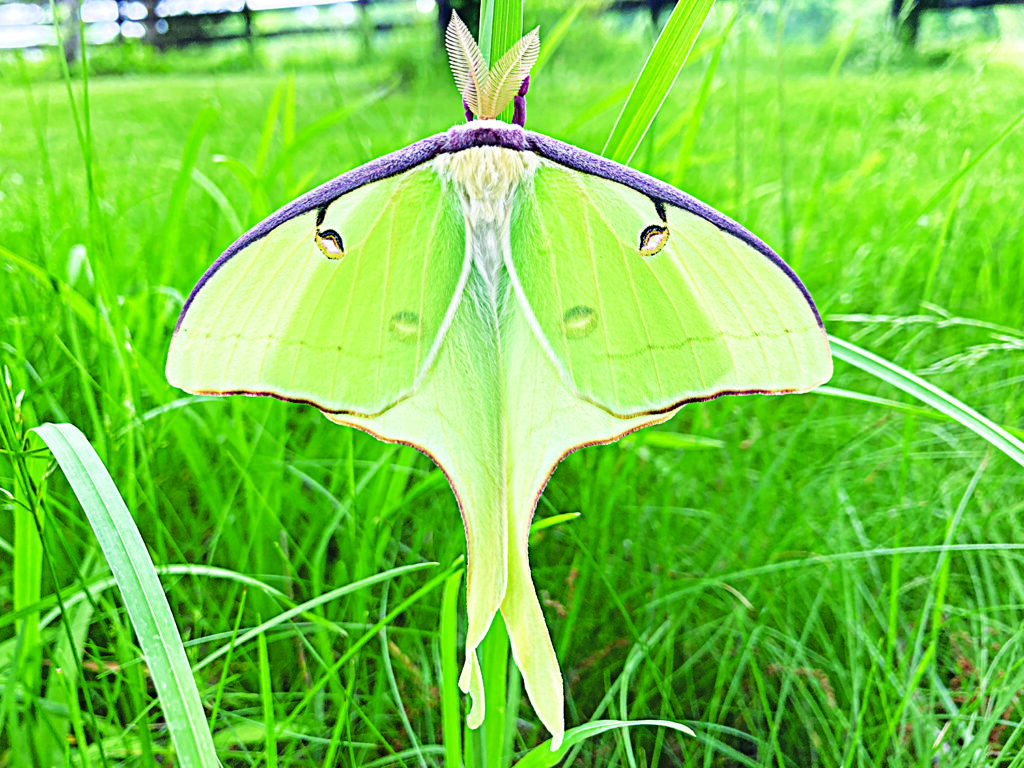
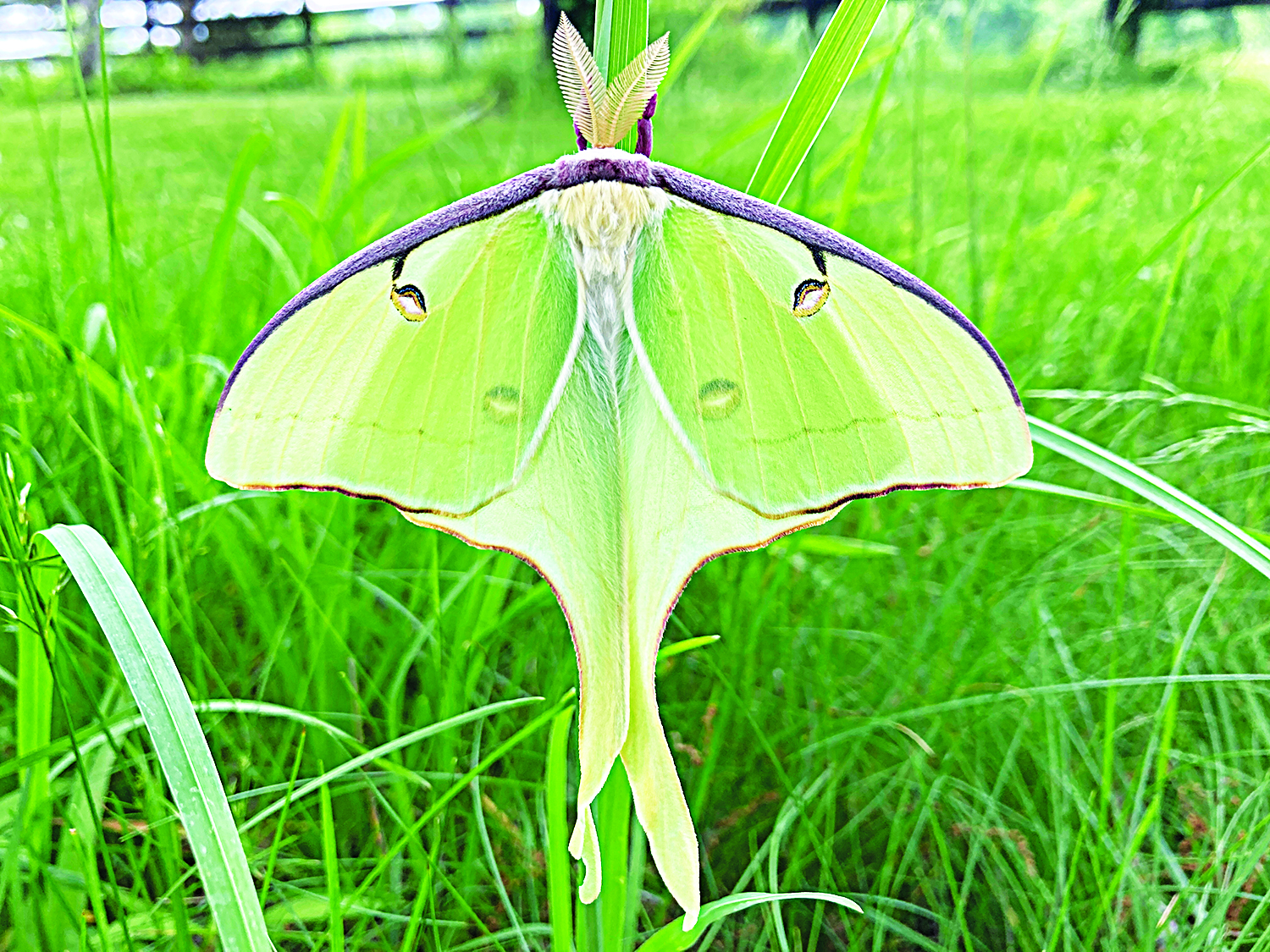
A male luna moth freshly emerged from its cocoon in Peoria County. The beautiful creature does not live long after it claws its way out of its ‘incubator’ after a long winter’s nap.
MIKE MILLER
June in central Illinois arrives wrapped in humidity and birdsong. Cottonwood seeds drift across country roads like summer snow, and the last light of evening lingers above cornfields and oak woods. It is during these warm nights that one of the Midwest’s most enchanting insects appears: The Luna Moth.

MIKE MILLER
Luna moths evoke a childlike sense of wonder in the observer. When I see one, I feel a hint of nostalgia, carried back to childhood, when I first saw one on a humid June morning. Its broad wings glow a pale green, stretching nearly five inches from tip to tip. Long, tapering tails trail behind the hind wings like ribbons in water. Each wing bears a transparent eyespot, giving the moth the appearance of some mythical forest spirit rather than an insect common to Illinois woodlands.
Across central Illinois, from river bottoms to the hardwood forests along the bluffs of the Illinois River, luna moths emerge quietly in late spring and early summer. June is often their season of greatest abundance.
The luna moth’s beauty hides a surprisingly brief adult life. The moth drifting around a porch light may live only a single week. Adult luna moths do not eat at all; they possess only vestigial mouthparts and survive entirely on energy stored during their caterpillar stage. Their brief purpose is reproduction beneath the warm Midwestern night sky.
Long before the moth takes flight, however, it spends most of its existence as a caterpillar hidden among the leaves of deciduous trees. In central Illinois, luna caterpillars commonly feed upon hickories, walnuts, and sumacs growing along woodland edges and within healthy savanna habitats.
The life cycle begins when a female moth releases pheromones into the night air shortly after midnight. Males, equipped with feathery antennae capable of detecting these chemical signals from remarkable distances, flutter through the darkness searching for her. After mating, the female deposits clusters of tiny eggs upon the undersides of leaves. Within about a week, miniature green caterpillars hatch and immediately begin feeding.
As summer deepens, the caterpillars grow rapidly. They pass through five developmental stages called instars, shedding their skin repeatedly while consuming enormous quantities of foliage. Their bodies become plump and vivid green, decorated with yellow bands and tiny reddish bumps. Though conspicuous in photographs, they often disappear perfectly among sunlit leaves.
By late summer, the mature caterpillar descends from its tree and searches through fallen leaves for shelter. There it spins a thin silk cocoon, often incorporating bits of dry leaf into its papery covering. Hidden beneath autumn leaf litter, the insect transforms into a pupa and waits through the long Illinois winter. Snow may drift above it while owls hunt frozen woods overhead, yet inside the cocoon the future moth remains alive and dormant.
When warm temperatures and longer days return, the transformation nears completion. On humid June mornings, the adult moth finally emerges. The pupa splits open, and the moth uses tiny serrated spurs near its wings to cut through the cocoon. At first the newly emerged luna moth appears crumpled and weak, its wings small and damp. Slowly it pumps fluid through delicate veins, expanding the wings to full size. For several hours the moth hangs motionless while the wings harden and dry in the morning air. By evening, it is ready to fly silently into the central Illinois darkness.
To encounter a luna moth on a June night is to glimpse something wondrous and fleeting. It is a reminder that even in the modern world, dreamlike mysteries still emerge quietly from the leaf litter each summer, glowing green beneath the stars.