




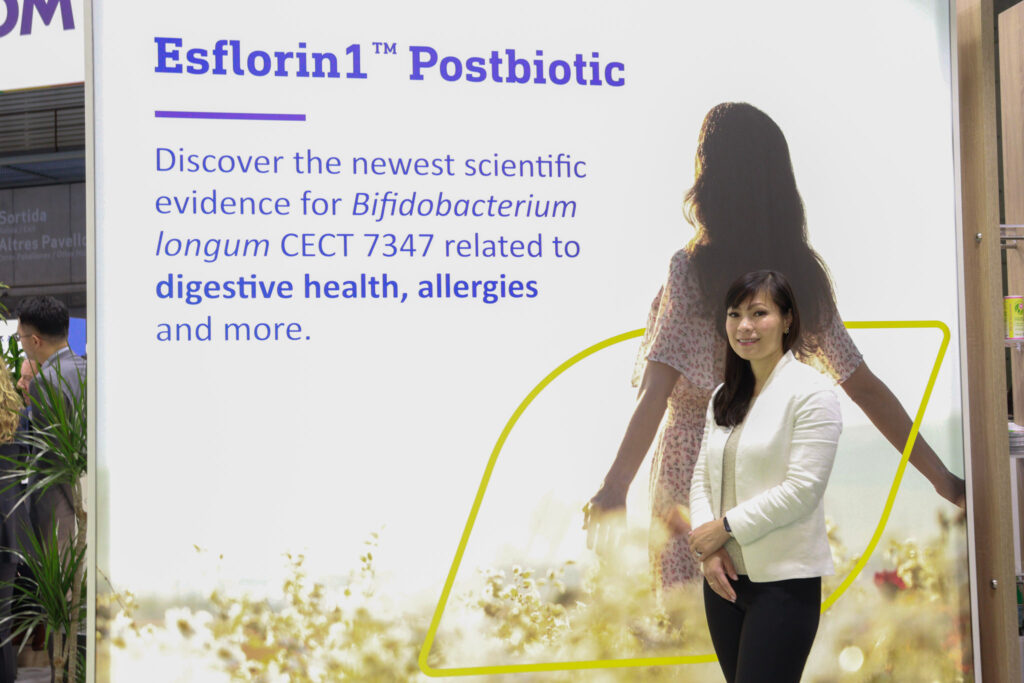
At Vitafoods Europe 2026, ADM showcased how advances in microbiome science help brands meet increasingly personalised consumer health needs. Through featured concepts, ADM highlighted microbiome solutions targeting stress, sleep, mood, digestive health, metabolic health, women’s health, active nutrition and more.
ADM centred on the growing role of postbiotics in delivering targeted everyday health benefits in convenient formats. Unlike conventional probiotics, postbiotics can retain functionality under challenging formulation conditions.
Among the standout concepts was a sugar-free ‘Barista Syrup’ formulated with ADM’s Esflorin1A Postbiotic (Bifidobacterium longum CECT7347), which may help support overall gut and digestive health, along with the potential for supporting reduced bloating.1
“Now consumers can get digestive health into their everyday coffee ritual,” said June Lin, vice president, global innovation marketing, ADM. “So, that’s what we mean when we say that functional nutrition is moving into consumers’ everyday life.”
ADM also showcased its ‘Zen Gummies’ concept, featuring Lactobacillus gasseri CP2305 Postbiotic, designed to support stress, sleep and mood.2,3,4 The concept reflects demand for accessible, lifestyle-friendly alternatives to traditional supplement delivery formats, particularly for evening routines.
In addition, ADM presented its ‘Sip of Wellness’ concept, formulated with ADM/Matsutani LLC’s FibersolB Prebiotic dietary fibreC and BPL1D Postbiotic (Bifidobacterium animalis subsp. lactis CECT8145). The concept targets factors relevant to satiety5 and metabolic health6, addressing consumer needs linked to GLP-1 use and post-GLP-1 nutrition support.
“Personalisation at scale is a very interesting challenge right now,” said Lin. “From a microbiome standpoint, we can bridge that together.”
Lin explained that ADM’s microbiome platform enables single ingredients to deliver benefits across multiple consumer segments and life stages, supported by extensive clinical research. She spotlighted L. gasseri CP2305 Postbiotic, which has eight clinical studies, including examining women’s health for young women and menopausal groups, as well as male athletes.7,8,9
This platform approach supports both targeted and broad consumer needs, allowing brands to address specific health concerns while maintaining scalable formulation strategies across demographics.
When discussing consumer awareness of postbiotics, Lin cited ADM research. While baseline awareness of postbiotics is low, purchase intent rises significantly once consumers understand postbiotics’ function and benefits10, underscoring the importance of education alongside innovation.
ADM further reinforced the convergence of science-backed nutrition, microbiome innovation and everyday wellness, demonstrating how postbiotics and “Tribiotic” combinations of prebiotics, probiotics and postbiotics can be embedded into foods, beverages and supplements for modern, multifunctional health needs.
AEsflorin1® is a trademark registered for Biopolis S.L. in the EU and other countries.BFibersol® is a trademark registered for ADM/Matsutani LLC in the US and other countries. Local regulations must be reviewed to confirm dietary fibre status.DBPL1® is a trademark registered for Biopolis S.L. in the EU and other countries. 1Srivastava, S., et al. (2024) Gut Microbes. 16(1):23383222Nishida, K., et al., (2017) Journal of Applied Microbiology 123:1561-15703Nishida, K., et al., (2017) Journal of Functional Foods 36:112–1214Nishida, K., et al., (2019) Nutrients 11:18595Ye, Z. (2015). Nutritional Research, 35, 393-4006Pedret, A., et al. (2019) Int J Obes (Lond). 43(9):1863‐18687Nishida, K., et al., (2021) Journal of Functional Foods 80:1044268Sawada, D., et al., (2022) Nutrients, 14:16959Sawada, D., et al., (2019) Journal of Functional Foods 57:465–47610ADM Outside Voice℠, Postbiotics Survey, Europe