

In his latest video project, photographer Michael Shainblum returns to the volatile, weather-driven landscapes of New Zealand with a body of work shaped less by fixed composition and more by responsiveness to constant change. We spoke with Shainblum to learn more about the creative and technical approach behind his immersive landscape photography.
The video project, A Different Way to See Landscape Photography | New Zealand, spans Fiordland National Park, including Milford Sound and Doubtful Sound, where weather systems, water movement, and shifting visibility repeatedly redefine what can be seen at any given moment.
Rather than presenting a sequence of stable landscapes, the film builds its visual structure from interruption. Fog moves through valleys, removing entire mountain ranges from view. Rain compresses depth into flattened tonal fields. Water continuously rebuilds the foreground, ensuring no composition remains static for long. While many photographers might shy away from a stormy forecast, Michael Shainblum embraces the rain, fog, and overcast conditions, demonstrating how challenging weather can become one of a landscape photographer’s most powerful creative tools for adding atmosphere, depth, and visual drama.
What emerges is a way of working that treats weather instability not as an obstacle, but as an essential part of the creative process.


Intuition in Motion
The foundation of the project is responsiveness in the field. Technical control exists, but it is always secondary to environmental behavior. Composition is not pre-built, it forms in reaction to what the landscape is doing in real time.
“I’ve never been great at defining my photography style because I don’t really think about style all that much. To me, photography has always been an extension of my personality, my imagination, and what I find interesting. Over time, that has naturally developed into a fairly expressive approach,” Michael Shainblum says.
That expressiveness becomes evident in how quickly he moves between attention scales. Wide scenes collapse into telephoto fragments within seconds, depending on shifting conditions. There is rarely a single stable interpretation of a location, only temporary versions of it.
“I would say intuition drives almost everything I do,” he says.
Decision-making is therefore continuous and reactive, shaped by small environmental changes rather than fixed visual goals.

Milford Sound and Moving Water Structures
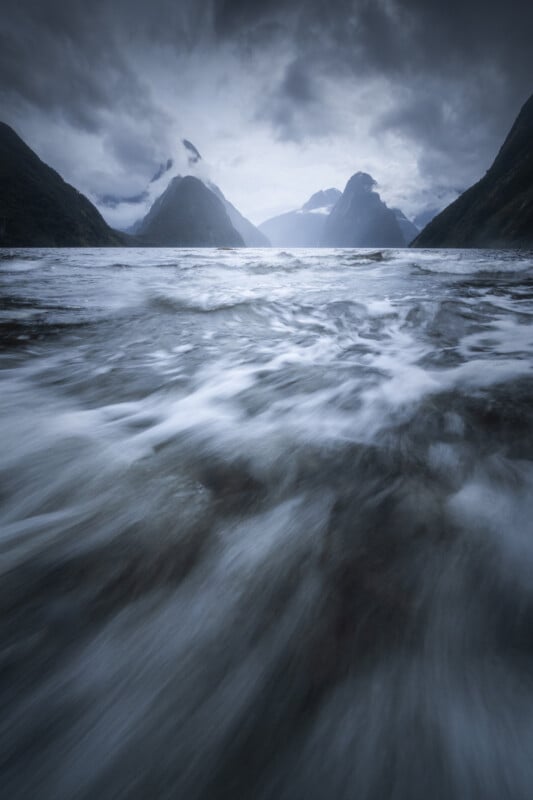
At Milford Sound, water becomes a primary compositional force rather than a background element. Boat wake spreads across shorelines, merging with wind-driven surface patterns and tidal motion. These overlapping systems constantly reshape the foreground.
Shainblum often positions himself at the edge of this movement, working where water is still forming structure but not yet settled into it. The foreground is in a state of constant reorganization, which forces compositions to be built in short bursts of alignment.
Exposure becomes a control mechanism within this instability. Slight long exposures smooth motion without removing detail entirely, while shorter exposures preserve texture and surface complexity. Aperture adjustments maintain consistency between foreground movement and distant landscape layers.
Each frame is effectively a brief alignment between motion and clarity that disappears moments later.

Working Inside Environmental Instability
Fiordland operates as a constantly shifting system. Fog moves through valleys without warning. Rain reduces depth to tonal abstraction. Mountain ranges appear and vanish within seconds.
“My workflow is really a combination of preparation and spontaneity,” he says. “When I find something interesting, I either photograph it right then or return later when I feel the conditions will work best.”
That flexibility becomes essential in a place where repetition rarely produces identical results. Even strong compositions can dissolve almost immediately as weather systems shift.
“I think some of the best photographs happen when you arrive somewhere without rigid expectations and simply respond to what nature gives you,” he says.
The working rhythm is therefore defined by adjustment rather than control.
Stream Tension and Physical Engagement
At stream level, water functions as both subject and organizing force within the frame. Currents break around rocks and uneven riverbeds, creating constantly shifting patterns that briefly suggest structure before dispersing again.
To work in these conditions, Shainblum often positions himself directly within the river, balancing on unstable surfaces while composing the image. The process is physical as much as it is visual, with footing, balance, and timing all affecting how and when a frame can be made. Stability is temporary, and must be continually adjusted as water moves through the scene.


In this environment, the stream’s flow influences how the image is read. It affects visual direction, depth relationships, and which elements remain clear enough to anchor the composition.
Each exposure captures a specific arrangement of motion and structure that only exists for a brief moment before the water shifts and the scene changes again.

Ultra-Wide Immersion and Environmental Pressure
Ultra-wide focal lengths place the camera directly inside the environment rather than at a removed vantage point. At this scale, the foreground is not a supporting element but part of the same system as everything else in the frame.
In Fiordland, that system is unstable by default. Water is constantly moving through the foreground in unpredictable ways, fog alters visibility and depth without warning, and uneven terrain breaks up flow patterns in ways that directly affect composition. Even small adjustments in camera position or height can significantly change how these elements relate to one another.
Working this way requires constant recalibration in the field. The frame is never fully “set,” because the conditions that define it are still in motion. Composition becomes something that is repeatedly rebuilt rather than finalized, with each moment offering a slightly different arrangement of the same elements.


Telephoto Compression and Fragmented Landscapes
At longer focal lengths, the landscape stops reading as a continuous environment and instead becomes a set of compressed visual relationships. Using a 100–400mm lens, distance collapses, and separate elements begin to stack into layered tonal and textural blocks.
“I love using ultra-wide lenses for immersive scenes and telephoto lenses for isolating patterns and details within the landscape,” he says.
In this compressed view, geographic context is reduced or removed entirely. A waterfall is no longer understood as part of a wider valley system, and a cliff face is no longer read as part of a mountain range. Instead, the focus shifts to structure: edges, transitions, repetition, and contrast.
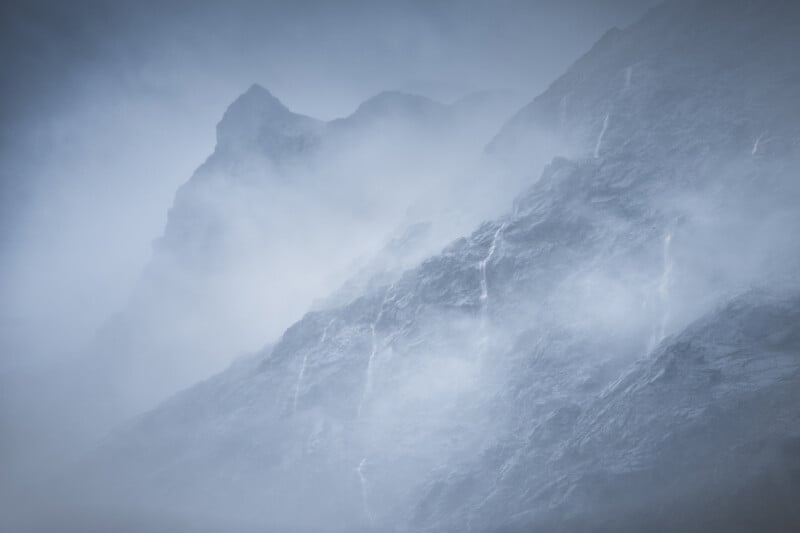
Atmospheric conditions play a major role in shaping these fragments. Wind introduces visible distortion in water surfaces, fog separates foreground and background into distinct planes, and shifting light flattens or deepens tonal relationships. The result is a landscape that reads less as a place and more as a set of isolated visual components.

Waterfall Motion and Exposure Variation
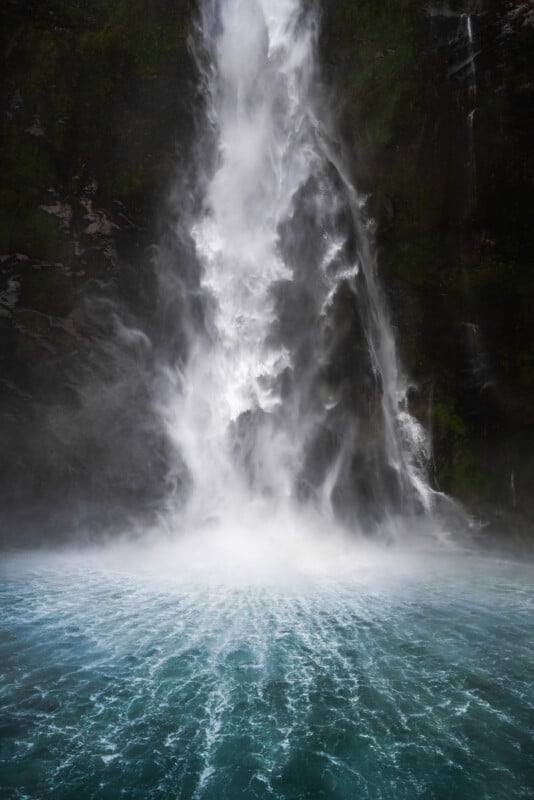
Waterfalls in Fiordland function as continuously changing subjects rather than fixed compositions. The same scene can produce very different results depending entirely on exposure time and timing.
Short exposures emphasize impact, texture, and discrete motion in the water. Longer exposures compress that movement into smoother, continuous forms that describe flow rather than individual detail. Neither interpretation is definitive; both are valid readings of the same subject under different conditions.
Wind adds another variable, occasionally shaping falling water into temporary forms that last only seconds before dissolving back into randomness. These brief moments cannot be replicated, even when shooting from the same position.
As a result, each frame becomes one version of many possible outcomes. A single waterfall can produce multiple visual interpretations depending on how motion, timing, and exposure interact at the moment of capture.
Gear as Adaptive Structure
The equipment used throughout the project is intentionally minimal. It is designed for flexibility rather than technical dominance.
“My kit is actually pretty simple. Most of the time I’m carrying a Sony A1, a 12–24mm lens, a 100–400mm lens, and a mid-range zoom. Occasionally I’ll bring out a longer telephoto for specific subjects like waves or wildlife, and I adjust the kit depending on whether I’m shooting night skies or something more specialized,” Shainblum says.
Each lens supports a different way of interpreting the same environment. Wide lenses emphasize immersion. Telephoto compresses structure. Mid-range focal lengths bridge transitions between the two.
“At the same time, I firmly believe that creativity matters far more than equipment. You absolutely don’t need the most expensive camera to create meaningful photographs. Great images come from the photographer, not the gear,” he says.
The system supports adaptability rather than prescribing a fixed approach.

Atmosphere and the Collapse of Visibility
Across Fiordland, atmospheric conditions play a key role in shaping how the landscape is seen at any given moment. Fog moves through valleys and reshapes depth, rain compresses distance into flatter tonal layers, and low cloud can interrupt visibility without warning or pattern.
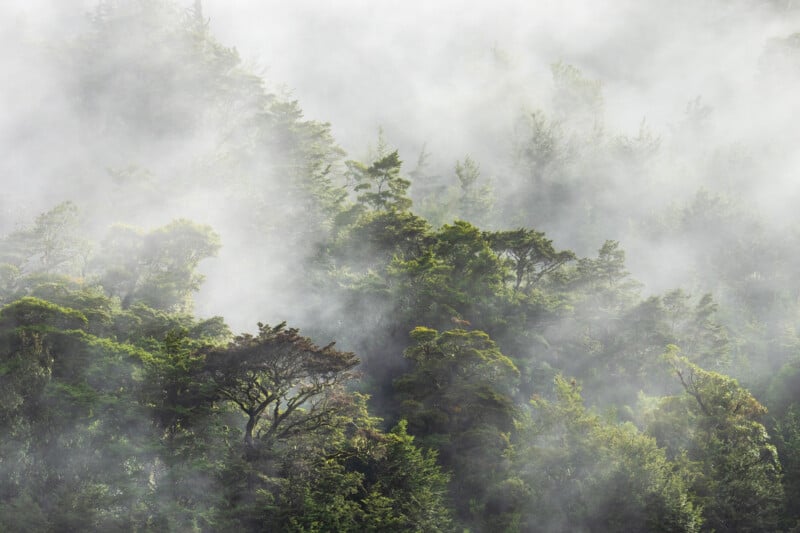
On Doubtful Sound, these effects become more concentrated. Narrow waterways hold fog between steep, forested cliffs, creating shifting layers of separation that change continuously as the boat moves forward. What is visible in one moment can be partially or fully obscured moments later, depending on how the atmosphere shifts through the channel.
Working in these conditions means that timing becomes as important as framing. Telephoto compression is often used to isolate sections of landscape as they briefly become visible, but those fragments are never stable for long. They are dependent on constantly changing atmospheric gaps.
Each image, in this context, becomes a record of temporary visibility rather than a fixed or complete view of place.


Boat Sequences and Moving Perspective
A significant part of the project takes place during scenic boat journeys through Milford Sound and Doubtful Sound, where the work is made entirely from a moving vessel in remote sections of Fiordland. These are not static viewing points but long passages through narrow waterways surrounded by steep cliffs, dense forest, and constantly shifting weather.
Working from the boat introduces a set of practical challenges that directly shape how images are made. Stability is limited, and even small movements of the vessel affect framing, particularly when using longer focal lengths. Wind, rain, and spray from the water also add to the difficulty, requiring constant adjustment of shutter speed, focus, and timing in response to changing conditions.
As the boat moves deeper into the sound, the landscape changes continuously. Cliffs slide in and out of view, fog moves across valleys, and waterfalls appear briefly before disappearing behind rock or mist. Each moment has to be read quickly, with compositions often only holding for a short window before shifting again.
In this setting, image-making follows the rhythm of the boat itself. Frames are created in response to passing alignments of motion and visibility, shaped by the constraints of shooting from a moving platform in an environment that is itself constantly in flux.

Featured Gallery
To better understand how Michael Shainblum applies his approach in the field, the following images demonstrate how patience, adaptability, and observation shape the final work. Across Fiordland National Park, conditions rarely remain stable long enough for repetition to matter, so each photograph emerges from decisions made in response to shifting weather, moving water, and changing light.
Together, these images reveal three distinct ways of working. Extended waiting for the weather to align, rapid pivoting when compositions fail, and recognition of abstract structure within fog and motion. Each approach reflects a system built on responsiveness rather than control.
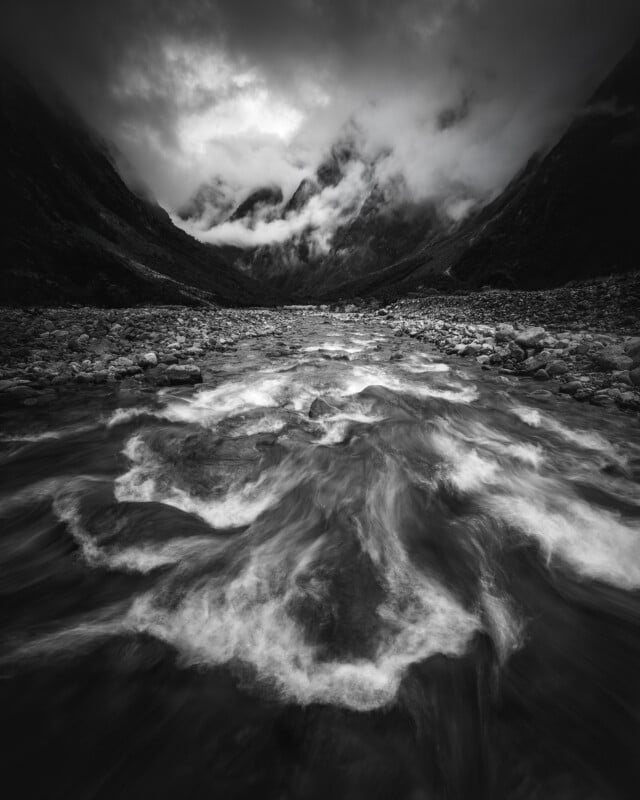
This image was made through a willingness to step outside his comfort zone and commit to the conditions in front of him, even when they required physically demanding work in the field. It involved wading into cold, fast-moving river water, carefully finding footing on slippery rocks, and staying in position long enough for the right alignment between weather, water, and composition to appear. Rather than rushing the process, the approach depended on staying present until the scene reached its strongest form.
“This was one of those images that really rewarded patience and persistence. I spent around two hours at this location in Fiordland, photographing different scenes while waiting for the weather and the landscape to come together. The mountain would periodically reveal itself through the clouds before disappearing again, and I kept working on different compositions while the conditions evolved.
For this particular image, I had to wade out into the river and carefully balance on slippery underwater rocks while the current pushed against both me and the tripod. I shot it with an ultra-wide 12-24mm lens and used a slightly long exposure to preserve some of the texture in the rushing water while still showing the movement.
Because the day was so moody and overcast, I felt the image worked much better in black and white. The high contrast really emphasizes the patterns and shapes in the water, and I love how the river’s triangular flow echoes the V-shape of the mountains above. It’s definitely one of my favorite images from the trip,” Shainblum says.
The final image emphasizes directional flow between water and mountain geometry, shaped by the same shifting conditions that governed its capture.

This frame emerged after an initial wide-angle approach failed to produce a workable composition, prompting a shift in focal length and a different way of reading the scene. Rather than trying to force the larger landscape into a fixed idea, the focus shifted toward smaller, more immediate patterns within the environment that had previously been overlooked.
“This image came from being willing to pivot creatively. I had been working with a wide-angle lens, trying to make a few larger scenes work, but nothing really felt right. Instead of forcing it, I switched to a telephoto lens and started paying attention to the smaller details around me.
I noticed these incredible swirls and patterns moving through the river and was immediately fascinated by their painterly quality. I zoomed in tightly and used a fast enough shutter speed to freeze the movement and preserve all of the intricate textures.
This photograph was completely spontaneous and serves as a reminder that some of the best images happen when you stop trying to force an idea and simply respond to what the landscape is offering. It ended up becoming one of my favorite abstract photographs from the trip,” Shainblum says.
What remains in the final image is a study of motion and structure drawn directly from the river itself, with abstraction emerging from natural flow rather than pre-visualized intent.

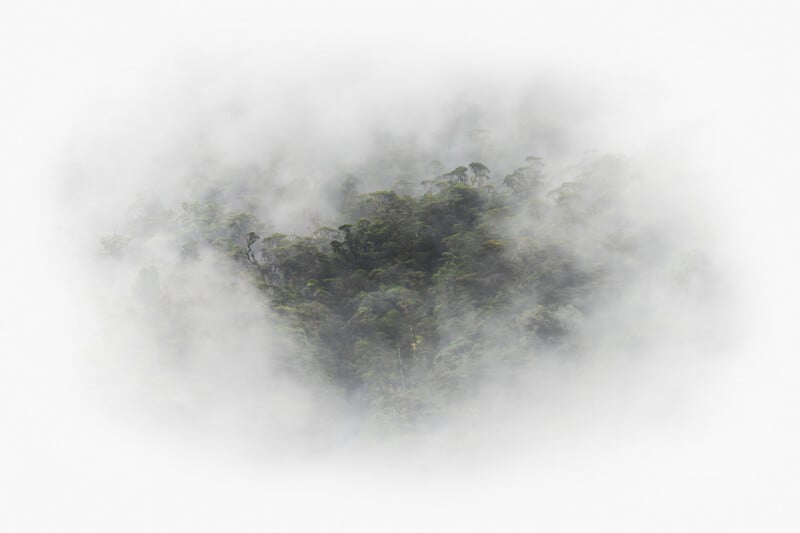
Captured during a boat sequence in Doubtful Sound, this image was shaped by constantly shifting fog and a moving point of view. Working from a drifting vessel meant the scene was never fully stable, with visibility changing every few seconds as atmospheric conditions passed through the valley. The composition developed gradually through observation rather than at a fixed moment, responding to the way the landscape revealed itself in stages.
“This was photographed from an overnight cruise in Doubtful Sound, a very remote and beautiful corner of Fiordland National Park. I was watching the fog spill across the forested mountainsides and was immediately drawn to the V-shape formed by the valley below.
As the boat drifted slowly, I kept photographing this section of the landscape while the fog shifted every few seconds. I experimented with different focal lengths and compositions, simply observing how the scene evolved. Eventually, the mist came together in a way that revealed what looked unmistakably like a skull shape hidden within the trees.
I love images like this because they transform familiar subjects into something unexpected. On one level, it’s simply fog and forest, but on another, it becomes something entirely different. Discovering those kinds of patterns and visual illusions is one of my favorite parts of photography,” Shainblum says.
The image highlights how perception shifts when atmospheric conditions are unstable, with form and meaning emerging only briefly before the landscape changes again.
Persistence Inside Uncertainty
Shainblum’s approach ultimately comes down to a willingness to stay with the landscape until it reaches the right moment, even when conditions are uncomfortable or physically demanding. In Fiordland, that often means standing for long periods in freezing rivers, working through rain, or waiting in cold wind while light and fog constantly shift around the frame.
“New Zealand really made me work for the shots that I was trying to get here,” Shainblum says.
Rather than moving on when conditions are difficult, he often stays put, watching for the brief alignment where weather, light, and composition finally come together. That commitment to remaining in place, even when the environment is harsh or uncooperative, is what allows many of the strongest images to happen.
The project reflects a simple but demanding reality of landscape photography in environments like Fiordland: the image is not just found, it is waited for, physically experienced, and sometimes endured until everything briefly aligns.

What’s Next
For Michael Shainblum, the focus is simply on continuing to explore. That includes returning to familiar locations with a new perspective, while also seeking out entirely new environments that challenge how he sees and works in the field. The goal is less about defined milestones and more about staying creatively in motion, following what feels visually compelling in the moment.
He has recently begun working with macro photography, offering a more intimate way to see smaller natural details that often go unnoticed in larger landscape work. Alongside that, several time-lapse projects are in development, expanding his interest in how landscapes shift over time rather than within a single frame.
Teaching also remains an important part of his practice. Through photography workshops, he continues to work directly with other photographers in the field, helping them develop both technical skills and creative confidence while photographing in real-world conditions. Upcoming workshops include locations in Utah during the fall color season, road trip-based experiences in Oregon, coastal workshops along the Oregon Coast, and a planned trip to South China, with additional dates and destinations being added regularly.
More information on his photography, workshops, and upcoming projects can be found on his site, where updates and new announcements are shared through his newsletter.
Image credits: Photographs by Michael Shainblum