
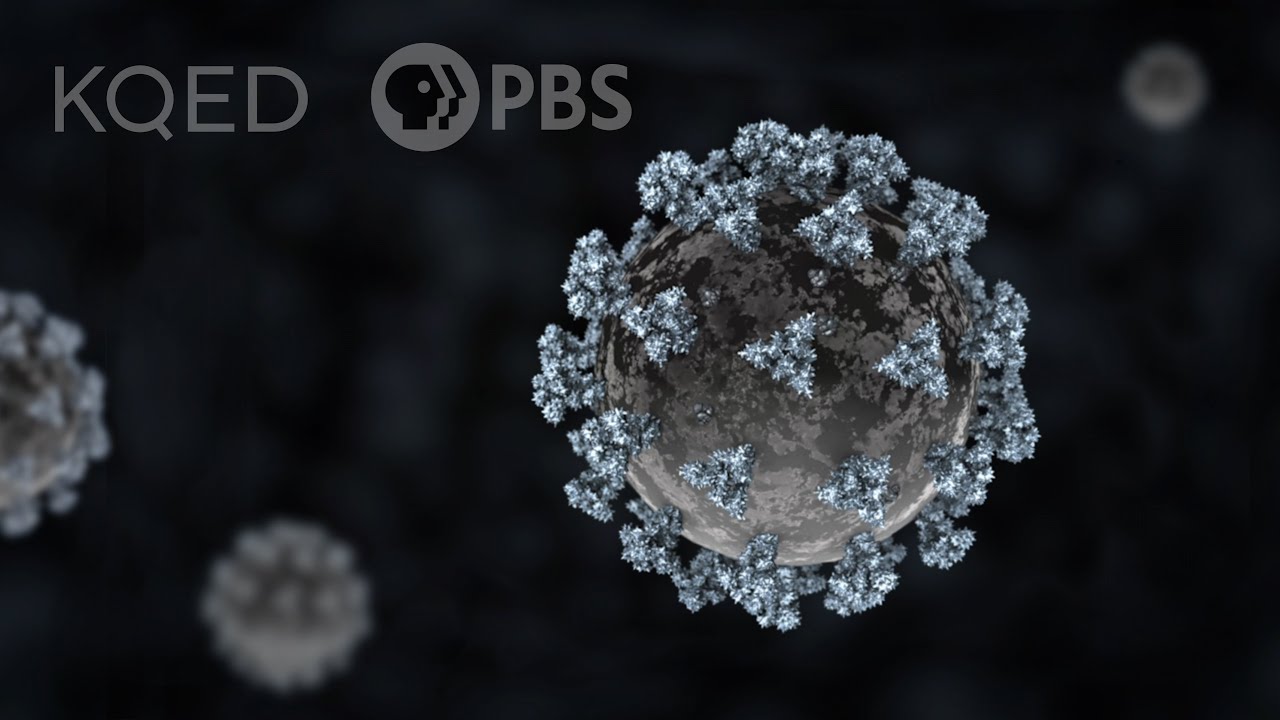
The new coronavirus packs a devastating punch. It penetrates deep into your lungs, causing our immune cells to go haywire and damage tiny air sacs – the alveoli – where oxygen normally flows into our blood.
More COVID-19 Reporting and resources from KQED Science: https://www.kqed.org/science/1963200/how-covid-19-attacks-your-lungs
Educators: Engage your students in an NGSS-aligned discussion about this video on KQED Learn: https://learn.kqed.org/discussions/68. KQED Learn is a safe online platform for middle and high school students to practice academic discourse.
Please support us on Patreon! https://www.patreon.com/deeplook
DEEP LOOK is a ultra-HD (4K) short video series created by KQED San Francisco and presented by PBS Digital Studios. See the unseen at the very edge of our visible world. Explore big scientific mysteries by going incredibly small.
—
The coronavirus has had an enormous impact on our lives: how we work, communicate and congregate. At this point, we’re familiar with how to protect ourselves from the virus – and the disease it causes, COVID-19 – by washing our hands thoroughly, wearing masks and social distancing.
Most people who get the virus are mildly sick and will recover at home. For others, the virus can be severe, even fatal.
One significant way the virus attacks is deep in our lungs.
—+ Read the entire article on KQED Science:
https://www.kqed.org/science/1963200/how-covid-19-attacks-your-lungs
— What are the symptoms of the new coronavirus?
The Center for Disease Control advises on its website that “symptoms may appear 2-14 days after exposure to the virus. People with these symptoms or combinations of symptoms may have COVID-19: Cough, shortness of breath or difficulty breathing. Or at least two of these symptoms: fever; chills; Repeated shaking with chills; muscle pain; headache; sore throat; new loss of taste or smell.”
— How can I protect myself from the coronavirus?
The Center for Disease Control has a comprehensive list of guidelines at cdc.gov, but the main tips to remember are: wash your hands often; avoid close contact with other people; cover your mouth and nose with a cloth face cover (like a mask or bandanna) when around others; cover coughs and sneezes with a tissue or your elbow; regularly clean and disinfect frequently touched surfaces in your home.
— If you’ve had the new coronavirus, are you now immune?
The Center for Disease Control states on its website: “We do not know yet if having antibodies to SARS-CoV-2 can protect someone from getting infected with that virus again, or how long that protection might last. Scientists are doing studies to answer those questions.”
—+ For more information:
KQED
https://www.kqed.org/coronavirusliveupdates
World Health Organization
https://www.who.int/
Center for Disease Control
https://www.cdc.gov/coronavirus/2019-nCoV/index.html
—+ More Great Deep Look episodes:
Decompress with Deep Look https://www.youtube.com/playlist?list=PLdKlciEDdCQBNcPi8j3XEXuTOKW8CgRgD
—+ Thank you to our Top Patreon Supporters ($10+ per month)!
Alex
Alexandre Valdetaro
Aurora
Aurora Mitchell
Bethany
Bill Cass
Blanca Vides
Burt Humburg
Caitlin McDonough
Carlos Carrasco
Chris B Emrick
Chris Murphy
Cindy McGill
Companion Cube
Daisuke Goto
dane rosseter
Daniel Weinstein
David Deshpande
Dean Skoglund
Egg-Roll
Elizabeth Ann Ditz
Geidi Rodriguez
Gerardo Alfaro
Guillaume Morin
Joao Ascensao
Josh Kuroda
Joshua Murallon Robertson
Justin Bull
Kallie Moore
Karen Reynolds
Kristy Freeman
KW
Laura Sanborn
Laurel Przybylski
Leonhardt Wille
Levi Cai
Louis O’Neill
luna
Mary Truland
monoirre
Nathan Wright
Nicolette Ray
Noreen Herrington
Pamela Parker
Richard Shalumov
Rick Wong
Robert Amling
Robert Warner
Roberta K Wright
Sarah Khalida Mohamad
Sayantan Dasgupta
Sharon Merritt
Shebastian Reyes
Shelley Pearson Cranshaw
Silvan Wendland
Sonia Tanlimco
Steven
SueEllen McCann
Supernovabetty
Syniurge
Tea Torvinen
TierZoo
Titania Juang
WhatzGames
—+ Follow KQED Science and Deep Look:
Patreon: https://www.patreon.com/deeplook
Instagram: https://www.instagram.com/kqedscience/
Twitter: https://www.twitter.com/kqedscience
KQED Science on kqed.org: http://www.kqed.org/science
Facebook Watch: https://www.facebook.com/DeepLookPBS/
—+ About KQED
KQED, an NPR and PBS affiliate in San Francisco, CA, serves Northern California and beyond with a public-supported alternative to commercial TV, Radio and web media.
Funding for Deep Look is provided in part by PBS Digital Studios. Deep Look is a project of KQED Science, the largest science and environment reporting unit in California. KQED Science is supported by The National Science Foundation, the Dirk and Charlene Kabcenell Foundation, the Vadasz Family Foundation, the Gordon and Betty Moore Foundation, Campaign 21 and the members of KQED.
#covid19 #coronavirus #deeplook
Hi, It’s Laura. We know this is a hard time.
Deep Look’s here for you. We have tons of resources about this pandemic to share. More
after the episode. Viruses have lived on Earth for billions of
years, mutating and adapting. They’ve been around longer than animals, longer than plants. They’re neither dead nor alive. They’re
active inside a living thing, powerless out in the open, but rise again in another host. Their goal is simple: to persist. They infect
our cells, then replicate and spread. Smallpox. AIDS. Polio. These are just some
of the diseases caused by viruses that have ravaged humankind. Now we’re facing a new disease: COVID-19,
caused by the coronavirus. Our bodies and communities are struggling to fight back. An individual virus particle, or virion, is
invisible to our naked eye. It takes roughly a thousand coronavirus particles to span the
width of a human hair. It travels lightly: A virus is just genetic
material wrapped in a layer of protein and fat … spreading through the air in moisture
droplets … or on surfaces … finding its way into our eyes, noses and
mouths. Inside, the coronavirus hijacks the cells
in the back of our nose, replicating and spreading downward – infecting healthy cells along
the way. Some viruses, like ones that cause the common
cold, infect our nose and throat. Others can cause viral pneumonia – that usually infects
smaller areas of just one lung. The coronavirus packs a vicious double punch:
it can infect the entire respiratory system … all the way down to millions of tiny air
sacs called alveoli. Here is a single, healthy alveolus. Right
next to it, there’s a thin blood vessel: a capillary. This is where one of our most life-sustaining
exchanges happens: the alveolus brings oxygen into the bloodstream and excretes carbon dioxide. But the virus disrupts this whole process.
This immune cell, a macrophage, attacks it. Sometimes it defeats the virus. If our body needs more help, it recruits more
immune cells – like these neutrophils. While they’re attacking the virus, they
can end up injuring the alveolus, too … breaking down its walls. Fluid rushes from the blood vessels into the
alveolus … filling it up and blocking the exchange of oxygen. Now it’s much harder to breathe. It’s ultimately this two-pronged attack that
makes the coronavirus so deadly: the attack from the virus, and our immune system’s
explosive response. All this can lead to acute respiratory distress
syndrome – what most people with COVID-19 die from. Viruses don’t benefit from wiping out their
hosts. They rely on us, so they can exist. To ultimately beat this coronavirus, we’ll
need an antiviral medication or immunity through a vaccine. The impact from this pandemic has been devastating.
But we can learn from it, so we can stay a step ahead of the next one … because there
are almost certainly more to come. You Bay Area locals may know this already,
but Deep Look is part of KQED’s science team in Northern California. When I’m
not hosting this show, I’m a health and science reporter. We’ve created a page with
our latest coronavirus resources – and a more in-depth look into this episode. Also, If you have COVID-19 questions for us,
leave them in the comments below. We’ll try to answer them in an upcoming Q & A. Thanks,
and stay safe out there.