



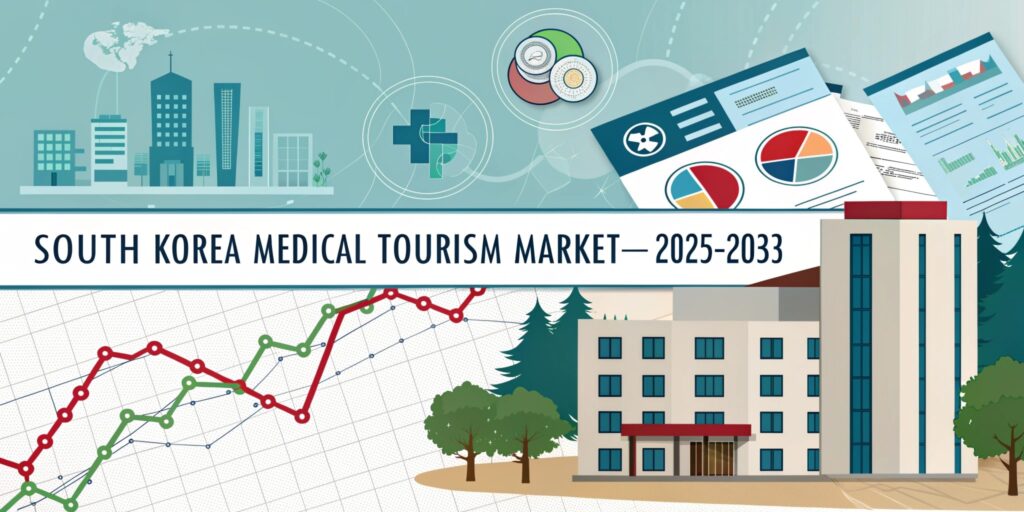
What does it take for a country to double its foreign patient intake within a single reporting cycle? In South Korea’s case, the answer lies in a precise combination of world-class clinical infrastructure, government-backed promotional machinery, and The South Korea medical tourism market size reached USD 2.0 Billion in 2024. Looking forward, IMARC Group expects the market to reach USD 3.1 Billion by 2033, exhibiting a growth rate (CAGR) of 4.93% during 2025-2033, is no longer riding a post-pandemic rebound. It is executing a deliberate, policy-driven ascent that has placed it firmly at the top of Asia’s medical travel hierarchy.
A Market Defined by Record-Breaking Patient Volumes
The numbers reshaping the south korea medical tourism market are difficult to overstate.
Foreign patient arrivals crossed 1.17 million in one reporting period, the first time the country surpassed the one-million threshold since launching its international patient initiative
That figure nearly doubled again to 2.01 million in the most recent period, with visitors arriving from 201 countries
The Korea Institute for Industrial Economics and Trade estimated total spending by foreign patients and accompanying companions at 12.5 trillion won (approximately USD 8.4 billion), of which only 3.3 trillion won went toward actual treatment costs
The cumulative count of foreign patients over sixteen years now stands at 5.05 million, a figure that reflects compounding trust rather than a single spike
These are not statistical anomalies. They reflect a structural shift in where global patients choose to seek care and why.
Government Schemes Driving Strategic Growth
South Korea’s public sector has been the backbone of the south korea medical tourism market’s expansion, treating it as a high-value export industry rather than a secondary outcome of a strong healthcare system.
The Ministry of Health and Welfare introduced mandatory registration of all medical institutions serving foreign patients alongside compulsory medical malpractice liability insurance requirements. This dual mandate raised both the quality floor and the accountability ceiling for the entire sector, building the kind of international credibility that no marketing budget can manufacture.
The government’s Strategy to Facilitate Attraction of International Patients, announced in May, set an original target of 700,000 foreign patients by a future benchmark year. That target was achieved well ahead of schedule, with actual arrivals surpassing it by a factor of more than 1.6 in the most recent measurement period. Following this overachievement, the government formally designated medical tourism as a strategic national industry and established dedicated support centres at Incheon International Airport and Seoul Tourism Plaza to assist arriving patients in their native languages.
Six Medical-Wellness Tourism Convergence Clusters have been designated across the country to distribute economic benefits beyond the capital, while enhanced visa facilitation programs have lowered entry barriers for patients from key source markets. The Korea Health Industry Development Institute (KHIDI) actively supports Korean medical institutions in serving foreign patients and promoting the export of Korean medical techniques and services internationally.
Evaluate Market Potential Before You Invest – Get the Report Sample
What Patients Are Coming For: A Treatment Segmentation Overview
The south korea medical tourism market is structured across two primary dimensions, each with measurable demand patterns.
By Type:
Inbound travel is the dominant category and the primary growth engine, driven by international patients arriving for treatment ranging from single-session dermatology consultations to complex multi-week surgical recoveries
Intrabound travel represents domestic medical movement within Korea, reflecting regional disparities in specialty availability
Outbound travel captures Korean nationals seeking care abroad, a smaller and more niche segment within the overall structure
By Treatment Type:
Cosmetic Treatment leads all categories, accounting for 11.2 percent of visits, powered by the global reach of K-beauty and the international standing of Korean plastic surgeons
Dermatology commands the single largest share at 62.9 percent of all foreign patient visits, with over 705,000 international patients seeking dermatological care in one reporting period
Dental Treatment, Cardiovascular Treatment, Orthopaedic Treatment, Bariatric Surgery, Fertility Treatment, and Ophthalmic Treatment each serve distinct international patient cohorts, particularly from markets where these procedures face long wait times or prohibitive pricing
The integration of Traditional Korean Medicine with modern clinical practice is emerging as a distinctive hybrid segment, recording an 84.6 percent increase in foreign patient visits year-on-year and signalling significant untapped potential
Seoul’s Dominance and the Push Toward National Distribution
Seoul’s grip on the south korea medical tourism market is formidable by every available metric.
Approximately 87.2 percent of all foreign patients receive treatment in Seoul, which hosts 62.5 percent of all medical establishments registered to treat international visitors
Within Seoul, five districts account for the overwhelming majority of activity: Gangnam leads with 377,073 visits, followed by Seocho with 288,475, Mapo with 124,447, Jung with 122,222, and Songpa rounding out the top five
International medical tourists spent a total of 1.2 trillion won on treatment in Seoul alone using foreign-issued credit cards, accounting for 85.7 percent of nationwide medical spending by foreign patients
The government’s cluster-based expansion strategy is actively working to redistribute some of this activity toward provincial centres, particularly for wellness, rehabilitation, and traditional medicine experiences where geography is an asset rather than a constraint.
The Competitive Landscape: Institutions Anchoring Global Reputation
The institutional network underpinning the south korea medical tourism market includes both large academic medical centres and highly specialised private clinics. Key players shaping the competitive landscape include Ajou University Medical Center, Banobagi Plastic Surgery, CHA Fertility Center, Injeuniversity Haeundae Hospital, JK Plastic Surgery Center, Keimyung University Dongsan Hospital, Korea Medical Hub, Nasaret International Hospital, Sun Medical Center, and Wonkwang University Hospital.
These institutions have increasingly moved beyond clinical service delivery to offer comprehensive medical tourism packages that bundle treatment with accommodation, airport transfers, interpreter services, and post-care follow-up, removing friction that once deterred international patients from choosing Korea over geographically closer alternatives.
Key Forces Shaping Market Momentum
Several reinforcing dynamics are accelerating the industry’s expansion:
Price competitiveness at quality parity: The average medical tourism patient spends approximately 6.41 million won (USD 4,600) per visit in Korea, a fraction of equivalent costs in Western markets, while accessing care from clinicians trained at internationally benchmarked institutions
Minimal waiting periods: Korean hospitals routinely schedule treatments within days or weeks of initial consultation, a decisive advantage over public health systems where elective procedures may involve months-long queues
K-culture amplification: The global popularity of K-pop, K-drama, and K-beauty shortens the decision cycle for international patients, particularly for cosmetic and dermatological procedures, by creating pre-existing trust in Korean expertise
Elective procedure expansion: Treatments outside standard insurance coverage, including fertility therapies, gender reassignment procedures, and dental reconstruction, are driving a category of motivated, financially prepared traveller
Strategic Outlook for Stakeholders
The south korea medical tourism market is undergoing rapid transformation and scale-up that rewards early positioning. The convergence of wellness and traditional medicine with high-technology clinical care is expected to attract a new category of health traveller seeking integrated health optimisation rather than a single procedure. This evolution expands revenue per patient visit and builds the repeat relationships that sustain long-term market leadership.
For businesses, investors, and healthcare institutions seeking to understand the full depth of segmentation data, regional dynamics, competitive positioning, and forward market projections, a comprehensive analysis of this sector provides the strategic foundation needed to make well-informed decisions in one of Asia’s fastest-scaling healthcare markets.