






TAMPA, Fla. (May 5 2026) — With input costs continuing to pressure farm budgets, some growers are making difficult decisions to reduce fertilizer application rates. While that strategy may ease upfront expenses, it is also accelerating a broader shift across agriculture that is placing greater importance on nutrient use efficiency and return on fertilizer investment (ROFI) to help growers get more value from every pound of fertilizer applied.
“Maximizing return on fertilizer investment is about making the decisions that, at the end of the day, put more dollars in your pocket,” said Chad Becker, field agronomist with Mosaic Biosciences. “Nutrients are one of the most important inputs for crop success. When we start looking at nutrient management as a strategy instead of just a necessary commodity, we can make more informed decisions.”
The ROFI strategy centers on nutrient use efficiency, ensuring that applied nutrients are available, taken up by the plant and fully utilized throughout the growing season. When any part of that chain breaks down, growers risk losing value.
“Nutrients can be lost from the soil in a variety of ways,” said Cameron Blackford, agronomist with Mosaic Biosciences. “They can be physically carried off the field through soil erosion or runoff from heavy rains, pushed down deeper into the soil profile below the root zone, or even be turned into a gas and leave the soil and go into the atmosphere. When that happens, you’re not just losing nutrients, you’re losing return.”
The implications are magnified when fertilizer rates are reduced. With less applied upfront, there is less margin for inefficiency and a greater risk that yield potential could suffer if nutrients are not fully utilized.
“When we look at crop nutrition on a per-acre basis, it’s not just about total pounds applied,” said Keith Byerly, commercial sustainability lead at The Mosaic Company. “It’s about the net gain from that investment and understanding how to ensure that those nutrients translate into yield and profitability.”
Increasingly, that conversation is turning toward tools and practices that enhance nutrient availability and uptake. Among them are biological technologies designed to improve how nutrients move through the soil and into the plant.
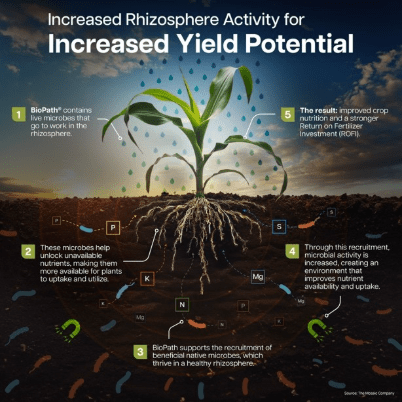
“Products like BioPath® and PowerCoat® from Mosaic Biosciences utilize plant growth-promoting rhizobacteria that colonize the root system,” said Tim Robie, regional sales manager with Mosaic Biosciences. “They start releasing acids and enzymes that help free up nutrients that are otherwise tied up in the soil and make them available to the crop for uptake.”
Beyond direct nutrient release, improved root development plays a critical role in overall efficiency.
“If you can grow a more robust root system, you directly influence the plant’s ability to take up nutrients from the soil and influence yield potential,” Robie added.
Field data supports that impact. Bio crop nutrition products such as BioPath and Powercoat have demonstrated measurable increases in total nutrient uptake—approximately +15.8 pounds per acre and +24.8 pounds per acre, respectively, across multiple nutrients.
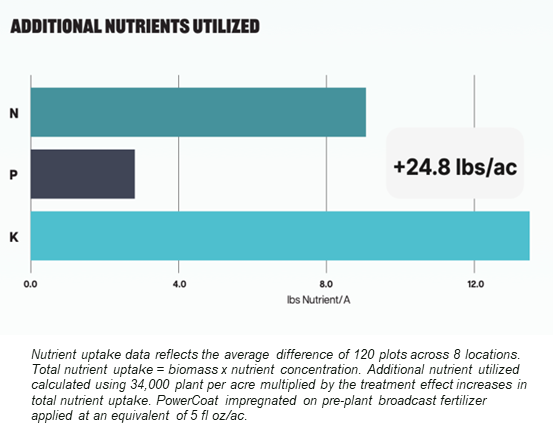 PowerCoat has demonstrated incresaes in total nutrient uptake of 24.8 pounds per acre.
From an economic standpoint, those gains can be significant. In many cases, the increased nitrogen uptake alone can offset the cost of application, while additional phosphorus and potassium uptake provide incremental return.
“Every dollar you invest in inputs should be working as hard as your equipment and your team,” Becker said. “When you improve nutrient uptake and utilization, you’re not just applying fertilizer, you’re amplifying its return.”
In a reduced-rate environment, success depends less on how much fertilizer is applied and more on how effectively it performs. That means evaluating crop nutrition programs through a lens that emphasizes efficiency, timing and overall system performance.
“Even modest improvements—$10 or $20 per acre—can have a major impact when scaled across an operation,” Byerly said. “That’s the power of focusing on return instead of just cost.”
As growers continue to navigate volatile input markets, ROFI will be an increasingly important factor in crop nutrition decisions. The goal is not simply to reduce inputs, but to ensure that every pound applied contributes as much as possible to yield and profitability.
To learn more, contact your local Mosaic Biosciences representative or visit cropnutrition.com.