


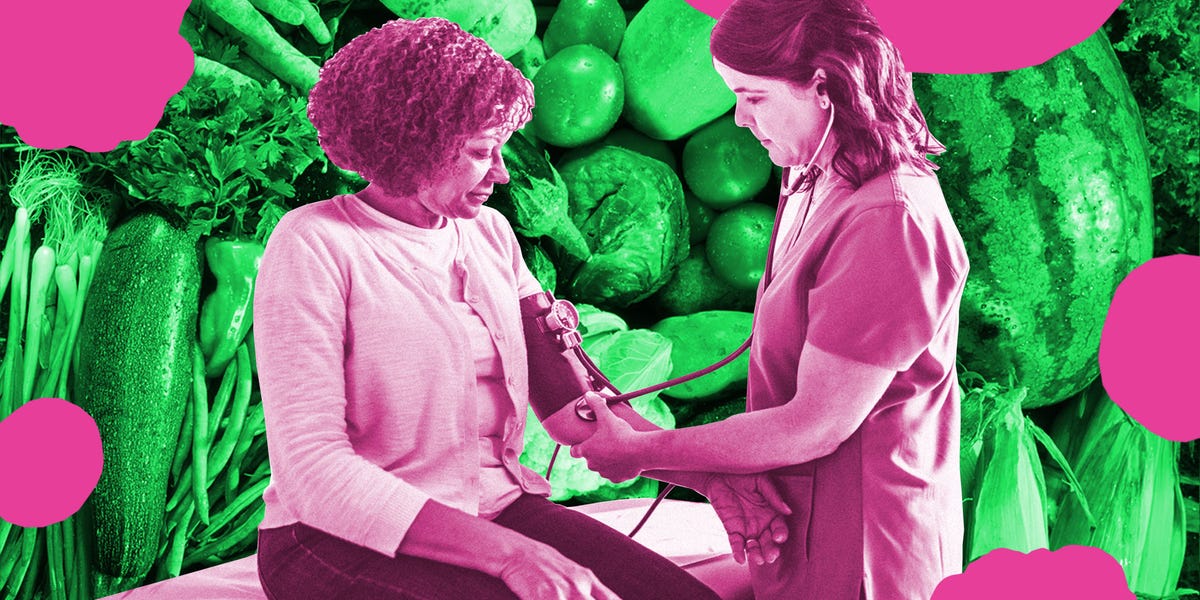
There’s a good reason your doctor checks your blood pressure at every annual physical: It’s one of the most important signs of cardiovascular health. High blood pressure, a.k.a. hypertension, can damage your blood vessels if left unchecked and raise your risk of heart disease, heart attack, and stroke. And the condition affects almost half of all U.S. adults: 119.9 million of us, to be exact.
Everyone can benefit from keeping their blood pressure levels in the healthy range—but it’s especially important for those of us in midlife. Menopause itself increases the risk of hypertension thanks to the loss of heart-protecting estrogen, along with a woman’s risk of stroke, heart disease, and kidney disease, says Jessica Villalvir, RDN.
There are lots of things people can do every day to support healthy blood pressure levels, which are defined as less than 120/80 mm Hg. Engaging in regular exercise, managing stress, and maintaining a healthy weight are the main ones. But what you eat makes a difference, too—which is where the DASH Diet comes into play.
Never heard of it? Think of it as a cardiologist’s take on the Mediterranean Diet, specifically designed with blood pressure in mind. Here’s everything you need to know.
What Is the DASH Diet?
The DASH Diet—which stands for “Dietary Approaches to Stop Hypertension”—focuses heavily on whole food ingredients and fruits and vegetables and limits specific nutrients linked to higher blood pressure, like sodium, added sugar, and saturated fat.
Like slip dresses and cigarette jeans, the DASH Diet has been around since the ’90s. While experts already knew that sodium, alcohol, and weight could affect blood pressure, “they wanted to understand if diet could play a role in lowering it,” says Villalvir. She says over 160 health and nutrition professionals were involved in developing and testing the DASH Diet; the first clinical trial results were published in The New England Journal of Medicine in 1997.
In the trial, 459 adults were first fed a control diet that mimicked the nutrition profile of an American diet for three weeks. Then participants were randomly assigned to either the control diet, a diet rich in fruit and veggies, or a “combination” diet, which had lots of fruits, vegetables, and low-fat dairy. After eight weeks, the study authors found that the “combination” diet (what became known as the DASH Diet) led to greater improvements in blood pressure than either the control diet or the fruits and vegetables diet. It was particularly effective among participants who had high blood pressure.
“Other research has shown that DASH is associated with a multitude of other health benefits, including lowering low-density lipoprotein cholesterol, supporting weight loss, and improving other heart health and inflammatory biomarkers,” says Elizabeth Widen, PhD, RD, a registered dietitian and an associate professor of nutritional sciences at the University of Texas at Austin. Other evidence suggests that the diet might be uniquely supportive for menopausal women, she adds. “DASH’s focus on low-fat dairy along with high fiber, protein, and fruits and vegetables would likely be very beneficial when body weight tends to increase and bone density decreases rapidly.”
What It Means to DASH
Unlike the Mediterranean Diet, which lacks specific nutrient or calorie goals, the DASH Diet comes with some significant restrictions. Cutting back on sodium is the central focus, since it plays a primary role in blood pressure. The official recommendation is no more than 2,300 milligrams of sodium per day, although experts like Villalvir say aiming for a daily max of 1,500 mg is even better.
As you can imagine, the sodium restrictions are tough—especially since our food supply is packed with it, Widen says. You’ll need to eat mostly whole foods on this diet, and swap in low-salt or no-salt-added pantry staples and other packaged goods. It also pays to get familiar with nutrition labels (paying attention to portion size!) to suss out secretly high-sodium foods like condiments, dressings, breads, desserts, and canned products.
There’s typically a saturated fat limit with this diet, too—about 6 percent of daily calories, or around 13 grams per day for someone on a 2,000-calorie diet—to support healthy cholesterol levels. It’s also a good idea to cut your added sugar intake to no more than 25 grams per day, Villalvir adds. “You’d be surprised how even the smaller amounts in food and drink can add up,” she says.
So what will you be eating more of? Fiber. DASH calls for 30 grams or more of the nutrient per day to further encourage cholesterol and blood pressure regulation.
Here’s a breakdown of approved DASH Diet foods:
● Protein: Lean options like skinless chicken or turkey, fish (including fatty varieties like salmon, sardines, and tuna), shellfish, legumes (peas, beans, lentils), eggs (with moderate yolk consumption), low-fat dairy, nuts, and seeds
● Healthy Fats: Olive oil, olives, avocado oil, avocados, canola oil, low-fat dairy, nuts, and seeds
● Fruits and Vegetables: Four to five servings each of whole fruits and vegetables of all kinds (aim for variety!) every day.
● Carbohydrates: Whole grains and seeds like quinoa, brown rice, buckwheat, sorghum, oats, barley, millet, and whole wheat bread, flour, and pasta; sweet potatoes, squash, skin-on white potatoes
Who Should Try It?
The DASH Diet has been recommended for nearly 30 years because it has been proven time and time again to effectively reduce blood pressure and heart health–related inflammatory markers in the body. Both Villalvir and Widen assert that it’s a fantastic option for peri- and post-menopausal women who want to preserve heart health and address hypertension.
But again, it’s restrictive—especially compared to other heart-healthy eating strategies, like the Mediterranean Diet. (Expect to cook a lot more at home, and enjoy less takeout or frozen pizza.) The structure may be alluring if you’re the kind of person who likes having specific guidelines or numbers to track.
If you feel called to try the DASH Diet—or your doctor or dietitian advises you to follow it—know the first few weeks of cutting down your salt intake will be tough. But it gets better! This is because the taste buds regenerate pretty regularly, so the high-salt foods you once loved may soon start to taste far too salty. (In the meantime, add flavor from fresh herbs, spices, and no-salt seasoning blends.)
In short: Don’t get salty about that blood pressure reading. You can eat your way out of hypertension—and enjoy some other health benefits along the way.

Christina Manian, RDN, MENV, is a writer, registered dietitian, and sustainable nutrition expert with more than 10 years of experience. Through her published work in reputable outlets like Oprah Daily, Health, Real Simple, Better Homes and Gardens, The Skimm, Nutrition Business Journal, and Simply Recipes, she aims to educate, inform, and inspire positive action. With a Master’s degree in environmental studies focused on sustainable food systems, she approaches much of her work through the lens of sustainability. Based in Boulder County, Colorado, she loves spending time outdoors with her horse and standard poodle.