142
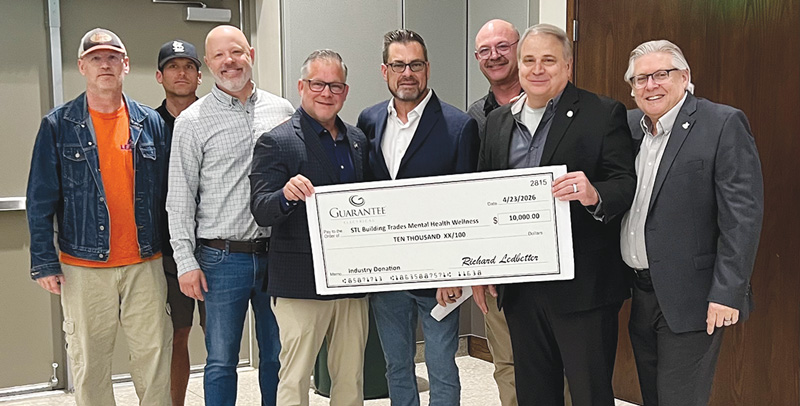
 GUARANTEE ELECTRICAL, which recently suffered a tragedy in its workforce, has donated $10,000 to the STL. Building Trades Wellness Coalition to address mental health, suicide prevention and addiction in the construction industry. Pictured at the check presentation are (from left) James Pursell and Aaron Walsh, peer support specialists with the Laborers Escaping Addiction Now (LEAN-STL) program; Todd Cook, Guarantee’s vice president of Risk & Safety; David Scott, Elevator Constructors Local 3 business representative and executive director of the Wellness Coalition; Guarantee CEO Rich Ledbetter; Guarantee Safety Manager and IBEW Local 1 electrician Dave Ballew; Guarantee Chief Construction Officer David Gralike; and Dr. John Gaal, director of the Missouri AFL-CIO’s Missouri Works Initiative’s Worker Wellness Program. – Labor Tribune photo
By TIM ROWDEN
Editor-in-Chief
St. Louis – Guarantee Electrical, the St. Louis-based electrical contractor and IBEW Local 1 signatory, has donated $10,000 to the STL Building Trades Wellness Coalition’s efforts to address mental health, suicide prevention and addiction in the construction industry.
Speaking at the Wellness Coalition’s recent meeting on recovery friendly workplaces, Guarantee CEO Rich Ledbetter called the donation “a drop in the bucket” toward what is needed. “We’ve got to get to $100,000 and a million next year. That’s what this effort needs to look like.”
A 2022 study from the Center for Construction Research and Training showed 17,100 construction workers died from opioid overdoses and 5,200 died by suicide compared to 991 who died because of a work-related injury.
Guarantee suffered its own recent tragedy among its workforce earlier this year.
“At Guarantee, I think we spend $3 million a year on very specific safety efforts and investments,” Ledbetter said. “We’ve done such a great job with limiting the risks on job sites. But 5,000 humans in our industry died by suicide in that same time frame and 17,000 died by overdose. How does that statistic not scream at each of us to show up and do whatever we can do, whether it’s speaking or a check for 10 grand, or devoting resources to well-being?
“I think the hopeful silver lining in all this is this is what do we do in this industry! We solve problems every day. Our entire being is about solving problems. And I think that is the most intense problem that any of us will solve or make progress on in our careers. Nothing is more important.”
TREATING SAFETY AND MENTAL HEALTH AS ONE
David Scott, Elevator Constructors Local 3 business representative and executive director of the Wellness Coalition, said the goal is to treat safety and mental health as one.
“I think one of the big goals of this coalition is to take safety from being on the left side, mental health from being on the right side and have them being one,” Scott said. “As we move forward with these conversations that we have with other people around the city, around the state, around the country, it’s that narrative that we have to keep moving forward that mental health, addiction and suicide crisis are part of safety. It’s not just physical safety, and it’s that conversations we need to make sure we’re having. I think one of the leaders in St. Louis in doing this is Guarantee Electrical.”
 RECOVERY-FRIENDLY WORKPLACES
St. Louis University (SLU), the Building Trades Wellness Coalition, the Occupational Safey and Health Administration (OSHA) and Aetna will host a program on recovery-friendly workplaces, the latest installment of SLU’s Building Resilience series May 19 at SLU’s Wool Center with Dr. Doug Swanson, field representative in Labor and workforce development with the University of Missouri Extension’s Labor and Workforce Development Program, and Andy Bowman of the Aviary Recovery Center. Scan the QR Code to register.