




This year’s Met Gala found its home in a liminal space. In between the social media dilution and distinct lack of personality that plagued some of the night’s safer looks, there was a kaleidoscope of archetypal womanhood to be discovered. Reverence in fashion is never too far from a free-fall into expensive cosplay or haute-Pinterest symbolism, but when it works, it’s interstellar. No pun intended.

Under the theme Fashion is Art, the most intriguing attendees embodied wonderful expressions of the emotional languages of femininity. Saints, marble goddesses, anxious girls, ornamental muses. The strongest looks were compelling because they existed outside of the names wearing them.
Here are the five looks New Wave can’t get enough of.
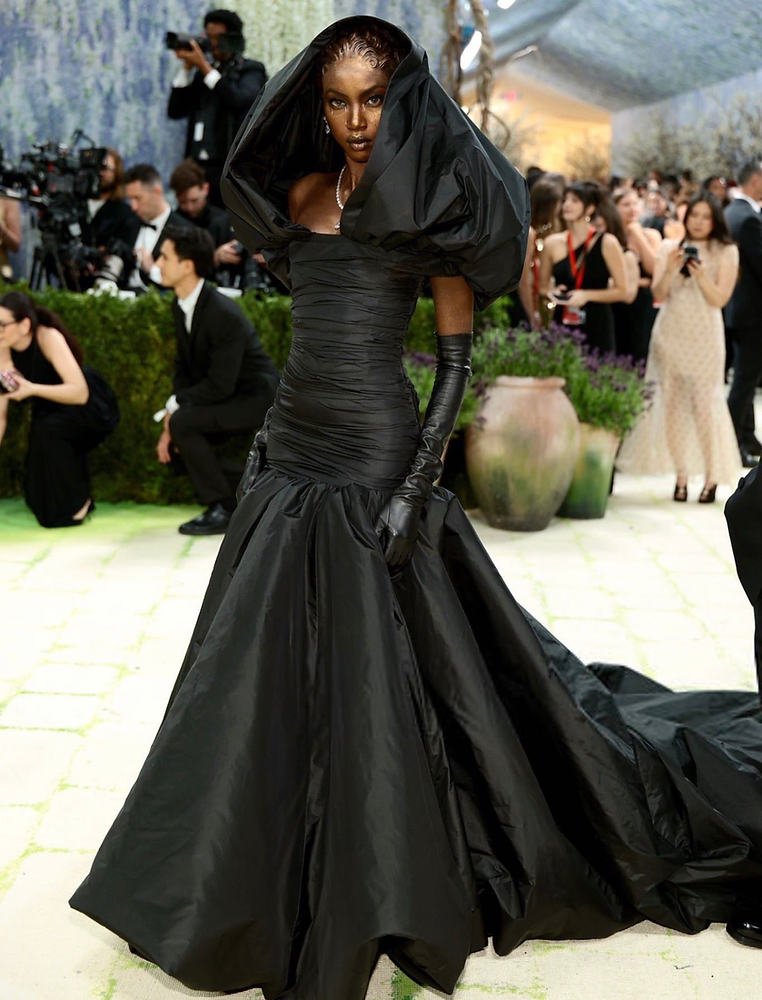
Anok Yai in Balenciaga by Pierpaolo Piccioli
Inspired by the Black Madonna

Anok Yai is the people’s princess.
She is no stranger to the dopamine-producing visual language of what she herself describes as “sexy.” Here, she moves beyond sensuality into the realm of iconography.

Pierpaolo Piccioli, Anok Yai.
Working with Balenciaga’s Pierpaolo Piccioli, Yai transformed herself into a Black Madonna, invoking religious statuary and weeping Sicilian icons. Makeup artist Malina Stearns traced gold tears across her face, and sculpted hair by Sasha Glasser blunted her softness. The styling felt ecclesiastical.
Across Europe, dark-skinned depictions of the Virgin Mary have symbolised protection, grief, long-suffering, divine motherhood, mystery.
Yai resisted the temptation to beautify the reference into nothingness.
“I don’t want to look like a human being. I want to look like a walking statue.”

Hair by Sasha Glasser. Makeup by Malina Stearns.
The result was utterly devotional.
Jisoo in Dior by Jonathon Anderson

Jisoo’s look was an ode to composure.
Her custom Christian Dior gown, alive in shimmering pinks, silver and delicate floral appliqué, loosely recalled Claude Monet’s romanticism. From a distance, the dress blurs into an impressionistic haze; looking closer, its dense embellishment revealed itself.

Her Dior Beauty look was equally restrained, echoing the stillness of late nineteenth-century portraiture by artists like John Singer Sargent.
This is a version of femininity a lot of women know intimately – the performance of serenity and the labour involved in appearing effortless.
Kendall Jenner in GapStudio by Zac Posen
Inspired by the Winged Victory of Samothrace

Kendall Jenner. Met Gala 2026.
Kendall Jenner’s reference to the Winged Victory of Samothrace introduced femininity as distance.
Winged Victory of Samothrace, circa 190 BC Heritage Images/Getty Images
The original sculpture survives without arms or even a head, yet still communicates a sense of triumph. It remains one of the most enduring representations of feminine power in Western art precisely because it feels unreachable.
Posen’s draped fabrics echoed the movement of classical sculpture, while Jenner’s muted beauty, created in partnership with L’Oréal Paris and somewhat unfairly critiqued, kept the look cool and impersonal.

Kendall Jenner for L’Oréal Paris.
Women are often expected to be desirable, but not entirely knowable. They can be admired while remaining emotionally inaccessible enough to preserve projected fantasy.
The Winged Victory captures this paradox beautifully. She is compelling because she resists closeness.
Emma Chamberlain in Mugler by Miguel Castro Freitas
Inspired by Edvard Munch’s The Scream and Vincent van Gogh’s Wheatfield with Crows

Emma Chamberlain, Met Gala 2026.
Emma Chamberlain’s look felt the most emotionally contemporary and, interestingly, deeply in conversation with the trajectory of her career.
Drawing on Edvard Munch’s The Scream and Vincent van Gogh’s Wheatfield with Crows, her hand painted custom Mugler look turned anxiety into something unexpectedly romantic.

Makeup artist Lilly Keys amplified Chamberlain’s signature shadowed beauty, with sharp textures and an unsettling silhouette transmuting Munch’s emotional overwhelm into magnetism.
Historically, women in art were expected to appear serene regardless of suffering. Modern femininity’s ask is slightly more dystopian: remain beautiful despite private, and sometimes very public, disintegration.
Emma captured that instability with timely accuracy.
SZA in Custom Bode by Emily Adams Bode
Inspired by Alphonse Mucha and Art Nouveau

Last but not least, SZA offered a final vision of femininity as abundance.

Styling by Emily Adams Bode and Briana Andalore.
In custom Bode, she appeared as though she had stepped out of an Alphonse Mucha illustration.
Flowing hair, floral ornamentation, honeyed tones courtesy of makeup artist Sophia Sinot, and romantic excess combined to create a living Art Nouveau poster.
In Mucha’s work, women dissipate into vines, flowers and halos, beauty becomes the environment.

This visual language has often flattened women, but SZA’s interpretation brought humour and warmth to the fantasy.
Her femininity did not feel decorative. It felt expansive and entirely self-possessed.

It’s proof that despite how often hyper-femininity is dismissed as intellectually unserious, there is power in adornment.
2026’s Met Gala was enthralling not because it was the strongest in recent memory, but because it offered such a rich emotional spectrum.
The sacred woman. The untouchable woman. The composed woman. The anxious woman. The ornamental woman.
Together, these looks highlighted something art has never forgotten, but fashion occasionally needs reminding of: womanhood has never been one thing.