






Scientists identify top antigens linked with natural immunity against malaria. Credit: Masum Saieed on Pexels.com
People living in regions where malaria outbreaks are common experience repeated exposure to the disease, which gradually teaches the body how to fight back. Over time, they develop naturally acquired immunity that helps the body control the density of malaria parasites (Plasmodium falciparum) in the blood and prevent the development of clinical symptoms.
A recent study set out to pinpoint the specific parts of the malaria parasite that the immune system targets to protect the body from disease. The researchers deliberately infected 142 Kenyan adults known to be immune to malaria, then monitored their symptoms and parasite levels. They successfully identified six merozoite antigens—proteins on the surface of the malaria parasite—that were linked to natural immunity against the disease. The findings were published in Nature Communications.
Burden of disease and death
Malaria has killed millions throughout human history, at times wiping out entire armies, and the problem has not gone away. In 2024 alone, there were 282 million cases and an estimated 610,000 deaths worldwide. Despite such devastation, only two vaccines exist—Mosquirix and R21—both of which offer only partial protection. The immunity that vaccines provide wanes over time and requires regular booster doses, which can be challenging to maintain in regions at the highest risk of disease.
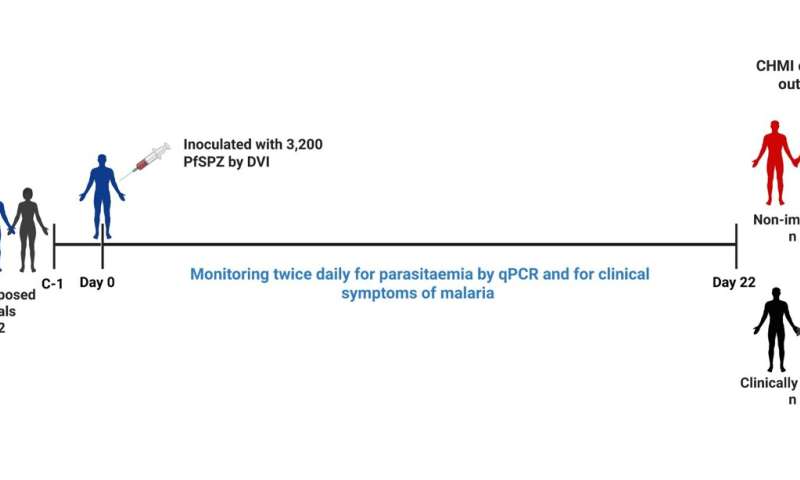
Study design. Kenyan adult volunteers (N = 142) were infected with 3,200 live P. falciparum sporozoites via direct venous injection (DVI). Credit: Nature Communications (2026). DOI: 10.1038/s41467-026-72716-x
The African Region continues to bear the overwhelming burden of malaria, accounting for nearly 95% of all cases worldwide. A small portion of the population living in areas where malaria is an endemic disease has developed natural immunity to the parasite through repeated exposure. Studies have found that antibodies targeting the blood stage of the malaria parasite—where the symptoms actually develop—play a major role in naturally acquired immunity.
The researchers of this study believed that a closer look at the targets of these antibodies on the malaria parasite could uncover new clues, paving the way for more effective ways to fight the disease.
Pinpointing proteins
The team began their investigation by recruiting 142 healthy Kenyan adults who had lived in malaria-endemic areas and had natural protection against malaria. Their blood samples were tested for antibodies against 70 different proteins found on the surface of the malaria parasite, allowing researchers to identify exactly which parts of the parasite each person’s immune system had already learned to recognize.
Then each person was given a small dose of the malaria parasite under controlled clinical conditions, and their health markers, such as fever and the number of parasites in the blood, were monitored regularly.
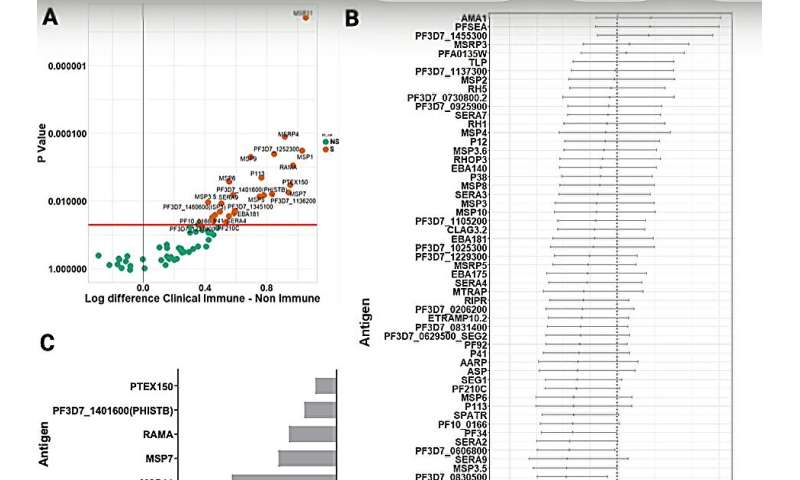
Independent analyses identify six antigens consistently associated with protection. Credit: Nature Communications (2026). DOI: 10.1038/s41467-026-72716-x
While a few volunteers became ill after infection, 86 remained healthy and did not require any medical treatment, showing clear signs of immunity to the disease. To identify what set these individuals apart, the researchers turned to five different analytical and machine-learning methods, which led them to six key proteins linked to protection: MSP1, MSP11, RAMA, MSP7, PHISTB, and PTEX150.
The team found that immunity was strongest when the body produced antibodies against more than one protein, as combinations of antibodies worked more effectively. They also observed that individuals with high levels of antibodies against four of the six proteins were the ones who showed complete protection from developing malaria symptoms during the study.
For vaccine researchers, these findings can open up promising new directions in the fight against malaria. More effective vaccines could ultimately save millions of lives, particularly among children in Africa, where the disease continues to wreak havoc every year.
Publication details
Rodney Ogwang et al, Controlled human malaria infection in adults identify combinations of merozoite antigens associated with clinical immunity, Nature Communications (2026). DOI: 10.1038/s41467-026-72716-x
© 2026 Science X Network
0 share
Send feedback to editors
Add as preferred source
Citation:
Natural malaria immunity: Human volunteers may hold the secret to why some people never get sick (2026, May 13)
retrieved 13 May 2026
from https://sciencex.com/news/2026-05-natural-malaria-immunity-human-volunteers.html
This document is subject to copyright. Apart from any fair dealing for the purpose of private study or research, no
part may be reproduced without the written permission. The content is provided for information purposes only.