




Joyce Stoltzfus has fond memories of visiting Clinton and Potter counties as a child and going on hikes with her parents in Kettle Creek State Park. One of her favorites is waking up one spring morning after an overnight snow and fording the creeks in snow boots.
“My dad just knew the way,” she says with a smile.
At 73, Stoltzfus continues to find her way through the wonders of Pennsylvania’s natural beauty with husband Ralph Detrick by her side.
The couple are among some 40 members of the Masonic Village Hiking Club, founded by fellow Masonic Village resident Chris Dunlap in 2022. The club holds monthly hikes, mainly in Lancaster and surrounding counties, but sometimes a bit farther afield.
The group reflects a growing number of seniors who are enjoying the outdoors. In its most recent annual survey of outdoor participation, the Outdoor Industry Association found that seniors had the highest growth in participation at 12.6%. Among those 55 and older, hiking is the third most popular activity, behind birdwatching and wildlife viewing, the survey reported.
“Participation in outdoor activities is soaring among seniors,” the report states, noting that 23.1 million Americans born before 1959 participated in outdoor activities in 2024, a 1.6 million increase from 2023 and an 11.3 million increase from 2015.
For all age groups combined, the survey found that hiking is the most popular “outdoor-specific” activity, with 63 million participants. While walking for fitness technically surpassed that number with 115 million participants, the survey only counted those who walk in natural environments, such as trails, or at a minimum, on dirt.
Distinguishing between hiking and walking is important for the Masonic Village group. There are plenty of opportunities to do the latter on the retirement community’s Elizabethtown campus, which boasts 12 miles of walking paths.
“There’s 1,400 acres on this campus, and it’s all our home,” says Detrick, 85, noting residents can log a lot of miles of walking without ever leaving the grounds.
But that’s not what the hiking club is about.

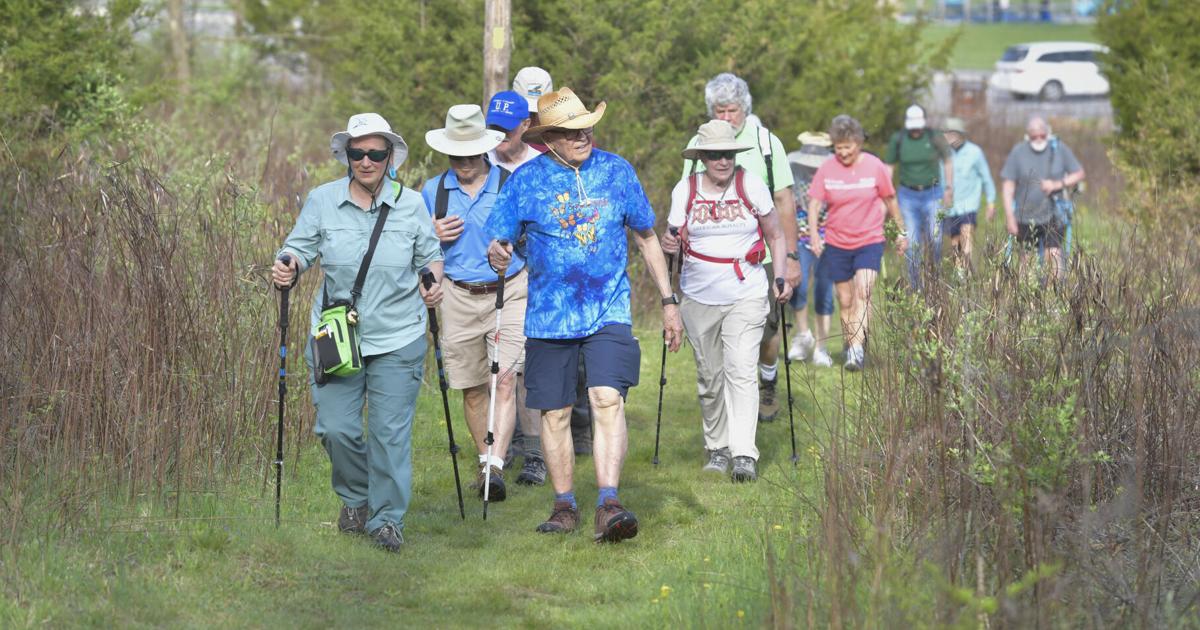
Joyce Stoltzfus, left, leads members of the Masonic Hiking Club along the access drive after completing the stream loop at the High Family Nature Preserve in Mount Joy Township on Thursday, April 16, 2026.
SUZETTE WENGER | Staff Photographer
WHAT TO BRING
Masonic Village Hiking Club founder Chris Dunlap recommends taking these items on a hike. Most will fit either in a day pack, a fanny pack or even in some copious pockets — whatever is most comfortable.
• A friend: “Particularly as you get into your golden years, it’s just not smart, in my opinion, to go out by yourself,” Dunlap says. While you may be fine on a route like the Northwest River Trail that is almost always highly populated, it’s not unusual to hike the area’s more secluded trails midweek and never encounter another person, he says.
• Cellphone: Most trails in this area have cell service, Dunlap says. A phone is a necessity, whether you need to call for help or want to follow a trail map online.
• Water and sunscreen: Hydration and skin protection are a must.
• Trail map: They come in handy if you lose your way. It doesn’t have to be an unwieldy brochure. You can usually download one on your phone or take a photo of one if it’s posted at the trail head where you start your hike.
• Compass: They’re normally recommended, but Dunlap says he doesn’t typically use one, at least when hiking locally. “If you’re on a marked trail and only going out a couple of miles … even if you get lost, you probably can’t hike more than a mile before you’re out of the park and onto a hard road.”
• Hiking poles: Not everyone uses them or needs them, but they are helpful for balance. And if you are hiking on a trail with a steep or long descent, they can save your knees, Dunlap says.
• Snack: Perhaps a granola bar or a few pieces of hard candy. It can be more of a psychological boost than sustenance, he says. Consider it a little reward for reaching the top of your climb.
• Small first-aid kit: Bandages for scrapes or blisters, antibiotic ointment and pain relievers can all come in handy.
• Toilet paper: A whole roll isn’t necessary, but just enough to fit in a zip-close bag. If you need it, you’ll be happy you brought it. On that note, Dunlap also recommends checking in advance to see if there are restrooms at the start of your hike and whether or not they are open if it’s off-season. Remember, take whatever TP you use with you.
• A little knowledge: Know how to identify nuisances like poison ivy and stinging nettles so you can avoid them.
Off the beaten path
In general, the club tries to avoid paved paths on its monthly hikes, although some of the area trails they traverse have paved portions. They also avoid towns, except in months when there is mud, snow or a danger of encountering hunters.
Still, it’s a club that is very much aware of its membership demographic.
“We’re not doing technical hiking,” says Dunlap, 76. “We’re not rappelling. We’re not going up steep mountains. Nothing that we do is anything more than moderate.”
Many of their outings are on rail trails, where there is a solid base, no rocks or roots, and little in the way of elevation changes.
“The most you have to generally contend with on a rail trail is gravel,” Stoltzfus says.
“Our pitch to people is … we have hikes of various difficulties,” Dunlap says, noting that difficulty is a somewhat subjective thing. What some think is difficult, others may consider moderate.
Once the club chooses a location, a few members will go out and scout the area to determine the best route — typically a hike of about 4-8 miles — along with shorter/easier variations.
They often try to plan hikes at a location where there is something else to see or do, such as Middle Creek Wildlife Management Area, where they can watch the snow geese and tour the visitor’s center.
Fun and fitness
Unlike Stoltzfus, Dunlap’s fondness for hiking began a little later in life, when his son joined the Boy Scouts.
“That got me backpacking around the world,” he says. “I just came to love it.”
Dunlap has hiked everywhere from the Swiss Alps to his personal favorite: New Zealand. “Words can’t describe how beautiful it is,” he says.
He’s also done over 100 miles of the Appalachian Trail.
“What I think many people don’t know … they think about the Appalachian Trail, but there are quite a few long-distance trails in Pennsylvania that are wonderful for hiking,” he says.
Although his backpacking days have dwindled, he’s still had a few adventures in recent years, including a trip with two fellow Masonic Village Hiking Club members, Fred Richter and Glenn Achey, to the Northwest Angle, the northernmost point in the contiguous United States. While the Angle, as it is known, is in Minnesota, it’s accessible only by way of Canada.
The same threesome also planned a recent trip to the highest points in four states: West Virginia, Maryland, Virginia and North Carolina.
But there are plenty of adventures to be had on these monthly hikes closer to home, too.
Highpoint Scenic Vista in Wrightsville, for example, is a neat place to watch the sunrise, Stoltzfus says. Detrick recounts taking an early-morning club hike there and coming upon a young man drumming with his companion.
“They were celebrating the summer solstice,” he says, recalling how the hiking club members stopped to relish the moment.
“It’s one of the serendipitous experiences you can have when you’re out hiking,” says Detrick, who is also the club’s photographer. “It’s what we see along the way. It’s not how fast we get from point A to point B.”
While Stoltzfus, Detrick and Dunlap have all spent many years of their lives hiking, there are some practical benefits to doing it as part of the Masonic Village club.
“It’s more fun hiking with people,” Dunlap says. “And being realistic, at our age it’s just really not safe to be out there by yourself.”
The important thing is getting out there.
“I feel good after (a hike) is over,” Detrick says. “It’s good for the heart, soul, mind and strength.”
WHAT TO WEAR
Masonic Village Hiking Club founder Chris Dunlap offers this advice:
• Consider the weather: Layering is key if it’s cooler than T-shirt weather, Dunlap says. You want to be able to add or remove a layer as needed. You also want to avoid heavy perspiration, since wet clothing can affect body temperature.
• Stay loose: Wearing loose clothing improves comfort, ventilation and ease of movement.
• Wear a hat: In cold weather, a hat can protect you from losing 30%-40% of body heat through your head. In warm weather, it can keep you cool and protect you from the sun.
• Dress for hunters: If you’re hiking in an area where hunting is permitted, dress to be seen. In Pennsylvania, you’re required to wear at least 250 square inches of blaze orange that can be seen on all sides when hiking on state gamelands between Nov. 16-Dec. 16.
• Prevent ticks: Although ticks are not usually an issue on rail trails, Dunlap advises wearing long pants when hiking through woods or fields. Insect-repellant clothing is also available.
• Treat your feet: Comfortable shoes are a must. Sneakers are fine for rail trails, but Dunlap recommends a hiking boot or at least something with more ankle support for rougher terrain. Waterproof footwear is a plus, especially if you’re hiking where there are stream crossings or marshy areas.