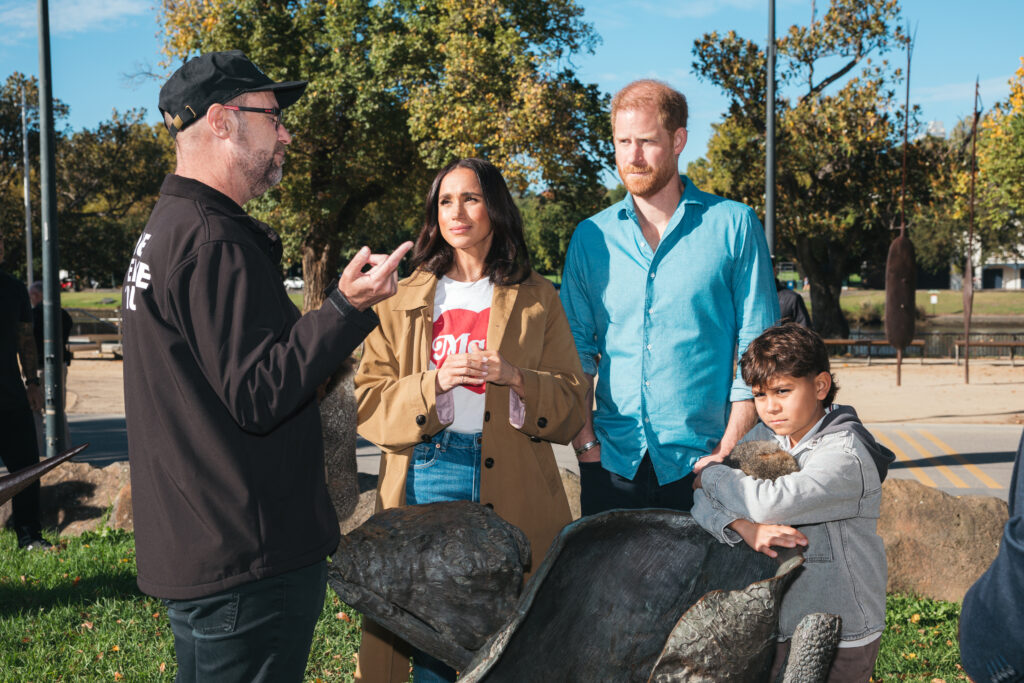
The Duke and Duchess of Sussex began the day with a deeply meaningful cultural experience on Melbourne’s Yarra River, joining the Koorie Heritage Trust for the Birrarung Wilam (River Camp) Walk – a guided tour that traces more than 60,000 years of Aboriginal history and connection to Country. For the Duke and Duchess, the visit was a chance to listen and learn directly from First Peoples voices, while paying respect to the enduring history and custodianship of the land.
Over the last few days, The Duke and Duchess of Sussex met with partners, young people, and community leaders who are reimagining how we support mental wellbeing at home, in schools, and in the workplace. Centered on lived experience and practical solutions, these conversations reflect a shared commitment to building cultures of care – where people are connected to one another, feel safe to speak up, and empowered to take meaningful action.
Championing Healthy Fatherhood
Yesterday, The Duke joined leaders from Movember to launch a new report on healthy fatherhood at Mission Whitten Oval, the training and administrative headquarters of the Western Bulldogs Football Club.
Movember is one of the world’s leading charities dedicated to improving men’s health, with a focus on mental fitness, suicide prevention, prostate cancer, and testicular cancer. Through its work, Movember has helped open conversations and challenge long-standing stigmas – encouraging men to seek support, stay connected, and prioritize their wellbeing.
At the Oval, The Duke took part in a discussion with Movember’s Global Director of Men’s Health Research, Dr Zac Seidler. During their conversation, The Duke and Dr Seidler explored the findings of Movember’s report and the importance of supporting fathers in building strong, healthy relationships with their children. The report features some noteworthy statistics on generational shifts in parenting and areas where more support was needed. For example:
72% of fathers said they’re more involved in the daily care of their kids than their own fathers were. 74% say “I love you” more than they heard it growing up.
Over 60% of fathers recognized that when they were struggling emotionally, it directly affected their partner and children.
Nearly half the fathers surveyed said fatherhood prompted them to get a health check they’d otherwise have skipped.
Three in five fathers reported that they were never asked by a health professional how they were coping – in the months leading up to becoming a father, nor in the first year after birth.
Drawing on his own experiences, The Duke spoke to the critical role of presence, emotional openness, and community in shaping positive outcomes for families. The conversation echoed themes The Duke has championed globally: that mental health is foundational to strong families and thriving communities, and that early intervention and open dialogue can be life-changing.
Following the panel, the event moved onto the oval to kick the ball around with some of the children and dads that attended the event. The Duke, and assembled families, were given a crash course in Aussie Rules ‘Footie’ by some of the Western Bulldogs (Doggo) pros.
Elevating Youth Voices with batyr
The Duke and Duchess also visited batyr, an Australian organization at the forefront of preventative mental health education and early intervention that has been leading the conversation around digital safety in the country. Since its founding in 2011, batyr has worked to reduce stigma and encourage help-seeking among young people, delivering peer-to-peer programs across schools, universities, and workplaces.
The visit to batyr focused on a central idea: when young people lead the conversation on mental health, solutions become more honest, relevant, and effective. Upon arrival, The Duke and Duchess met a group of young leaders who were participating in a two-day workshop focused on digital wellness and mental health. The cohort represented young perspectives from across Australia, including rural and remote regions. Through creative exercises, the group had developed visual storyboards exploring solutions to some of the most pressing challenges facing their generation – from navigating social media pressures to building healthier online habits.
The couple spent time listening directly to the students as they shared their ideas and personal reflections. The storyboards, displayed across the space, offered a powerful visual representation of both the challenges young people face and the solutions they are actively shaping.
The conversations reinforced a central tenet of batyr’s approach: that lived experience is not only valid, but essential. By equipping young people with the language and confidence to speak openly about mental health, batyr is helping to build a culture where seeking support is normalised and encouraged.
From Awareness to Action at InterEdge with Lifeline
In the afternoon, The Duke and Duchess attended Lifeline’s InterEdge Summit. Lifeline is a nonprofit organization that provides a free, 24-hour telephone crisis support service in Australia. At the Summit, leaders from across sectors gathered to discuss ways to increase psychosocial safety in the workplace.
Delivering a keynote address, The Duke acknowledged that separating work from home is a fallacy, because “behind every job title is a human being carrying a life far bigger than their work.” He explored what emotional and mental safety looks like in the workplace, describing it as when individuals feel supported enough to say, “I’m not okay,” or when leaders acknowledge that performance and wellbeing are not competing priorities, but fundamentally connected.
Central to his remarks was the issue of burnout, which he described not as an emerging challenge, but an existing reality.
“For too long, we’ve treated burnout as an individual failure rather than a systemic one,” he said, calling for a shift in how organizations understand and address chronic stress, disconnection, and loss of purpose. He also called on leaders to model vulnerability, create environments of trust, and recognise that psychological safety is not a workplace perk, but a foundational responsibility.
Throughout his address, The Duke emphasized the value of lived experience in shaping effective solutions, and how those who have experienced burnout, trauma, or other mental health challenges bring essential insights to the conversation. He also spoke candidly about fatherhood, and how the wellbeing of parents can shape the lives of their children.
He further emphasized the need for greater inclusion, acknowledging that not everyone experiences the workplace equally, and that true safety must account for diverse perspectives and realities.
In addressing the role of technology, The Duke reflected on the growing impact of constant connectivity, calling for a redefinition of safety in the digital age – one that includes clear boundaries, healthier expectations, and a recognition of the human cost of being perpetually ‘on.’
He concluded with a call to action, urging organizations to listen, act, and lead – transforming insight into immediate and meaningful change.
“If we’re honest about the world as it is – not as we wish it to be – that clarity can feel uncomfortable. But clarity is not something to fear. It’s something to build from. Because when we see things clearly, we are no longer operating under illusion – we are operating with choice. Every one of us will face pressure, loss, or uncertainty at some point in our lives. That is unavoidable. What we can change – is whether people face those moments alone. And ultimately, that is what this is about.”
Across all three engagements, a clear message emerged: that lasting change begins with listening – whether to young people shaping the future, or to individuals navigating challenges in their daily lives – and is sustained through collective, courageous action.
From classrooms to conference halls, the day reflected a shared commitment to building environments where people feel seen, supported, and empowered to thrive.
Photo Credit: Jordan Rajek for The Office of The Duke and Duchess of Sussex