

Immune Health Supplements Market
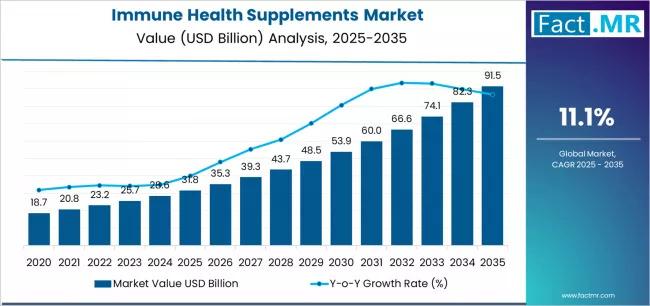
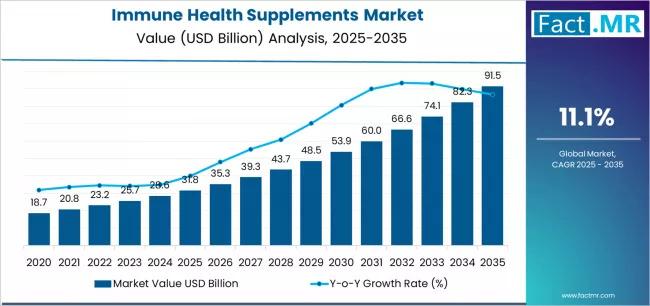
The global immune health supplements market is entering a decade of unprecedented growth, transitioning from a reactive “cold and flu” niche into a cornerstone of daily proactive health. According to a comprehensive industry report by Fact.MR, the market is valued at USD 31.8 billion in 2025 and is projected to skyrocket to USD 91.5 billion by 2035, expanding at a robust CAGR of 11.1%.
Get detailed market forecasts, competitive benchmarking, and pricing trends:https://www.factmr.com/connectus/sample?flag=S&rep_id=11615
The Shift from Defense to Offense: Expert Insights
Historically, immune supplements were seasonal purchases. Today, a fundamental shift in consumer psychology is fueling year-round demand.
“We are witnessing the ‘normalization’ of immunity,” says a lead analyst at Fact.MR. “Consumers are no longer waiting for symptoms to appear; they are integrating vitamins, minerals, and herbal solutions into their permanent wellness stack. This ‘always-on’ immune strategy is the primary engine behind the USD 59.7 billion absolute opportunity we see over the next ten years.”
Quick Stats: Immune Health Supplements Market at a Glance
Current Market Value (2025): USD 31.8 Billion
Projected Market Value (2035): USD 91.5 Billion
Growth Rate:1% CAGR (2025-2035)
Leading Segment: Vitamins & Minerals (37.4% Market Share)
Fastest Growing Segment: Herbal Supplements (Projected 27-30% share by 2030)
Dominant Distribution Channel: Offline (Pharmacies/Drugstores) at 54.9%
Fastest Growing Region: Asia Pacific (CAGR of 9.6%+)
Key Market Drivers & Trends
The Rise of “Clean Label” Herbals: Herbal supplements are the fastest-growing category. Consumers are moving away from synthetic formulas in favor of botanical solutions like elderberry, echinacea, and turmeric, seeking “natural” immunity with fewer side effects.
The Gut-Immunity Connection: Probiotic supplements currently hold a 5% share, with rapid growth expected as clinical research increasingly links microbiome health to systemic immune response.
Personalization & Bioavailability: There is a surge in demand for Softgels (expected to see the fastest formulation CAGR) due to their superior absorption and ability to carry both oil- and fat-soluble nutrients.
Aging Population: An expanding geriatric demographic particularly in North America and East Asia is driving the consumption of Vitamin D and Zinc to combat immunosenescence.
Regional Insights: Asia Pacific Leads the Charge
While North America remains a mature stronghold, the Asia Pacific region is the growth engine of the future. Driven by rising middle-class disposable income and a deep-rooted culture of traditional medicine in China and India, the region is anticipated to grow at the fastest pace globally. In the UK, the market is specifically projected to hit USD 7.36 billion by 2036, led by England’s rapid adoption of premium wellness innovations.
Competitive Landscape
The market remains fragmented, characterized by a mix of pharmaceutical giants and agile D2C (Direct-to-Consumer) brands. Key players profiled include:
Bayer AG, Pfizer Inc., and Sanofi (Dominating the pharmacy/offline space)
Amway, Nature’s Bounty, and Now Foods (Leading in vitamins and minerals)
Herbalife and Blackmores (Expanding the herbal and botanical footprint)
Featured Snippet: What is driving the Immune Health
Supplements Market?
The primary drivers of the immune health supplements market include a global shift toward preventive healthcare, an aging population susceptible to infections, and the rising popularity of herbal and probiotic ingredients that support the gut-immune axis. Post-pandemic health awareness has permanently moved these products from seasonal treatments to daily lifestyle essentials.
Frequently Asked Questions (FAQs)
Which supplement category is most popular for immune health?
Vitamins and minerals (specifically Vitamin C, D, and Zinc) currently dominate the market with a 37.4% share, though herbal supplements are the fastest-growing segment.
What is the projected CAGR for the market through 2035?
The market is expected to grow at a Compound Annual Growth Rate (CAGR) of 11.1% between 2025 and 2035.
Is online or offline shopping more common for these supplements?
Offline channels (pharmacies and health stores) still hold over 54% of the market, but online D2C channels are seeing the highest growth rate due to subscription-based models.
Why are softgels becoming more popular than tablets?
Softgels offer better bioavailability (faster absorption), are easier to swallow, and can effectively encapsulate liquid-based natural ingredients like Omega-3s and botanical oils.
Unlock 360° insights for strategic decision making and investment planning: https://www.factmr.com/checkout/11615
To View Our Related Report:
Demand for Immune Health Supplements in UK: https://www.factmr.com/report/united-kingdom-immune-health-supplements-market
Demand for Immune Health Supplements in USA: https://www.factmr.com/report/united-states-immune-health-supplements-market
Immune Checkpoint Inhibitor Market: https://www.factmr.com/report/immune-checkpoint-inhibitor-market
Autoimmune Disease Diagnostics Market: https://www.factmr.com/report/autoimmune-disease-diagnostics-market
– Contact Us –
11140 Rockville Pike, Suite 400, Rockville,
MD 20852, United States
Tel: +1 (628) 251-1583 | sales@factmr.com
Fact.MR is a global market research and consulting firm, trusted by Fortune 500 companies and emerging businesses for reliable insights and strategic intelligence. With a presence across the U.S., UK, India, and Dubai, we deliver data-driven research and tailored consulting solutions across 30+ industries and 1,000+ markets. Backed by deep expertise and advanced analytics, Fact.MR helps organizations uncover opportunities, reduce risks, and make informed decisions for sustainable growth.
This release was published on openPR.