




Europe Dietary Supplements Market Report 2026
Europe Dietary Supplements Market Summary:
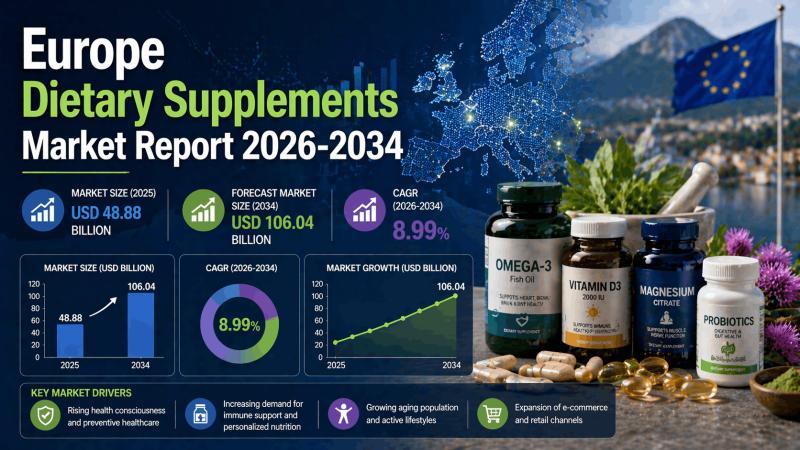
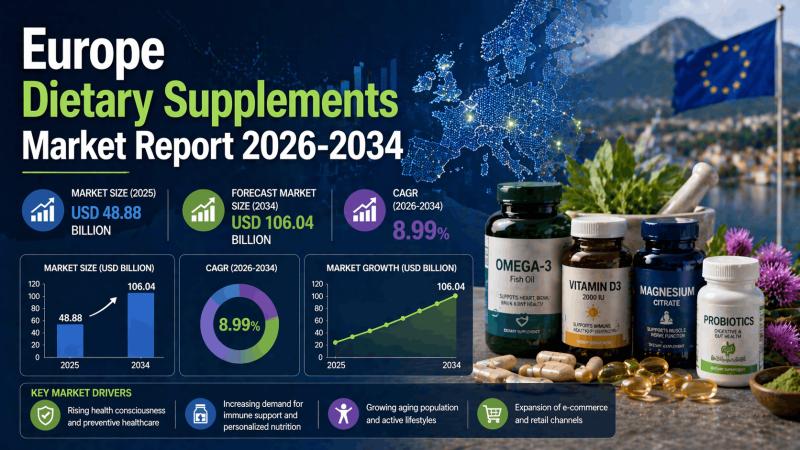
• The Europe Dietary Supplements Market size reached USD 48.88 Billion in 2025.
• Market is projected to reach USD 106.04 Billion by 2034.
• Germany dominates the European market with a significant 25% share in 2025.
• Growth driven by aging demographics and rising chronic disease prevalence, increasing health-consciousness and preventive healthcare orientation, and robust EU regulatory frameworks ensuring product quality and consumer safety.
Market Overview and Growth Trajectory
As per the IMARC Group‚ the Europe Dietary Supplements Market was valued at USD 48.88 Billion in 2025 and is projected to reach USD 106.04 Billion by 2034‚ with a CAGR of 8.99% from 2025 to 2034.
The nutraceutical F&B Sector is now undergoing a transformation from a more reactive treatment model to a more proactive preventive care model and is moving from customary blended formulations of vitamins and minerals to personalized formulations that target genetic testing and clean-label plant-based formulations. According to IMARC Group‚ end-user trends are shifting from daily multivitamin usage to thorough wellness protocols‚ direct-to-consumer subscription models and scientifically substantiated longevity and healthy-aging products‚ allowing manufacturers to provide consumers with the highest-quality benefits and a clear view of the brand and its transparency.
Read the full report here: https://www.imarcgroup.com/europe-dietary-supplements-market
What Are the Key Drivers of the Europe Dietary Supplements Market?
Aging Population and Rising Chronic Disease Burden: The growing aging population in Europe‚ coupled with a higher prevalence of lifestyle-related chronic conditions‚ is the biggest driver for the market. Since older consumers seek supplements for specific health benefits‚ the rising demand for bone health‚ cognitive health‚ cardiovascular health‚ and immunity supplements drives market growth. To address this structural need‚ industry leaders such as dsm-firmenich have announced new Healthy Longevity product portfolios at Vitafoods Europe 2025‚ cementing dietary supplements as integral to preventive long-term healthcare and healthcare cost containment in the region’s aging population.
This trend has led to personalized nutrition. Genetic testing‚ at-home testing kits‚ and apps featuring artificial intelligence are allowing European consumers to easily choose supplements. Austria’s Novogenia is among those companies using DNA tests coupled with customized micronutrient supplements. These tests tell consumers how much supplement to take or if they should take one at all. And this personalization layer is driving average order values‚ customer retention‚ and premium pricing in the capsule/gummy/powder forms of the products.
Stringent EU Regulatory Frameworks Reinforcing Consumer Trust: The Europe Dietary Supplements Market is expected to be driven by the unified EU regulatory framework‚ governed by the European Food Safety Authority (EFSA). In November 2025‚ the European Union authorized the use of calcidiol monohydrate as a source of vitamin D in dietary supplements‚ based on EFSA assessment‚ strengthening the scientific basis of the EU. These rules surrounding safety assessments‚ labeling‚ and health claims have set European supplements apart as high-quality‚ trusted products‚ being widely accepted by people of all ages.
Emerging Trends: Personalized Nutrition and Plant-Based Clean-Label Innovation
This report continues by discussing the changing character of the industry market‚ with clean-label‚ plant-based and sustainably produced supplement formulations identified as a prominent market trend. In response to EU regulations and changing consumer demands‚ the industry has seen progress in vegan-friendly capsules‚ botanical actives and sustainably sourced raw materials. At Vitafoods Europe 2025‚ sustainability certifications and transparency in supply chain were a theme and plant-based ingredients and sustainable packaging materials were the central theme of innovations.
Furthermore‚ the growing trend of e-commerce sites and the subscription-based supplements to consumers is expected to increase the growth of the market due to their convenience‚ personalized and cost-effective solutions that they offer. The Europe e-commerce market generated a revenue of USD 3.96 Trillion in the year 2024 and is expected to grow in the forecast period. Additionally‚ personalized capsule machines‚ like the on-demand capsule machine ACG launched in partnership with Art of You at Vitafoods Europe 2025‚ are being developed to meet the market’s growing demand for personalized‚ small-batch nutraceuticals‚ impacting market outlook.
Request to Get the Sample Report: https://www.imarcgroup.com/europe-dietary-supplements-market/requestsample
Europe Dietary Supplements Market Segmentation Analysis
IMARC Group provides a comprehensive analysis of the key trends in each segment of the market. The report has categorized the market based on Product Type, Form, Distribution Channel, Application, End-Use, and Region.
By Product Type
• Vitamin and Mineral Dietary Supplements (Largest Segment): According to the report, vitamin and mineral dietary supplements account for the largest market share at 28.12% in 2025. This dominance is attributed to widespread awareness of micronutrient deficiencies, strong scientific backing for their role in immunity and energy metabolism, and routine recommendations from healthcare professionals across European preventive care frameworks.
• Herbal Dietary Supplements: Widely used for stress management, sleep support, cognitive function, and digestive wellness, leveraging Europe’s rich botanical tradition.
• Protein Dietary Supplements: Serve fitness, sports nutrition, muscle recovery, and elderly protein-intake use cases across mainstream and specialty channels.
• Others: Include omega-3, probiotics, amino acids, and specialty nutraceuticals targeting niche wellness needs.
By Form
• The market is dissected into tablets, capsules, powders, liquids, soft gels, and gel caps. The shift toward capsules, which lead with a 34.09% share, reflects the growing desire among consumers to access convenient, tasteless, and precisely dosed delivery formats that also support ingredient stability and bioavailability.
By Distribution Channel
• The market is dissected into pharmacies and drug stores, supermarkets and hypermarkets, online channels, and others. The continued leadership of pharmacies and drug stores, with a 36.05% share, reflects the growing desire among European consumers to rely on trusted healthcare-oriented retail environments and professional pharmacist guidance when selecting supplements.
By Application and End-Use
• The market is dissected by application into additional supplements, medicinal supplements, and sports nutrition, with additional supplements leading at a 45% share. By end-use, adults dominate the segment with a 62.03% share. The shift toward additional supplements and adult consumers reflects the growing desire among European households to integrate preventive nutrition into daily routines, supporting immunity, energy, cognitive performance, and long-term wellness goals.
Regional Insights: Germany Leads the Europe Dietary Supplements Market
Geographically, Germany currently dominates the market within Europe, holding a significant 25% market share in 2025. IMARC Group analysts attribute this dominance to several factors:
• High Per-Capita Supplement Consumption: Germany hosts one of the most mature consumer bases for vitamins and minerals in Europe, with strong demand for immune-boosting, vitamin D, and omega-3 products driven by sustained health awareness across demographic groups.
• Robust Pharmacy and Retail Infrastructure: The country has one of the highest rates of pharmacy-led healthcare engagement in the region, driving massive demand for pharmacist-recommended supplement regimens and professionally curated product assortments.
• Expanding Sports Nutrition and Functional Foods Segment: German consumers and retailers are heavily investing in fitness-driven protein powders, plant-based supplements, energy bars, and scientifically validated formulations, supported by expanding specialized health stores and e-commerce infrastructure.
Other European markets, including the United Kingdom, France, Italy, Spain, Switzerland, Netherlands, and Poland, are also showing significant growth, fueled by rising geriatric populations and the increasing need for preventive nutrition and personalized wellness solutions in mature Western European economies.
Request Customization: https://www.imarcgroup.com/request?type=report&id=24559&flag=E
Competitive Landscape
The Europe Dietary Supplements Market is characterized by the presence of several key players focusing on expanding their geographical reach across the region. These industry leaders are investing in research and development, personalized nutrition technologies, and integrated digital platforms to offer clinically validated, clean-label, and sustainably sourced products to European consumers. They are also engaging in mergers and acquisitions, such as Uriach’s September 2025 acquisition of Athens-based iPHARMA S.A., to strengthen their regional footprints and expand their nutraceutical portfolios.
Key companies profiled in the report include:
• Bayer AG
• Haleon plc
• Procter & Gamble
• Perrigo Co Plc
• Herbalife Nutrition Ltd.
• Amway
• Reckitt Benckiser Group plc
• Abbott
• Wolfson Brands Ltd.
Media & Sales Contact
IMARC Group,
134 N 4th St. Brooklyn, NY 11249, USA
Email: sales@imarcgroup.com
Tel No: (D) +91 120 433 0800
United States: +1-201971-6302
About IMARC Group
IMARC Group is a global management consulting firm that helps the world’s most ambitious changemakers to create a lasting impact. The company provides a comprehensive suite of market entry and expansion services. IMARC offerings include thorough market assessment, feasibility studies, company incorporation assistance, factory setup support, regulatory approvals and licensing navigation, branding, marketing and sales strategies, competitive landscape and benchmarking analyses, pricing and cost research, and procurement research.
This release was published on openPR.