




The winners in the attention economy are good at world-building. They construct alternate universes — with a recognizable voice, space and aesthetics — and invite you inside.
Think of Hannah Neeleman’s whimsical, if unrealistic, farm life in Utah. Or the kitchens of food influencers like Meredith Hayden, Molly Baz and Nara Smith. Or the interview sets for viral podcasts (Alex Cooper’s pink sofas, Hasan Piker’s bookshelf and Theo Von’s armchair). Each, in their own way, is a portal.
One of the most intense appeals of religion, too, has always been that it constructs a world in which people can find meaning. Religions have, for a very long time, created whole cosmologies, cathedrals and communities to help people escape, even just for a moment, their everyday.
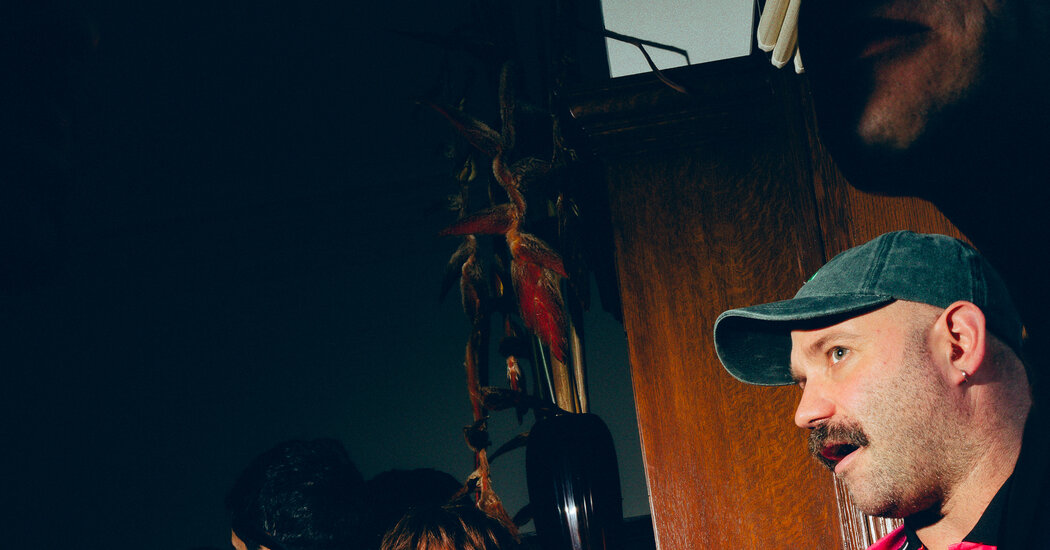
I talked about that link — between religion and world-building — with the New York artist and designer Laila Gohar. She creates surreal experiences by getting creative, really creative, with food: a dangling installation of Babybel cheese, an alien landscape of egg shells, a cake shaped like Emily Ratajkowski’s butt.
I sense, though, a spirituality in her work — and a deeply intuitive capacity for world-building. (The name of her tableware company is “Gohar World.”) It’s a fluency that made me think she had a religious upbringing, one that informs her pursuit of enchantment and wonder now. Through fantastical spaces and dining experiences, she said she hopes to provide “a little bit of beauty in days dark for humanity.”
So I asked her about all of that.
The world-building of art is similar to the world-building of religion to me. Do you see it that way?
I love the parallel. I never really thought about it like that, but it makes a lot of sense.
I find people who are good at creating worlds often grew up inside a very intact, distinctive world themselves. Did you?
I was born and raised in Egypt, a world unto itself. Both my parents are Muslim. My father is pretty secular, but my mother is extremely spiritual. She prays five times a day, and she used to tell me that God was everywhere.
In Cairo, we were surrounded by mystery, too. People there are closer to God, whether you’re Christian or Muslim. There’s always talk of Judgment Day. It’s just very entwined in the everyday, and it shows up in language. Children are told, If you do that, you’re going to go to hell, which sounds so dramatic in English, but in Arabic it doesn’t. For example, if there’s a big storm outside, my grandma would be like, “Oh my God, it’s Judgment Day.”
Apocalypse now!
Haha, exactly!
We can joke about that, but there’s also an enchantment in it. Max Weber, the sociologist, wrote about modernity as disenchanting the world, and I see your work as fighting against that. Was Cairo your first encounter with enchantment?
Yes. That sort of upbringing teaches you that there’s more than what the eye can see.
Egypt is just such an old place, and there are so many layers of it, and it’s extremely tactile. And the pyramids! For me and for children all over the world, the idea of Egypt — the idea of the pyramids — is their first taste of magic.
You left to pursue your art in the United States. Was this a kind of pilgrimage for you?
I remember when I was young in school, I was in track and field, and I was a sprinter. I could run really fast. I remember thinking one time to myself: I am going to use these little legs of mine to get myself as far as I can possibly go.
And I did. I got a scholarship to the University of Miami. I went there because it just seemed like the most exotic, foreign place that I could get myself to. I arrived, and everyone spoke Spanish. It was a whole other world. And I immediately loved it. I was so inspired, and I was constantly drawn to food. It wasn’t a linear career path. I didn’t have a big game plan.
You’ve said you want your store to be “another dimension.” Do you think of your work as world-building?
If I were to distill down to one sentence everything I do, I would say what I do is world-building. And that’s what I enjoy doing the most. I love imagination. I love being able to imagine things and then see them come to life. And for me, it’s all-encompassing. It needs to be a whole universe, a place.
And how do you do that? What is your process?
I think about all of the different senses and how they get affected, how you feel a space. Beauty is also a big part of it — I’m obsessed with beauty. Sometimes when I say this to people, I feel like they think it’s vain. But it’s not.
I don’t think it is. I think it’s so important.
It’s my North Star. It’s my God.
I get it. But why?
I’ve never really asked myself why. It’s like a blind belief.
A blind faith.
Yes. I think it can save us. It’s the most important thing in my life. It’s a light, always present for me, that guides everything I do regardless of what I’m going through. If I’m feeling great, if I’m horrible, if I’m grieving. My partner and I debate this: He believes people are conditioned to find things beautiful, that we’re basically sheep. Thinking like that makes me feel depressed. I believe there’s something inside of us that can just feel it.
Why do you think people are so drawn to the spaces you create?
Wonder. Often I feel like a big kid. I think we’re born with these really vivid and lively imaginations. In many ways, as we grow, they’re sort of dulled, which is sad. Our worlds, in a literal way, become bigger, but in a figurative way kind of become smaller.
Is there a project that captures this wonder and enchantment?
Last September, I participated in a biennial in Bukhara, Uzbekistan, about dying craft traditions of the Silk Road. I discovered navat, a rock sugar traditionally made from grape juice in this incredibly laborious process — only two people in the country still know how. I found one of them, and together we grew sugar crystals on metal rods and built a glistening pavilion in front of an ancient madrasa. People would realize it was sugar and completely freak out. Children licked it. Their mothers scolded them: “Don’t lick the art!” I just watched from far away. That’s what interests me — taking something utterly familiar and turning it upside down.
Holy Grail
We’re asking artists and tastemakers what they hold sacred. Laila shares her answers below.
Sacred text: “The Prophet” by Kahlil Gibran.
Hymn: Not exactly a song, but I grew up hearing the call to prayer five times a day in Egypt. I still find it incredibly calming.
Prayer: We didn’t come this far to come this far.
Superstitious? I’m not. I don’t like superstition or nostalgia. I find it annoying.
Believe in a higher power? Yeah, I do.
Pope-gate
Pope Leo did not stutter. He’s criticized the war in Iran, prompting attacks from President Trump. And Leo responded with what appeared to be a rebuke. “Woe to those who manipulate religion and the very name of God for their own military, economic and political gain, dragging that which is sacred into darkness and filth,” he said in a speech in Cameroon. He’s also been reiterating calls for peace.
In case you missed it, here’s a recap:
Leo has said, again and again, that he is against the war.
Early last week, Trump lashed out and called the pope “weak on crime,” and posted a pic of himself as a Jesus-like figure.
Leo said that he was “not afraid of the Trump administration” and, later, that the world was being run by a “handful of tyrants.”
Vice President JD Vance, who is Catholic, jumped in and said the pope should “be more careful.” Speaker Mike Johnson agreed.
My colleague Elizabeth Dias wrote a smart piece about what all of this means and what constitutes a just war. “Their fight is not simply political,” she wrote. “It is fundamentally religious, as the Republican leaders are now arguing with the pope over theology to support the U.S. and Israeli military campaign in Iran.”
More on politics
We have more data on whether there is a religious “revival” in the United States: There was a sharp spike in American men under 30 who say religion is “very important” to them, a new Gallup survey found. It was 42 percent in 2025, up from 28 percent two years before.
Gallup also found that religion is dropping in importance among young women. It’s not clear yet how the shifting attitudes might translate to church attendance.
Some people are calling the trend of young men’s growing interest in church Catholicmaxxing. (The influencer Clavicular, an ambassador for “looksmaxxing” who overdosed on camera last week, recently converted to Catholicism.)
“The Drama”
I went to see “The Drama” last week and loved it. (Our critic called it “bright and shiny and aggressively nasty.” I’m there!)
The movie is all about forgiveness — a big, existential topic that religion tackles often. It implied that we’re always changing, so it may be misguided and hypocritical to hang onto fixed ideas about one another. (That’s a very Buddhist position.)
I’ve been thinking about forgiveness in a few of my own relationships, so the movie sent me down a rabbit hole. I wanted to share a working syllabus, of sorts:
Trending
After the Artemis II astronauts came back to Earth, Reid Wiseman, the commander, immediately sought out a chaplain. He said he was searching for a new way to describe what had happened to him. “I’m not really a religious person,” he said, “but there was just no other avenue for me to explain anything.”
Another member of the mission, Victor Glover, quoted the Bible to a crowd that welcomed him back to his home. “Let’s be neighbors,” he said. Sweet.
My colleague Ruth Graham wrote a beautiful piece about the meaning of the mission for the country. “It turned all of us into children at camp,” she observed, “lying supine and looking up at the stars, thinking very big thoughts.”