




The weather is changing, and so is public trust in medical evidence—and both are showing up in the data.
Tick season is off to a bad start, a decrease in trust is pulling several diseases down with it, and the Pentagon just ended its flu immunization requirement. But there’s a lot of good news this week, too. Plus, we answer your questions on alpha-gal syndrome, a tick-triggered meat allergy.
Here’s what’s circulating and what it means for you.
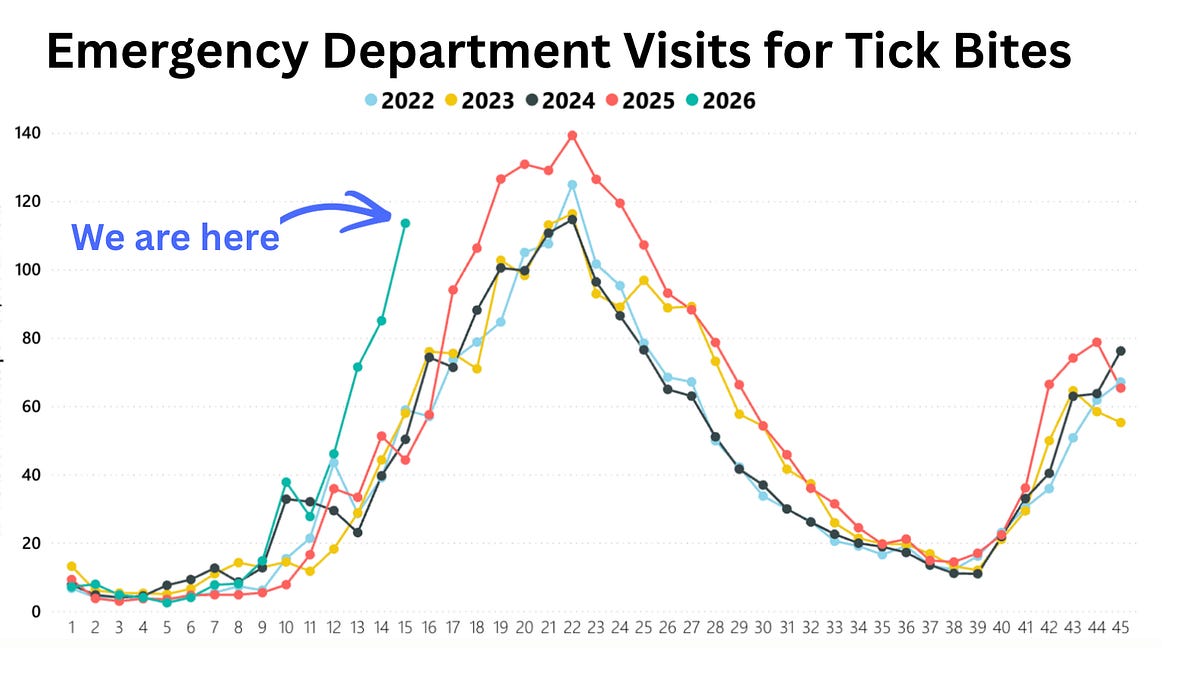
Well, it wasn’t a blip. Tick season really is off to an unusually bad start. Emergency department visits for tick bites are running at roughly 114 per 100,000 people per week, nearly triple the typical rate at this time of year (44 per 100,000). The Northeast is bearing the brunt of it, with the Midwest running a close second.
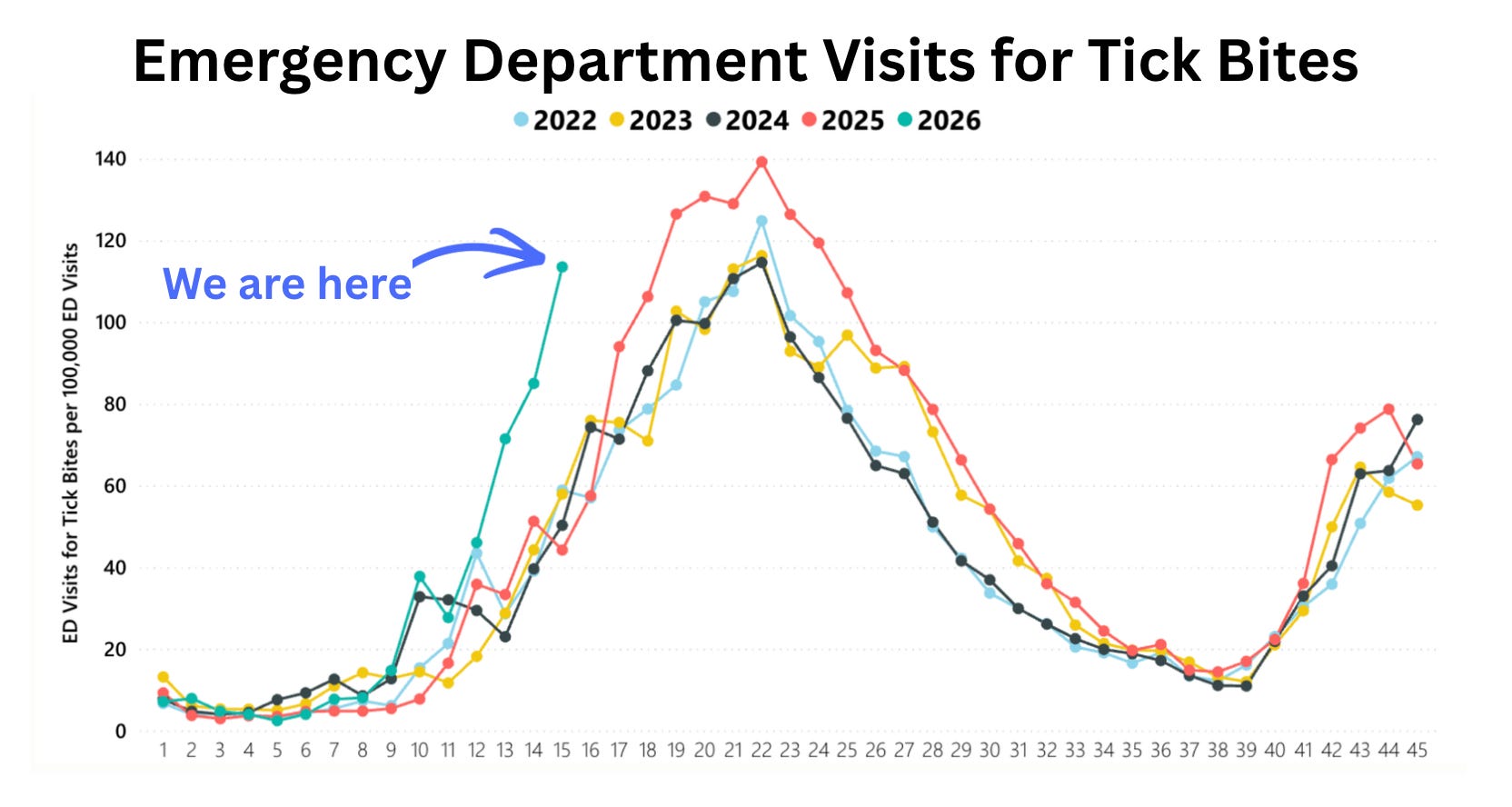 Data from CDC; Annotated by Your Local Epidemiologist.
What this means for you: The main concern is Lyme disease (carried by black-legged ticks), but lone star ticks and dog ticks are also active and can transmit other illnesses, such as alpha-gal syndrome (see more below). There are many things you can do to prevent tick bites, and remember: nymphs are the size of a poppy seed.
If you’re sick right now, it’s almost certainly a common cold. Rhinoviruses and enteroviruses dominate this time of year, and everything else—flu, RSV (which had a notably late season), and Covid—is finally declining for the first time in a long time!
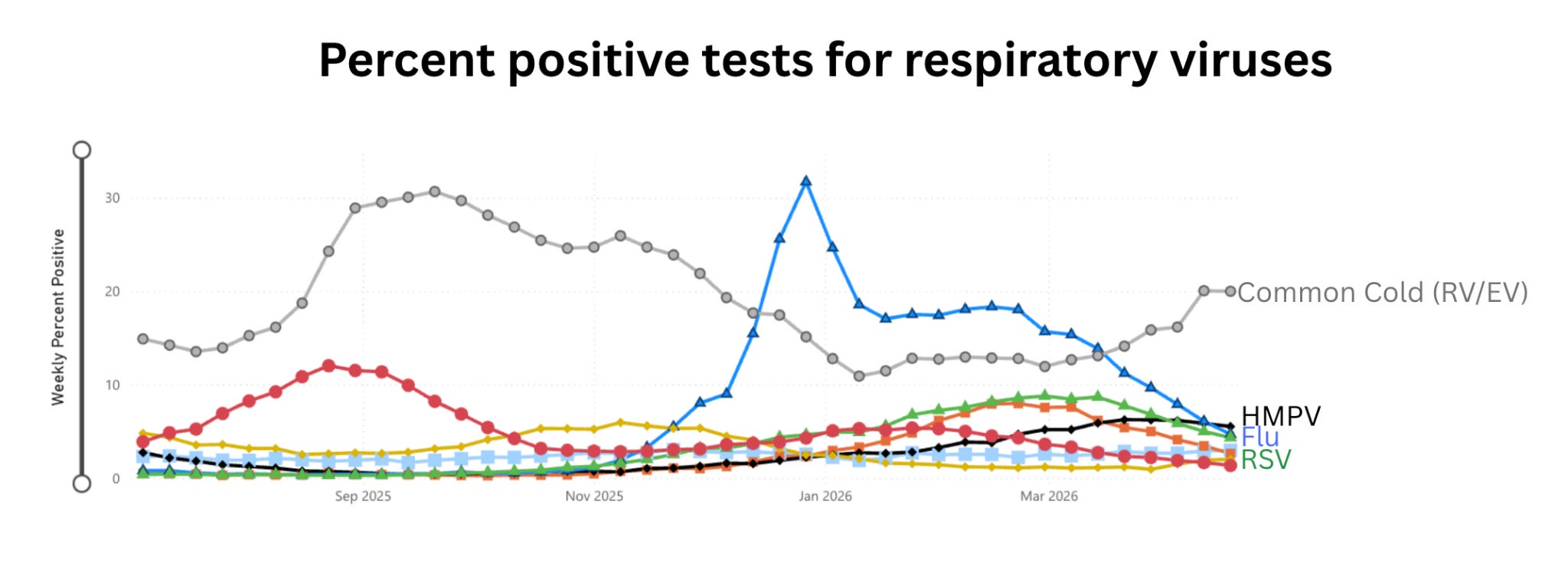 Percent of positive tests for respiratory viruses. Source: NREVSS; Annotated by Your Local Epidemiologist
What this means for you: Rest and fluids. (Yes, this really helps your immune system.)
Rotavirus (a contagious gut virus and the leading cause of severe diarrhea in young children) is generating headlines, with levels higher than last year. Wastewater monitoring shows a striking signal, though this monitoring technique is relatively new for rotavirus, making interpretation difficult. CDC test positivity rates (a more established metric) are modestly elevated compared to last year.
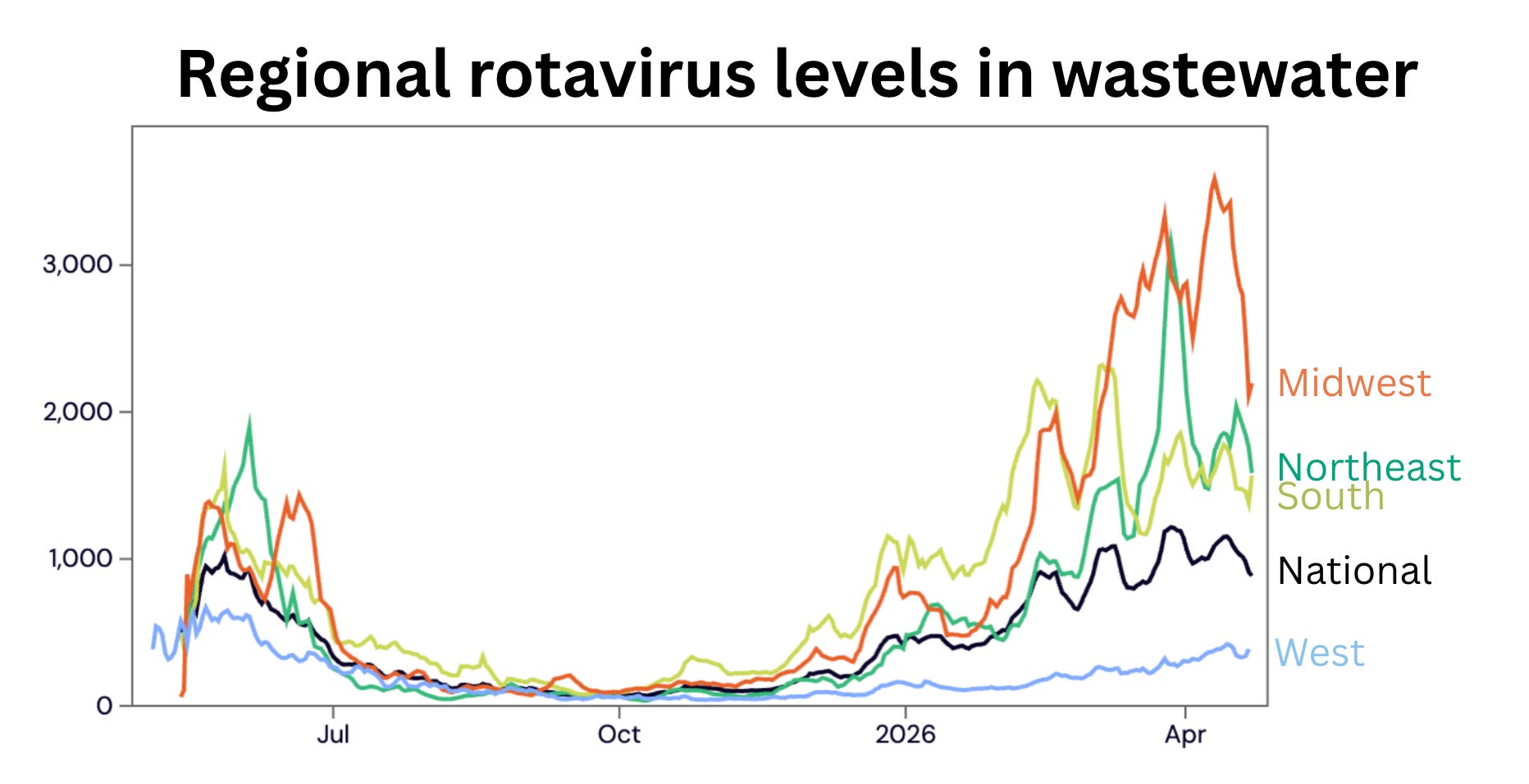 Levels of rotavirus in wastewater compared to last year. Source: Wastewater Scan; Annotated by Your Local Epidemiologist.
Why the uptick? Vaccination rates have declined gradually (74% compared to 77% in 2018).
But, as David Higgins notes, hesitancy alone likely isn’t the driver. Rotavirus vaccination is uniquely vulnerable to access barriers: The first dose must be given before 15 weeks, and the full series must be completed by 8 months. A child who loses Medicaid coverage, can’t find a pediatrician, or misses a single visit simply ages out of eligibility.
Vaccination data is delayed. So the current rates reflect children who should have been vaccinated in 2021, at the height of the pandemic-era disruption in care. Watching how these trends evolve alongside new access challenges, like Medicaid cuts, will be critical.
Vitamin K refusal shows concerning trends, increasing 77% (from 2.1% to 5.2%) from 2017 to 2024. This shot prevents Vitamin K Deficiency Bleeding (VKDB), a condition where newborns bleed spontaneously because they can’t yet produce enough clotting factors. The classical form affects as many as 1 in 60 to 1 in 250 unprotected infants. In other words, even a small increase in refusal translates directly into preventable harm.
What this means for you: If your child receives standard care (the routine childhood vaccination schedule and no refusal of the Vitamin K shot), they are very well protected. On a population level, we have a real problem. This will take all of us listening to questions, concerns, and confusion, answering questions from a place of empathy, and creating systems that make it easier (and more affordable) for people to access care.
We’ve gotten a lot of questions about alpha-gal syndrome from ticks lately, including a lovely snailmail note from a reader asking us to cover it.
What is it? A meat allergy triggered by a Lone Star tick bite. The tick introduces a sugar molecule called alpha-gal into your bloodstream. Your immune system responds. The next time you eat red meat, your body reacts.
Who is at most risk? The Lone Star tick is most common in the Southeast and South-Central U.S., but its range is expanding. For example, last year, there was an explosion of cases in the Northeast (Martha’s Vineyard).
Is alpha-gal actually increasing, or does it just feel that way? Both. Awareness has grown enormously in the last few years, which means more doctors are testing for it, and more cases are being caught that would previously have been written off as mystery GI issues or unexplained allergies. But the underlying cases are also genuinely rising. The lone star tick’s range is expanding northward and westward, driven largely by climate and deer population changes. CDC estimates there are around 450,000 cases in the U.S., but that’s almost certainly an undercount.
How would I know if I have it? The reaction is delayed two to six hours after eating, so by the time hives, stomach cramps, or nausea appear, most people don’t connect it to the meal. It can progress to anaphylaxis. People spend months thinking they have IBS or a sensitive stomach. If you have unexplained allergic reactions, especially delayed ones after meals, ask your care team about the possibility of an allergy.
Is it just red meat? Mostly. Beef, pork, lamb, and venison are the main triggers. Some people also react to dairy, gelatin, or mammalian-derived medications. Sensitivity varies a lot, which is part of why it’s so hard to diagnose.
Will I have this forever? Not necessarily. Some people regain tolerance if they avoid further tick bites, which is what prevents the immune system from re-sensitizing. Others don’t recover. No treatment exists beyond avoidance.
How do I avoid getting it? Take precautions against tick bites.
The South Carolina measles outbreak—the largest in the U.S. in 35 years—has officially ended, marking a significant milestone in containment.
Suicide prevention is working. A new study found that roughly 4,300 fewer teens and young adults died by suicide in the years following the launch of the 988 Suicide and Crisis Lifeline. Tell people about this resource.
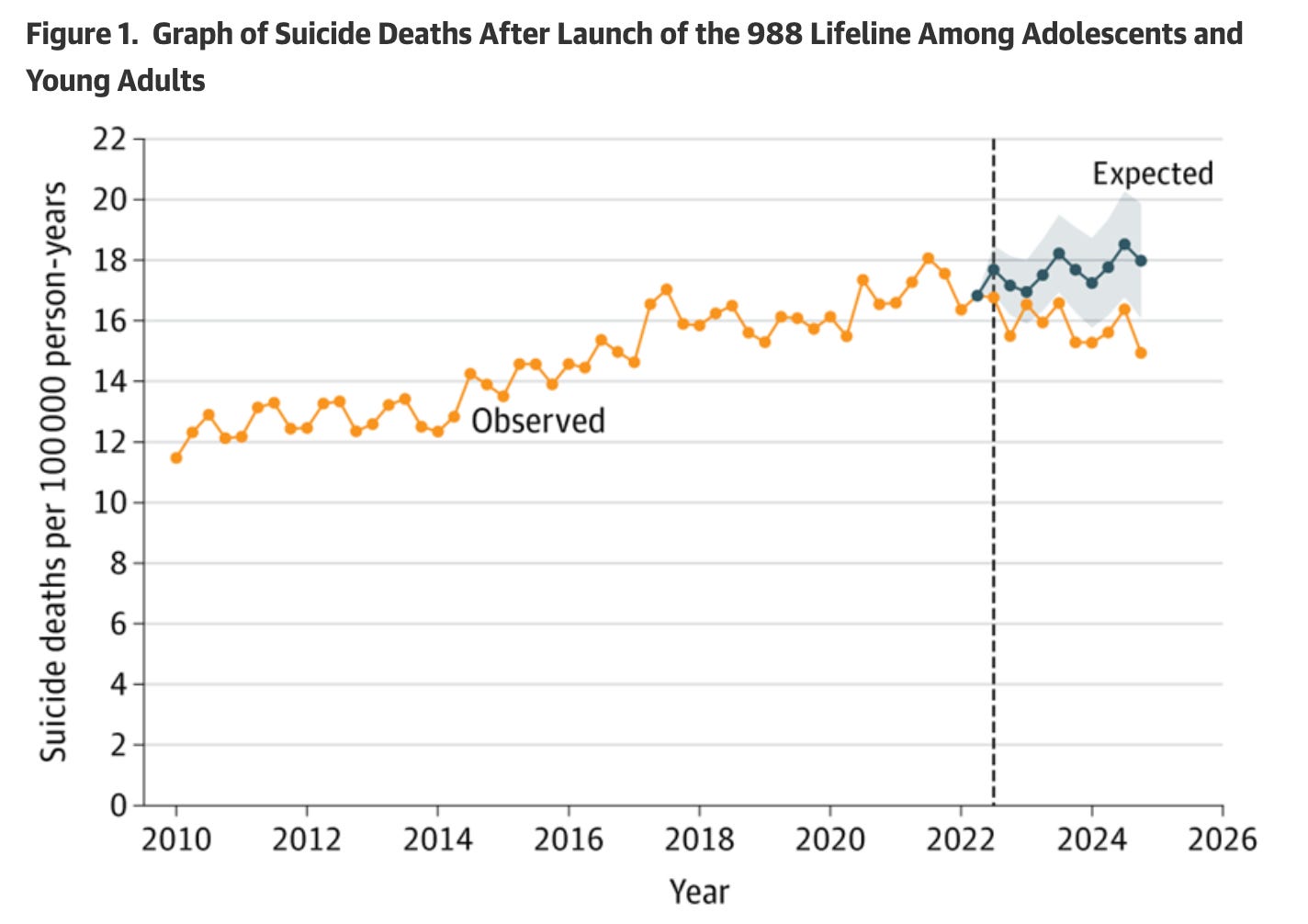 Source: JAMA
A pancreatic cancer trial is showing real progress. Pancreatic cancer is one of the deadliest cancers because it’s caught late and responds poorly to treatment. Follow-up results from a very small phase 1 clinical trial testing a vaccine to treat pancreatic cancer showed that nearly 90% of people whose immune systems responded to the vaccine were still alive up to six years after receiving the last treatment. (Typically, the five-year survival rate is ~13%.)
Good news on dengue vaccines. A dengue vaccine trial kept every vaccinated participant out of the hospital over five years and reduced symptomatic infections by 65%. Dengue infects an estimated 100–400 million people annually worldwide.
What is your take on the Pentagon recently ending its flu immunization requirement for active-duty military?
Here’s the deal: scientifically and economically, this new policy just doesn’t add up. I did some back-of-the-napkin math, and the military immunization requirement saves 30,000–98,000 duty days a year from the flu, which amounts to about $10-40 million in taxpayer dollars. This policy has been in place since the 1950s precisely because military readiness depends on keeping troops healthy and in the field.
But values and politics shape a huge portion of health policy. That’s what happened here. The performative political statement against vaccines as well as the intersection of individualism coming to the fore against the collective good.
If you have questions or requests, comment or email us at hello@yle.health. We read everything! And love to hear from you.
The weather is changing, trust is changing, and both are reshaping the diseases we face and how we protect ourselves. In the background, public health and research continue to fight to bring you good news.
Love, YLE
Your Local Epidemiologist (YLE) is founded and operated by Dr. Katelyn Jetelina, MPH PhD—an epidemiologist, wife, and mom of two little girls. YLE reaches over 425,000 people in over 132 countries with one goal: “Translate” ever-evolving public health science so that people are well-equipped to make evidence-based decisions. This newsletter is free to everyone, thanks to the generous support of fellow YLE community members. To support the effort, subscribe or upgrade below: