




 The global enteral nutrition market is undergoing a structural evolution, shifting from hospital-centric consumption to a broader continuum-of-care model that includes home-based nutrition support and disease-specific clinical applications. Traditionally anchored in ICU and acute care settings, enteral nutrition is now expanding across long-term care environments, driven by cost efficiency, patient convenience, and the growing burden of chronic diseases. This transformation is redefining competitive dynamics, where clinical efficacy, product specialization, and distribution reach are becoming as critical as scale.
Rising healthcare infrastructure investments, increasing awareness of clinical nutrition, and the expansion of reimbursement frameworks are further accelerating market growth. As demand becomes more specialized, manufacturers are focusing on developing targeted formulations for conditions such as gastrointestinal disorders, oncology, and metabolic diseases. For stakeholders, the market is no longer defined solely by hospital procurement volumes-it is increasingly shaped by product innovation, patient-centric delivery models, and integrated healthcare solutions.
Quick Stats Snapshot
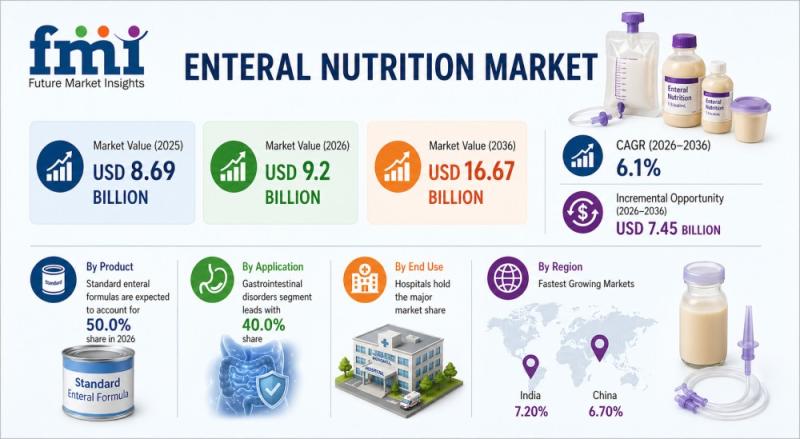
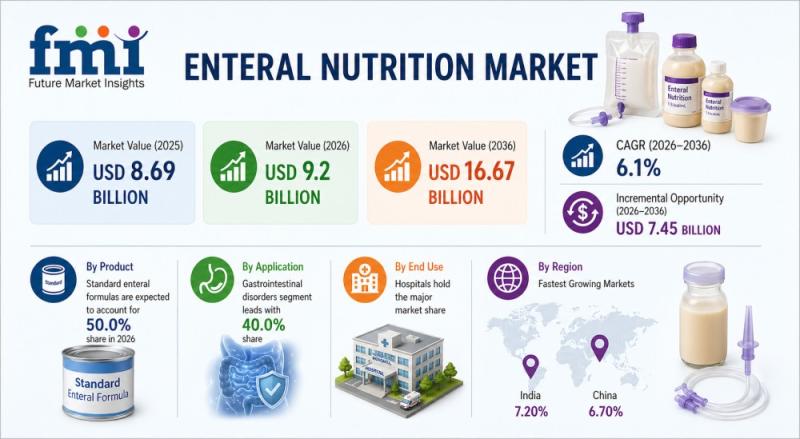
• Market size (2025): USD 8.69 billion
• Estimated size (2026): USD 9.2 billion
• Forecast (2036): USD 16.67 billion
• CAGR (2026-2036): 6.1%
• Incremental opportunity: USD 7.45 billion
• Leading product segment: Standard enteral formulas (50.0%)
• Top application: Gastrointestinal disorders (40.0%)
• Dominant end-use: Hospitals (60.0%)
• Fastest-growing markets: India (7.20%), China (6.70%)
Detailed insights, segmentation breakdown, and competitive intelligence@ https://www.futuremarketinsights.com/reports/sample/rep-gb-19760
Market Size and Forecast
The enteral nutrition market is projected to grow from USD 9.2 billion in 2026 to USD 16.67 billion by 2036, registering a CAGR of 6.1%. While this reflects steady expansion, the more significant shift lies in the evolution of demand patterns-from standardized hospital nutrition toward specialized, high-value clinical formulations and home-based care delivery.
Over the next decade, growth will increasingly be driven by disease-specific nutrition, aging populations, and healthcare system optimization strategies aimed at reducing hospitalization costs while maintaining patient outcomes.
Growth Drivers: Clinical Demand Meets Care Delivery Evolution
1. Hospital ICU and Acute Care Procurement Dominance
Hospital systems continue to account for over 50% of global demand, with standardized enteral formulas forming the backbone of clinical nutrition protocols in ICU and post-surgical recovery settings.
2. Rapid Expansion of Home Enteral Nutrition
Home-based enteral nutrition has grown from under 20% of market volume in 2015 to over 30% in 2025. This shift is driven by lower treatment costs, improved patient comfort, and expanding insurance coverage.
3. Rising Demand for Disease-Specific Formulations
Specialized formulas targeting diabetes, renal disorders, oncology, and gastrointestinal conditions are gaining traction. These products command 40-60% price premiums, significantly enhancing market value.
4. Healthcare Infrastructure Growth in Emerging Markets
Expanding hospital networks and ICU capacity in countries such as India and China are supporting strong demand growth, particularly in clinical nutrition adoption.
Speak to Analyst: Customize insights for your business strategy @ https://www.futuremarketinsights.com/customization-available/rep-gb-19760
Key Challenges: Reimbursement and Competitive Pressures
Reimbursement Variability
Differences in insurance coverage across regions impact accessibility, particularly for home enteral nutrition, creating uneven adoption rates.
Hospital Formulary Constraints
Standardization of hospital procurement limits pricing flexibility and intensifies competition among major suppliers.
Competition from Parenteral Nutrition
In critical cases where enteral feeding is not feasible, parenteral nutrition remains a competing alternative, especially in ICU settings.
Emerging Opportunities: Premium Clinical Nutrition and Home Care
The most attractive growth opportunities lie in high-margin, disease-specific, and specialty enteral formulas. These include immune-modulating, peptide-based, and condition-specific nutrition solutions designed for targeted therapeutic outcomes.
• Diabetes and renal care formulations driving premiumization
• Oncology nutrition supporting treatment recovery
• Pediatric and long-term care nutrition expanding niche segments
Investment in clinical validation, product innovation, and home healthcare distribution networks will be critical for capturing these opportunities.
Segmentation Insights
By Product
• Standard enteral formulas (50.0%) dominate due to widespread hospital usage
• Disease-specific formulas represent the fastest-growing premium segment
By Application
• Gastrointestinal disorders (40.0%) lead demand
• Oncology and neurological conditions contribute significant growth
By End Use
• Hospitals (60.0%) remain the primary consumers
• Home healthcare is the fastest-growing segment
By Distribution Channel
• Hospital pharmacies dominate procurement
• Retail and online channels are expanding for home care
Regional Analysis: Emerging Markets Drive Growth Momentum
Asia-Pacific: High-Growth Engine
India and China are leading growth due to expanding healthcare infrastructure, rising ICU capacity, and increasing awareness of clinical nutrition.
• India (7.20% CAGR): Strong hospital expansion and home care adoption
• China (6.70% CAGR): Growing demand for advanced nutritional therapies
North America and Europe: Established Demand Centers
These regions dominate overall spending, supported by strong reimbursement systems and advanced healthcare infrastructure.
Emerging Markets
Latin America and Southeast Asia are witnessing increasing adoption driven by improving healthcare access and rising chronic disease burden.
Competitive Landscape: Clinical Capability as a Differentiator
The market is highly consolidated, with leading players focusing on clinical validation, hospital relationships, and product portfolio expansion.
Key competitive factors include:
• Hospital formulary access and partnerships
• Clinical trial-backed product development
• Specialized nutrition portfolios
• Strong distribution across hospital and home care channels
Global leaders such as Abbott Laboratories, Nestlé Health Science, Danone Nutricia, and Fresenius Kabi collectively hold over 75% of market share, supported by strong clinical and commercial capabilities.
Access the full report for detailed market trends: https://www.futuremarketinsights.com/reports/enteral-nutrition-market
Strategic Implications for Industry Stakeholders
For Manufacturers
• Expand disease-specific and premium product portfolios
• Invest in clinical research and regulatory compliance
• Strengthen home healthcare distribution channels
For Healthcare Providers
• Optimize nutrition protocols across care settings
• Balance cost efficiency with patient outcomes
• Integrate home-based nutrition into long-term care plans
For Investors
• Focus on companies with strong clinical nutrition pipelines
• Monitor emerging market expansion and infrastructure growth
• Evaluate reimbursement trends and policy developments
Future Outlook: From Hospital-Centric to Patient-Centric Nutrition
The enteral nutrition market is set to evolve into a more diversified and patient-centric ecosystem. Over the next decade:
• Home enteral nutrition will gain significant share
• Disease-specific formulations will drive value growth
• Healthcare systems will prioritize cost-effective nutrition delivery
• Emerging markets will lead volume expansion
This transformation reflects a broader healthcare trend-where integrated care delivery, clinical specialization, and patient convenience are redefining market dynamics.
Executive Takeaways
• The market is growing steadily with a shift toward specialized clinical nutrition
• Home-based enteral nutrition is emerging as a key growth driver
• Disease-specific formulas are accelerating premiumization
• Hospitals remain dominant, but care delivery models are evolving
• Strategic success will depend on clinical efficacy, distribution reach, and innovation
In essence, enteral nutrition is no longer confined to hospital settings-it is becoming a critical component of holistic patient care, spanning acute, post-acute, and home healthcare environments.
Explore FMI’s Extensive Coverage in the Food and Beverage Industry:
Casein Market: https://www.futuremarketinsights.com/reports/casein-market
Pulses Market: https://www.futuremarketinsights.com/reports/pulses-market
Freeze-Dried Food Market: https://www.futuremarketinsights.com/reports/freeze-dried-food-market
Future Market Insights Inc.
Christiana Corporate, 200 Continental Drive,
Suite 401, Newark, Delaware – 19713, USA
T: +1-347-918-3531
Website: https://www.futuremarketinsights.com
Future Market Insights, Inc. (ESOMAR certified, recipient of the Stevie Award, and a member of the Greater New York Chamber of Commerce) offers profound insights into the driving factors that are boosting demand in the market. FMI stands as the leading global provider of market intelligence, advisory services, consulting, and events for the Packaging, Food and Beverage, Consumer Technology, Healthcare, Industrial, and Chemicals markets. With a vast team of over 400 analysts worldwide, FMI provides global, regional, and local expertise on diverse domains and industry trends across more than 110 countries.
This release was published on openPR.