




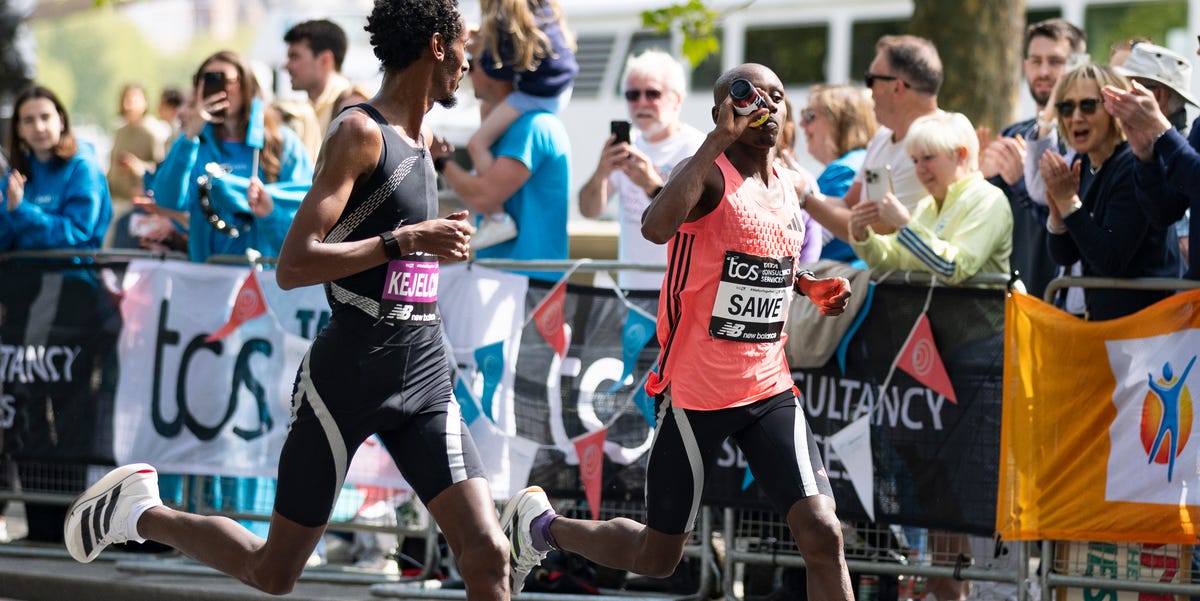
Sabastian Sawe lit the world record on fire at the 2026 London Marathon as he became the first person to officially break two hours, clocking 1:59:30.
Watching the limits of human performance shift was incredible and inspiring. It made me want to head out the door and test my own capabilities. But in addition to thinking about how insane it is to average a 4:33 pace for 26.2 miles, my mind also went to the fact that I’d never have a team of coaches and specialists helping me every step of the way to break my own PR.
I then asked myself: If I’ll never have all that, what can I actually take away from this performance to use in my own running—beyond maybe getting my hands on a pair of his $500 super shoes?
Fair question, I think. Runners like you and me will likely never reach the two-hour barrier in the marathon (although if anyone reading this does go for it, we believe in you). But for those hunting an elusive BQ finish or looking to complete 26.2 for the very first time, the good news is, the principles that powered Sawe’s performance aren’t reserved for the greatest athletes on the planet. They can apply to us, too.
To run a strong marathon, no matter your time goal or fitness level, the single most important aspect is how well you prepare, says Josh Rowe, head of sports tech at Maurten, a key strategist behind Sawe’s fueling for London. Rowe, along with others from Maurten, spent 32 days with Sawe’s team in Kenya to fine-tune his nutrition strategy for London.
Ahead, Rowe outlines three key lessons you can learn from Sawe’s record-breaking effort, and how to use them to finish your next marathon stronger than ever.
Related StoriesHave a Fueling Plan
Every marathoner is working against the same limitation: Your body only stores so much fuel.
“At some point during the race, you’re going to run out of carbohydrates,” says Rowe. “That’s when people refer to hitting the wall.”
The sudden fatigue and immediate slowdown you experience at that “wall” isn’t random. It’s your body shifting from carbohydrate to fat as its primary fuel source, which is a much less efficient process, Rowe says.
Sawe avoided this fate with a meticulously planned fueling strategy (see below) that included taking in an average of 115 grams of carbohydrates per hour during his record-breaking run, according to a Maurten press release.

Sawe’s Race-Day Fueling Strategy
Before the race:
6:45 a.m.: Bicarb System 15
Bus to start line: Drink Mix 320
Five minutes before the race: Gel 100
During the race:
5K: 160 mL of Drink Mix 320
10K: 160 mL of Drink Mix 320
15K: 160 mL of Drink Mix 320
20K: 160 mL of Drink Mix 320, Gel 100 Caf 100
25K: 160 mL of Drink Mix 320
30K: 160 mL of Drink Mix 320
35K: 160 mL of Drink Mix 320
40K: 160 mL of Drink Mix 320
The exact numbers aren’t the key; everyone’s fueling is unique. It’s the testing and planning beforehand to arrive at these numbers that you can use in your training.
Rowe, a former 2:20 marathoner himself, says treating fueling like an afterthought is a common mistake recreational runners make. Waiting for the free gels at aid stations or packing your own but only taking them when you get tired rarely allows you to run strong over a full 26.2 miles.
“A majority of runners have a plan for their training and their pacing,” Rowe says. “You need to do the same for your nutrition.”
That means making these two decisions ahead of time:
What type of fuel you’ll take (gels, chews, drink mixes, or something else)How often you’ll take it (whether that’s guided by mile markers or elapsed time)
Maurten recently launched a free, race-specific tool that does both of these things for you, with the goal of making personalized fueling available to runners like you and me—not just the elites.
Deciding on your strategy ahead of time is one thing, but it’s important to practice this plan in your training, which is Rowe’s second takeaway.
Related StoryTrain Your Gut
Rowe says many runners underestimate how often they actually need fuel during a marathon. Sawe’s strategy included fueling every 5K, which during his 1:59:30 race, meant taking in carbs about every 14 minutes. Most fueling advice for recreational runners suggests fueling every 30 minutes or so, which for a sub-four marathoner, still means taking in fuel about every 5K. (See, you’re not as different from Sawe as you think!)
This is where gut training becomes essential. In Sawe’s buildup to London, fueling wasn’t something he just figured out on race week. Rowe and the Maurten team worked with Sawe on his fueling for months, training his gut to process the exact amount of fuel he needed to sustain his record-setting pace in London.
“We’ve been saying it for years, ‘just get used to [your fuel],’” Rowe says. “That’s very much the idea around gut training.”
Rowe’s team ran a series of complicated and expensive tests to figure out the exact amount of carbs Sawe metabolized while he ran, and then adjusted his intake accordingly so he would always have the energy to perform. While we may not have that precise insight, practicing fueling throughout your training block allows for trial and error so you can also pinpoint the amount of carbs you need and when you need to replenish them.
Related Story
Rowe says to think of your gut as just another system to train, similar to your aerobic or anaerobic energy systems, which you target with specific workouts.
One of the biggest mistakes runners make is only practicing fueling on low-intensity long runs. “As you increase intensity, blood flow gets diverted away from the stomach,” Rowe explains. “So when you’re putting in gels and drinks, it struggles to metabolize them.”
That’s why, if you’ve only ever practiced fueling during long runs, the same fuel can suddenly cause an issue at mile 18 on race day, as you’re working at a higher effort.
To avoid this problem, Rowe recommends practicing your fueling in marathon-pace efforts in training. Then, gradually increase how much you take in over the course of your training cycle, just like you do with mileage and intensity.
Rowe says gut training for recreational runners may take anywhere from four to 10 weeks during their race training block. Some runners’ bodies may grasp their fueling better than others, making gut training shorter for them than for athletes who need to experiment with different options before actually progressing their intake level.
“It’s not like the start of a marathon training block, you actually go run a marathon,” Rowe says. “You build up to it. It’s the same with gut training.”
Related StoryDo the “Boring Stuff” Consistently
It’s tempting to think Sawe’s accomplishment came down to a team of specialists working to optimize every single aspect of his training, much like I did. While that was certainly part of it, zoom out, and the foundation of his success is a lot more attainable to the everyday runner.
“[Elite runners are] exceptionally good at doing the non-sexy things,” Rowe says.
In addition to racking up easy miles (he reportedly clocked about 150 miles a week on a 10-day training cycle), and simply knowing the purpose behind every workout, Sawe mastered nutrition. He didn’t just follow a plan—he took an active role in refining it, learning what worked for his body through repeated testing and adjustments, Rowe says. Over time, that hands-on approach helped him dial in a strategy he fully understood and trusted.
“A lot of people think all the training effects happen in the session itself,” Rowe says. “But a big factor is what happens after the training.”
If you finish a run completely depleted and ignore fueling, your body doesn’t have the energy it needs to absorb the work you just did, Rowe says. Over time, that can quietly limit your progress. “You could have an A-plus session, but if you have B or C nutrition, it completely brings the level of that session down,” Rowe says.
For recreational runners, the biggest gains often come from stacking these small, repeatable habits:
Fuel before key sessions so you’re not starting emptyPractice your fueling, not only on long runs, but specifically during marathon-pace workPrioritize postrun nutrition to support recovery
Sawe’s 1:59:30 wasn’t the product of one magical workout. It resulted from years of training and dedication to achieving a goal he always believed was possible.
“When I go home, they always ask about my training and preparation,” Sawe said in a press release from Maurten. “I haven’t shared with them my ambition to run a world record, because in our culture we don’t talk about such things in advance—only when they happen.”

Matt Rudisill is an Associate Service Editor with the Hearst Enthusiast Group. A Nittany Lion through-and-through, Matt graduated from PSU in 2022 with a degree in journalism and worked in communications for the university’s athletic department for the past three years as the main contact and photographer for its nationally-ranked cross country and track & field teams. Matt was also heavily involved in communications efforts for the Penn State football team’s 2024 College Football Playoff run as well as the Nittany Lion men’s basketball team’s 2023 NCAA Tournament appearance. In his role with Hearst’s Enthusiast Group, Matt contributes to both Runner’s World and Bicycling magazines, creating service content to benefit runners and cyclists of all ages. When he’s not out jogging, Matt can be found tweeting bad takes about the Phillies or watching movies.