




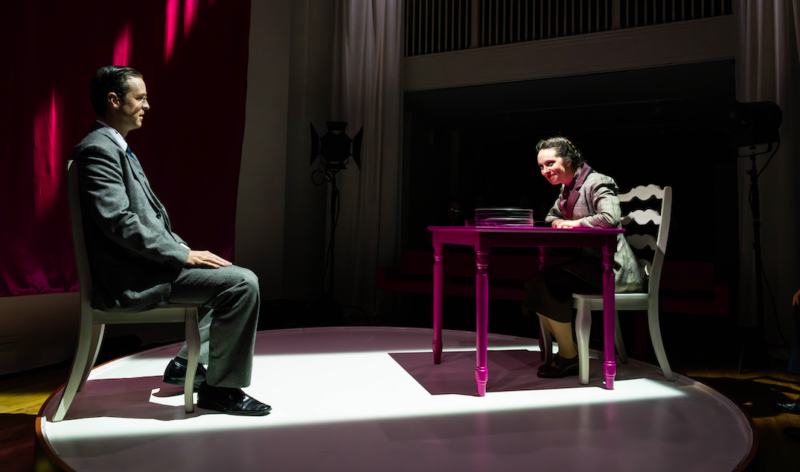
Photo: Beauty Freak features Keith Rubin and Baize Buzan. Photo courtesy of Alexia Haick / Provided by Everyman Agency with permission.
Beauty Freak is the new play by James Clements, currently running through May 17 at the cell theatre in New York City. The show, directed by Danilo Gambini and produced by What Will the Neighbors Say?, tells the story of notorious Naza propagandist Leni Riefenstahl, a woman who made films commissioned by the Third Reich. The play centers on the creation of Olympia, her documentary on the 1936 Berlin Olympics.
Recently Clements exchanged emails with Hollywood Soapbox, opening up about the difficulties of adapting Riefenstahl’s story for the stage and how her life has become a history lesson in horror. Questions and answers have been slightly edited for style.
When did you first learn of Leni Riefenstahl and her work? Was it a history class?
I first encountered Leni Riefenstahl’s work in history class, without even knowing it. Most of us have seen her work in documentaries about the Nazis and World War II. She is the definitive image-maker for that regime, whether we are aware of it or not. As I started making source-based theatre in my professional career, I was drawn to studying this era, and the propaganda specifically, as I saw parallels with our current moment (then 2016). Leni first interested me because she was the only woman in the Nazi history books that wasn’t a wife, a girlfriend or a secretary, and that just made me curious. The more I researched her, the more fascinated — and horrified — I became.
How did you figure out a way to tell her story in a dramatic format? Adapting her life must have been a head-scratcher.
It was beyond so. Balancing her incredible talent with the terrible impact she had on our world, and some of the unconscionable things she did, felt like such a tightrope act. None of us are all villain, or all hero — and presenting her as only a monster was too easy. For me, it all comes back to research — all of my work begins with archival work or interviews. I studied her in archives in Scotland, England, Germany, across the U.S., and spoke with people who had known her, visiting the sites of her life. That feels like my responsibility as an artist. After that, I tried to let the research soak into what is fundamentally a human story. I had to give myself permission — and accept I wasn’t going to get everything in a 100-minute play. It’s always a conversation.
What lessons from her life can be applied to 2026?
For me, Leni acts as a lens for 2026 in so many ways. For each of us — what are our lines in the sand? What are compromises we refuse to make? What is “too much” in a moment in our world where everything feels so painful and chaotic, and yet we have to continue living our lives? These questions are as prescient as they were in 1936, or 2016. An additional concern for me is the rise of AI, which wasn’t on my radar when I started work in 2016 — more than ever, we need to be thinking critically now about what we consume, and what reality actually means.
Is it difficult to be surrounded by this dark material? Did you ever need to step away and come up for a breath?
I have never worked on a piece of theatre for this long, and I think there are a few reasons for that. For one, Leni was so hard to unravel, so complex, so terrifying, that each answer opened up 10 more questions. The play just needed this long to germinate and take shape. Secondly, as our world went through the social and political traumas of the last decade, there were moments when I questioned if the play was necessary, and moments where I thought I’d never finish it. It’s been 140 pages; it’s been 50 pages. I’ve worked it, re-worked it and re-worked it again. It just needed time. So there were some built in pauses in the process, fortunately for me. And I’ve had amazing collaborators along the way, too, who have worked with me at various junctures. Opening the process up and letting other people in always feels liberating, regardless of the project, but especially with this one.
Are you nervous before a world premiere? Excited? Anxious?
I’m always nervous before a show I’ve written premieres. I think that is natural. But the actors, designers, producers and creatives on this project are so phenomenal, so value-aligned, that I am absolutely more excited than anxious, but a bit of both all the same.
What’s it like working with Danilo Gambini?
I have admired Danilo’s work for many years, since we encountered each other at Rattlestick’s Global Forms Festival for immigrant artists in 2021. We’ve seen each other’s work and always talked about working together on something. We are both immigrant artists, both a bit provocative, both quite strong-willed. This project came at a perfect time. Danilo was relocating to New York from his stint as associate artistic director of Studio Theatre in Washington, D.C., and I asked him if he would be interested. I was beyond thrilled that he said yes. He is a brilliant director, a great friend and a caring collaborator — my play feels safe in his hands.
By John Soltes / Publisher / John@HollywoodSoapbox.com
Beauty Freak by James Clements continues through May 17 at the cell theatre in New York City. Click here for more information and tickets.