



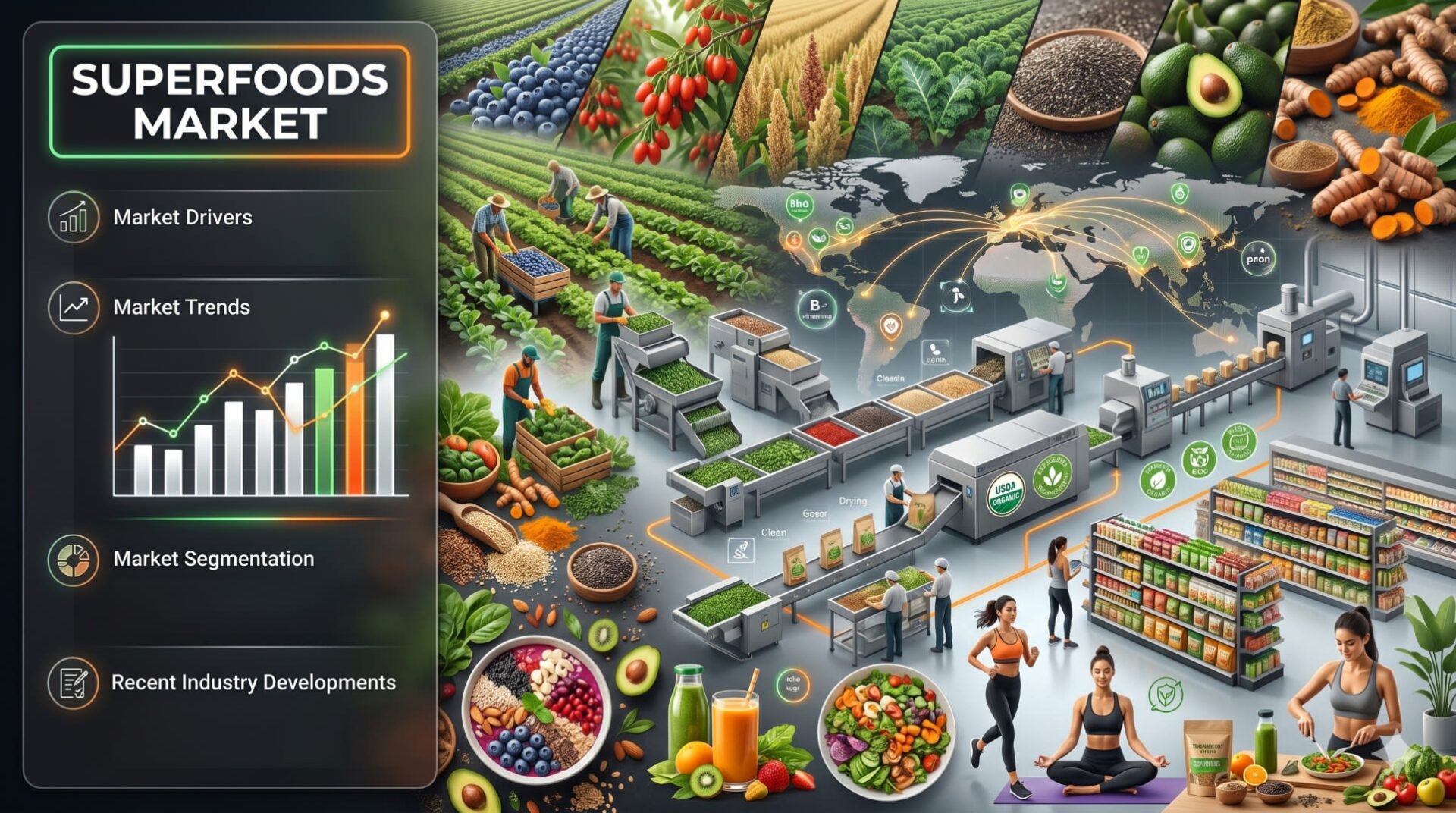
According to IMARC Group’s latest research publication, the global superfoods market size was valued at USD 187.7 Billion in 2025, expected to reach USD 272.2 Billion at a CAGR of 4.20% during 2026-2034.
How AI is Reshaping the Future of the Superfoods Market
Personalized Nutrition and AI-Driven Diet Recommendations: AI-powered platforms are transforming how consumers discover and incorporate superfoods into their daily routines. By analyzing biometric data, lifestyle habits, and health goals, these systems generate personalized superfood recommendations with remarkable precision. Wellness applications integrated with AI are now capable of suggesting specific combinations of chia seeds, spirulina, or moringa based on individual nutritional deficiencies. This personalization wave is converting passive buyers into loyal, engaged superfood consumers, directly fueling demand volume across both retail and direct-to-consumer channels worldwide. Supply Chain Transparency and Traceability Technologies: AI combined with blockchain and IoT-enabled sensors is enabling full end-to-end traceability for superfoods sourced from regions like Latin America, Southeast Asia, and Sub-Saharan Africa. Brands can now verify the origin of quinoa from Peru, acai from Brazilian rainforests, or moringa from East African farms in real time. This transparency capability is critical in the superfoods segment where organic certification and ethical sourcing claims are central to consumer purchasing decisions. Retailers and distributors leveraging these systems are building measurable trust advantages in an increasingly quality-conscious global market. Predictive Demand Forecasting for Perishable Inventory: Machine learning algorithms are enabling superfoods retailers and food manufacturers to forecast demand for highly perishable items such as fresh berries, leafy greens, and raw seeds with significantly improved accuracy. Inventory optimization tools powered by AI are helping companies reduce spoilage and overstock losses while maintaining product freshness standards that consumers expect from premium superfoods. Companies implementing these forecasting systems have reported meaningful reductions in waste across cold chain logistics networks, improving both profitability and sustainability metrics in an industry where shelf-life management is operationally critical. Innovative Product Development Accelerated by Data Analytics: Food technology companies are leveraging AI-driven consumer sentiment analysis and trend-mapping tools to fast-track the development of superfood-infused products. From kale chips and quinoa puffs to adaptogen-blended protein bars and matcha-enhanced baked goods, data insights are guiding R&D teams toward formats that resonate with evolving dietary preferences. The ability to identify micro-trends early and bring products to market faster is giving agile brands a decisive competitive advantage across the rapidly diversifying superfoods product landscape. E-Commerce Personalization and Digital Marketing Optimization: AI-powered recommendation engines on e-commerce platforms are increasing basket sizes and repeat purchase rates for superfoods brands. By analyzing browsing behavior, past purchases, and nutritional preferences, platforms dynamically surface relevant superfood products to individual shoppers. Wellness influencers and nutrition experts amplifying superfood messaging on social media are further supported by AI-driven content distribution tools that maximize audience reach. Between April 2022 and April 2023, global social media user numbers grew by 150 Million, representing a 3.2% year-on-year increase, a channel now central to driving superfoods market awareness and conversion.
Request a Sample Report with the Latest Data & Forecasts
Superfoods Industry Overview:
The superfoods market is witnessing strong growth momentum globally, underpinned by rising health consciousness, increasing prevalence of chronic diseases, and an accelerating shift toward plant-based and functional diets. In the United States, which holds a 75.6% share of the North American market, growing consumer demand for clean-label, organic, and nutrient-dense products is reshaping grocery retail and foodservice alike. The CDC reported adult obesity prevalence at 40.3% between August 2021 and August 2023, creating structural demand for preventive nutritional solutions. In Asia Pacific, governments in India and China are actively promoting dietary diversity initiatives that encourage consumption of indigenous superfoods such as turmeric, ginseng, and goji berries, reflecting the region’s growing integration of traditional wellness systems with modern nutrition science. The India Brand Equity Foundation estimates that the preventive healthcare market, encompassing functional foods and supplements, is on a strong upward trajectory with healthcare start-up investments in India exceeding USD 150 Million. Europe’s regulatory environment, including the EU’s strict food labeling and health claims framework, is reinforcing consumer trust in certified superfood products and driving premiumization across Germany, the United Kingdom, and France. Latin America, home to indigenous superfoods including acai, maca, amaranth, and quinoa, is benefiting from both domestic consumption growth and rising global export demand, with Brazil’s e-commerce sector growing at 14.3%. In the Middle East and Africa, the market for plant-based foods is projected to reach USD 8 to 9 Billion, with indigenous superfoods like moringa, baobab, and dates gaining significant commercial traction supported by government anti-malnutrition initiatives.
Superfoods Market Trends and Drivers
The explosive growth of health-conscious consumer segments globally is the primary driver of superfoods market demand. A study involving 500 participants confirmed that diets rich in superfoods such as blueberries and kale delivered a 20% reduction in cardiovascular disease incidence, providing scientific validation that is directly influencing purchasing behavior across demographics. More than one-fifth of the EU’s population of 448.8 Million people is aged 65 and above, creating a structurally significant aging consumer base actively seeking functional foods that support healthy aging, immune function, and cardiovascular health. The plant-based food movement is simultaneously accelerating superfood adoption, with sales of plant-based foods growing three times faster than overall food sales according to the Good Food Institute, and 8% of Black Americans identifying as strict vegans or vegetarians, with African Americans representing the fastest-growing vegan population in the country.
Retail sector expansion and digital transformation are reshaping how superfoods reach consumers and broadening market accessibility well beyond traditional health food stores. Supermarkets and hypermarkets now account for approximately 49.7% of superfoods distribution, offering competitive pricing, rigorous quality assurance, and in-store nutritional guidance that convert casual shoppers into committed buyers. In 2024, Zevia dramatically expanded its retail presence from 800 to 4,300 Walmart stores, illustrating how strategic distribution partnerships can rapidly scale superfood brand reach. Online platforms are equally transformative, giving consumers in secondary cities and underserved markets access to a full spectrum of superfood powders, beverages, and ready-to-eat formats previously unavailable locally.
Product innovation and sustainability commitments are creating additional growth levers across the superfoods value chain. In February 2024, Creative Nature, a leading UK allergen-free snack brand, launched its first savory product exclusively on Virgin Atlantic, targeting premium and business travelers and expanding its commercial reach across 18 countries. In 2024, ADM and Farmers Business Network launched Gradable, a joint venture developing a technology platform that helps farmers and buyers embrace sustainable and regenerative farming practices, directly addressing the ethical sourcing expectations of superfoods consumers. The beverages application segment leads all end-use categories with approximately 38.7% market share, driven by the convenience and functional appeal of superfood drinks featuring turmeric, matcha, spirulina, and acai that simultaneously target immunity, digestion, and detoxification benefits for on-the-go consumers.
Leading Companies Operating in the Global Superfoods Industry:
Archer-Daniels-Midland Company Creative Nature Ltd. Del Monte Pacific Ltd. Healthy Truth Nature’s Superfoods LLP Navitas LLC Nutrisure Limited (Supernutrients) Rhythm Superfoods LLC Suncore Foods Inc. Sunfood Corporation Superlife Co. Pte. Ltd.
Superfoods Market Report Segmentation:
By Product Type:
Fruits Vegetables Grains and Seeds Herbs and Roots Meat Others
Fruits represent the largest product type, holding approximately 29.6% of the market, owing to their high antioxidant content, natural sugar profile, dietary fiber richness, and exceptional versatility across fresh consumption, smoothies, salads, and prepared foods.
By Application:
Bakery and Confectionery Beverages Supplements Convenience/Ready-to-Eat Foods Others
Beverages lead the application segment with around 38.7% market share, driven by growing demand for convenient, immune-boosting, and functional drink formats incorporating superfoods such as matcha, spirulina, acai, and turmeric.
By Distribution Channel:
Supermarkets and Hypermarkets Convenience Stores Specialty Stores Independent Small Grocery Stores Online Sales Others
Supermarkets and hypermarkets dominate distribution with approximately 49.7% market share due to their wide product assortment, competitive pricing, quality standards, and consumer education resources that support superfoods adoption at scale.
Regional Insights:
North America (United States, Canada) Asia Pacific (China, Japan, India, South Korea, Australia, Indonesia, Others) Europe (Germany, France, United Kingdom, Italy, Spain, Russia, Others) Latin America (Brazil, Mexico, Others) Middle East and Africa (Turkey, Saudi Arabia, Others)
North America exhibits clear dominance in the superfoods market, accounting for approximately 39.8% of global market share, driven by high disposable incomes, a robust nutrition research community, widespread retail availability, and deeply embedded consumer awareness of functional food benefits.
Recent News and Developments in the Superfoods Market
June 2024: Nutrisco acquired majority ownership of LiveMore Superfoods, a smoothie company focused on delivering high-quality, nutritious, and affordable superfood products to a broad consumer base. The acquisition reflects the growing investor appetite for functional food brands that combine health impact with commercial scalability. June 2024: B.T.R. and Blue Bottle Coffee collaborated to launch a Superfood Protein Bar in the Spiced Chocolate Chip Cookie Dough flavor, targeting premium health-conscious consumers seeking nutritional support through innovative snack formats that blend performance ingredients with indulgent taste profiles. May 2024: Laird Superfood Inc. announced the launch of its new Laird Superfood Protein Creamer, delivering 12 grams of protein per serving through a blend of pea, hemp, and pumpkin seed proteins, naturally sourced MCTs from coconut, and a proprietary blend of performance mushrooms designed for coffee and tea applications. January 2024: Nutrabolt emerged as the largest investor with approximately a 20% stake in Bloom Nutrition, contributing to a broader USD 90 Million financing round. Bloom Nutrition, established in 2019, has become a leading omnichannel brand anchored by its popular greens and superfoods product line, built significantly through TikTok and social media engagement.
Note: If you require specific details, data, or insights that are not currently included in the scope of this report, we are happy to accommodate your request. As part of our customization service, we will gather and provide the additional information you need, tailored to your specific requirements. Please let us know your exact needs, and we will ensure the report is updated accordingly to meet your expectations.