



US President Donald Trump has officially reinstated the Presidential Fitness Test for American schoolchildren, a major policy directive somewhat overshadowed by his startling admission that his own exercise regimen maxes out at a mere sixty seconds a day.
The Tuesday signing ceremony in the Oval Office, attended by professional athletes and senior cabinet officials, thrust the 79-year-old president’s health and physical stamina back into the global spotlight. The juxtaposition of demanding rigorous physical standards for the nation’s youth while openly mocking his own personal fitness routines has sparked renewed debate over the physical demands of the world’s most powerful office.
The Oval Office Declaration
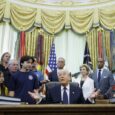
Surrounded by school children and legendary golfers Gary Player and Bryson DeChambeau, President Trump signed the executive proclamation with characteristic theatricality. Before putting pen to paper, Trump addressed the swirling speculation regarding his age and vitality with a dose of self-deprecating humor that quickly dominated the news cycle.
“I work out so much, like, about one minute a day, max. If I’m lucky,” Trump stated, drawing laughter from the assembled guests. He subsequently turned to one of the students, patted the boy on the arm, and asked if he thought he could beat the President in a fight, adding with a chuckle that the student likely could.
The lighthearted exchange was immediately defended by Health Secretary Robert F. Kennedy Jr., who asserted that the President possessed immense stamina. Kennedy noted that playing regular rounds of golf constitutes significant cardiovascular exercise, stating that Trump routinely walks several miles on the course every weekend without fatigue.
A Return to the Presidential Fitness Test
The executive order marks the return of the Presidential Physical Fitness Award, a mid-century staple of the American physical education curriculum that was phased out in previous administrations due to concerns over body shaming and changing pedagogical philosophies. The program historically measured students in events like the shuttle run, pull-ups, and the mile run.
Proponents of the reinstatement argue that the test is a necessary intervention to combat rising childhood obesity rates and declining physical activity among teenagers. By attaching presidential prestige to athletic performance, the administration hopes to incentivize a return to competitive physical education in public schools.
However, public health experts and educators have expressed reservations. Critics argue that the rigid, performance-based metrics of the traditional fitness test often alienate students who lack natural athletic ability, advocating instead for programs that promote lifelong wellness and personalized fitness goals over standardized physical benchmarks.
The Politics of Presidential Health
President Trump’s remarks arrive at a highly sensitive moment in American politics, where the advanced age of the nation’s leadership remains a central voter concern. Turning 80 next month, Trump is the oldest president ever inaugurated, a fact that his political opponents consistently highlight.
Throughout the 2024 election cycle, Trump aggressively leveraged the issue of age against his Democratic predecessor, Joe Biden, framing himself as the more robust and energetic candidate. His current willingness to joke about his lack of formal exercise reflects a confident political strategy that seeks to disarm critics through blunt transparency.
Medical professionals monitoring the presidency note that the grueling schedule of the executive branch demands extraordinary resilience. While structured gym workouts may not be part of the President’s daily routine, the sheer adrenaline and relentless pace of global diplomacy, campaign rallies, and executive decision-making exact a significant physical toll.
Global Precedents in Leadership Fitness
The public perception of a leader’s physical fitness often serves as a proxy for their political strength. Across the globe, heads of state frequently utilize exercise as a potent public relations tool. From staged judo matches to highly publicized morning jogs, leaders instinctively understand that projecting vitality projects competence.
President Trump’s distinct departure from this norm—openly acknowledging his aversion to traditional exercise—subverts the standard political playbook. It aligns seamlessly with his broader populist brand, which frequently mocks the established behavioral expectations of the political elite.
As schools across the United States prepare to implement the newly reinstated fitness protocols, the effectiveness of the program will be closely monitored. Whether the President’s candid remarks undermine the initiative’s serious public health objectives remains a subject of intense debate among political analysts and medical professionals alike.
President Trump, who turns 80 next month, is the oldest inaugurated president in United States history.The original Presidential Physical Fitness Award was introduced in 1966 under President Lyndon B. Johnson.Health Secretary Robert F. Kennedy Jr. publicly defended the President’s stamina, emphasizing his regular golfing routine.The reinstated fitness testing program is expected to eventually impact an estimated 50 million students across American public schools.
The reinstatement of the fitness award underscores a broader administrative push toward traditional standards, even as the commander-in-chief candidly admits to falling far short of those very metrics. The ultimate success of the program will depend not on the rhetoric in the Oval Office, but on how effectively it inspires a sedentary generation to move.