




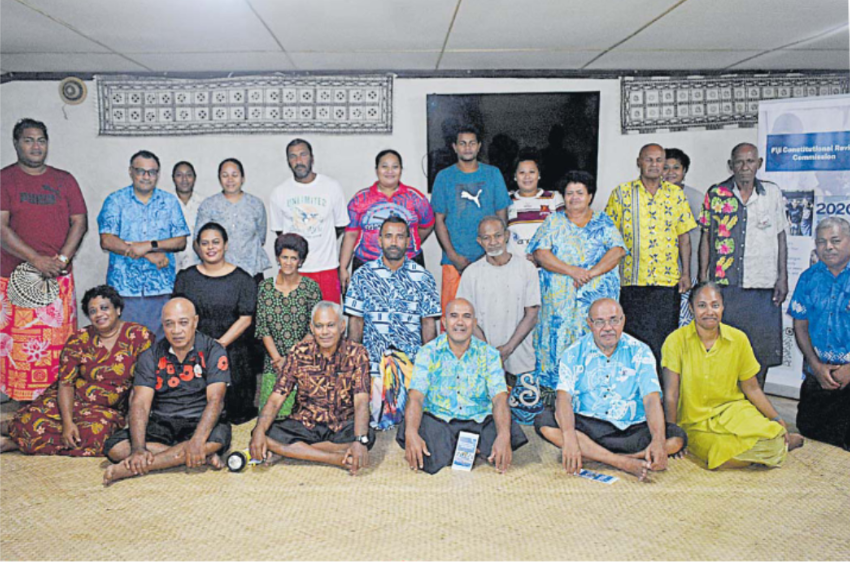
A VILLAGE leader and educator has demanded the abolishment of the constitutional immunity for coup makers, arguing it is a slap in the face for ordinary citizens.
Oneata District School head Sowane Kurusiga Tuivanua took his plea to the Constitution Review Commission, calling for the immediate removal of Chapter 10 of the 2013 Constitution.
Mr Tuivanua told commissioners it was fundamentally unfair that petty criminals faced the full weight of the law while those who overthrew governments walked free.
“When you think about it, how can someone be arrested and serve time for breaking into a shop, while someone who conducted a coup d’état not be arrested or serve his time?” Mr Tuivanua said.
Speaking at the Waiqori Village hall, he argued that the current legal framework created a one-sided system of justice that protected the powerful.
His submission insisted that the Constitution’s promise of equality must be upheld without exception or special loopholes for political disorder.
“Regardless of your status, work, and occupation, we are all equal, and everyone should be bound by the laws and constitution of the land.”
“If one wishes to commit treason, they should be dealt according and lawfully.”
The commission is currently gathering public feedback on potential reforms to the nation’s Constitution in the Lau Group.
Moce backs chiefly authority
VILLAGERS of Moce Island have called for the Great Council of Chiefs to regain its authority to appoint
the President during a Constitution Review Commission hearing on Moce Island in Lau.
The push to restore the traditional selection process were made by residents Viliame Cama and Metuisela
Bua, who both submitted that the GCC should be reinstated as the appointing authority for the Head of
State.
Mr Cama told the commission that involving the GCC would ensure the presidency was anchored by a clear leadership background and traditional selection.
“Bring back the GCC to appoint the President, they would see who is fit for leadership according to how
one leads,” Mr Cama said.
His submission was supported by Mr Bua, who formally supported the proposal to return to the
appointment of the President used in Fiji’s previous constitution.
“I support that the President be appointed by the Great Council of Chiefs,” Mr Bua said.
The submissions are part of a broader series of consultations the commission is holding to gather
public feedback on the potential review of the nation’s constitution.
Calls for stricter discipline
AN educator is demanding the return of corporal punishment to Fiji’s classrooms, insisting that strict
discipline is the key to moulding the nation’s future leaders.
The head of Oneata District School, Sowane Kurusiga Tuivanua, recommended a controversial push to
reintroduce physical discipline in schools in his submission to the Constitution Review Commission.
He proposed the power to discipline a student be stripped from general teachers and reserved solely
for school heads.
Mr Tuivanua argued that a law of limitation is the only way to ensure the practice remains a tool for
character building rather than a form of child abuse.
By limiting the authority to punish, he believes the Government can maintain a strict standard of
discipline while protecting children from unregulated or excessive force.
Reflecting on his own upbringing, the headteacher credited the discipline of yesteryear for the success of
today’s community elders.
“We know the benefits of being disciplined as a young child — look at us now,” he said.
“We’ve become better men today.”
Villagers call for protection of indigenous identity
MOCE villagers are demanding the exclusive right to the Fijian label, insisting the name must reflect the
indigenous iTaukei culture to ensure true national identity.
Moce native Tataka Buadromo expressed support for a submission, originally recommended by the Great
Council of Chiefs on April 1, that argues the term Fijian should be reserved solely for iTaukei people.
“I support the submission of identifying us iTaukei as Fijians, and calling others according to their
culture,” Mr Buadromo said.
The response was highlighted by fellow villager Sovea Turagabeci, who told the commissioners that
the label must embody the authentic traditions of the land’s first people.
“To be called Fijian, you need to reflect the culture and traditions of the Fijian people, which is us
iTaukei,” Mr Turagabeci said.
He maintained that the push to separate labels was a vital step in embracing the distinct backgrounds of
all citizens.
“We need to identify each other because of the difference in our culture and customs.”
Mr Turagabeci clarified that the move was not fuelled by animosity, but rather a desire for mutual respect
as before. He highlighted that calling ourselves according to our culture is not out of hate, but a form
of embracing each other’s identity.
To be called Fijian, you need to reflect the culture and traditions of the Fijian people, which is us iTaukei –
Tataka Buadromo