




K-beauty has already secured global attention. Products are widely distributed across e-commerce platforms, social media channels, and international retail networks. However, as Korean brands expand deeper into Western markets, a different constraint is beginning to shape outcomes.
Hence, the issue is no longer visibility or even understanding. It is in the belief.
As content appears in their social media, consumers are now increasingly questioning: is this real? Or just another beauty marketing? This then results in a trust gap between brand messaging and consumer perception, and this gap is now influencing conversion.
K-Beauty Barrier: When Perfect Content Starts to Feel Unbelievable
The global marketing environment is shifting. Technological capability has made it easier to produce polished, high-quality visuals at scale, including AI-generated imagery and highly refined digital content.
However, consumer response is moving in the opposite direction.
A 2026 survey by Gartner found that 50% of U.S. consumers prefer to engage with brands that avoid using generative AI in consumer-facing content. This signals a growing hesitation toward content perceived as overly artificial or detached from real experience.
At the same time, research from Nuremberg Institute for Market Decisions shows that only around one in five consumers trust AI systems or the companies behind them. This reinforces a broader pattern. The more content appears technically perfect, the more it risks being questioned.
This shift is particularly relevant for K-beauty brands, where visual presentation plays a central role in communicating product value.
As discussions on how content execution shapes global conversion continue, Founder and CEO of Seoul to Studios, Anna Lena Maerz, who works closely with Korean brands on cross-border marketing and localization, told KoreaTechDesk,
“Many Western consumers are experiencing a strong ‘Anti-AI’ wave. They are pivoting toward radical authenticity and raw storytelling. When brands rely on highly polished or AI-generated visuals, it can feel disingenuous or even uncanny.”
Her observation points to a structural tension. What signals innovation and quality in one market can signal distance and artificiality in another.
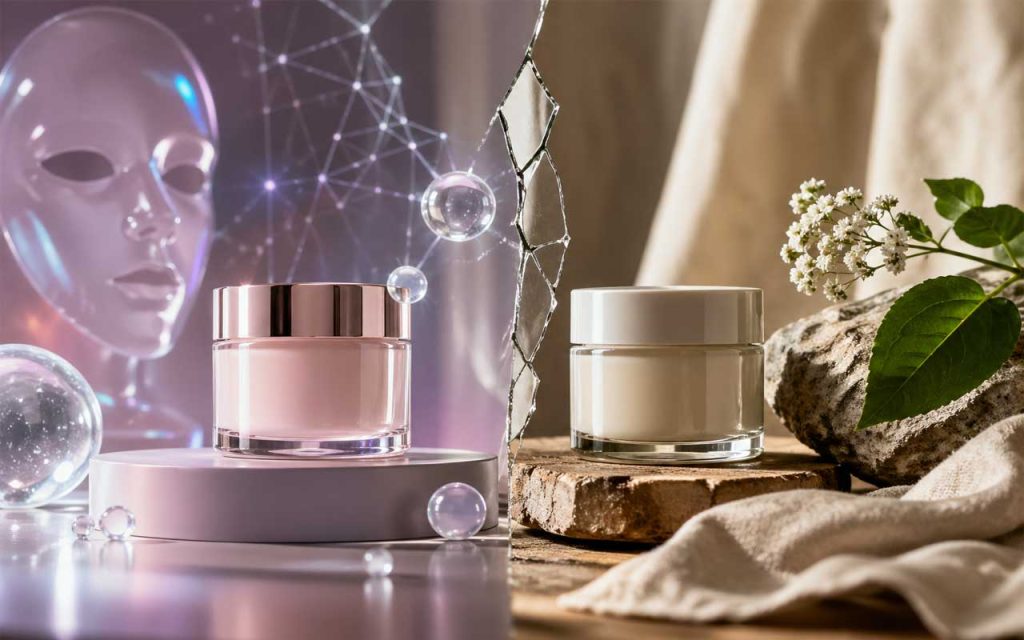 AI illustration of beauty filter trust challenge in K-beauty
Beauty Advertising Is Moving Under Closer Scrutiny
Moreover, the trust issue is not only behavioral. In fact, it is also increasingly regulatory.
In South Korea, authorities are already responding to the risks associated with misleading digital content. Reporting by the Associated Press shows that the government plans to require labeling of AI-generated advertisements starting in 2026, as part of broader efforts to prevent deceptive marketing practices.
At the same time, enforcement data highlights the scale of the issue. Korea’s Ministry of Food and Drug Safety identified more than 96,000 illegal online advertisements in 2024, with tens of thousands more flagged in 2025 across sectors including cosmetics.
This reflects a growing concern. When visual claims, promotional content, or endorsements exceed what can be reasonably delivered, the problem is no longer limited to marketing effectiveness. It becomes a matter of consumer protection.
A similar direction is visible in Western markets. The UK’s Advertising Standards Authorityhas warned that beauty ads using filters or visual enhancements can mislead consumers if they exaggerate results. Even when disclaimers are present, the overall impression must remain realistic.
These developments suggest a convergence. Across markets, regulators are beginning to treat visual presentation itself as part of the product claim.
The Conversion Break Happens at the Moment of Doubt
In beauty products, the distance between promise and reality is particularly sensitive.
Consumers are not simply evaluating features. They are imagining outcomes on their own skin, in their own routines, under their own conditions. When that imagined outcome feels unrealistic, the purchase decision stalls.
Anna Lena Maerz described this as a trust gap created by idealized marketing:
“When consumers see perfect results that rely on heavy filtering or unrealistic conditions, it creates a disconnect. The product may generate interest, but trust does not carry through to purchase.”
This disconnect may seem subtle, but it’s actually critical. A campaign may succeed in generating clicks or engagement, especially in a category supported by strong global interest like K-beauty. However, if the consumer begins to question the credibility of the result, the interaction ends before it becomes meaningful.
In this context, conversion does not collapse due to lack of information. It collapses when the consumer no longer trusts what is being shown.
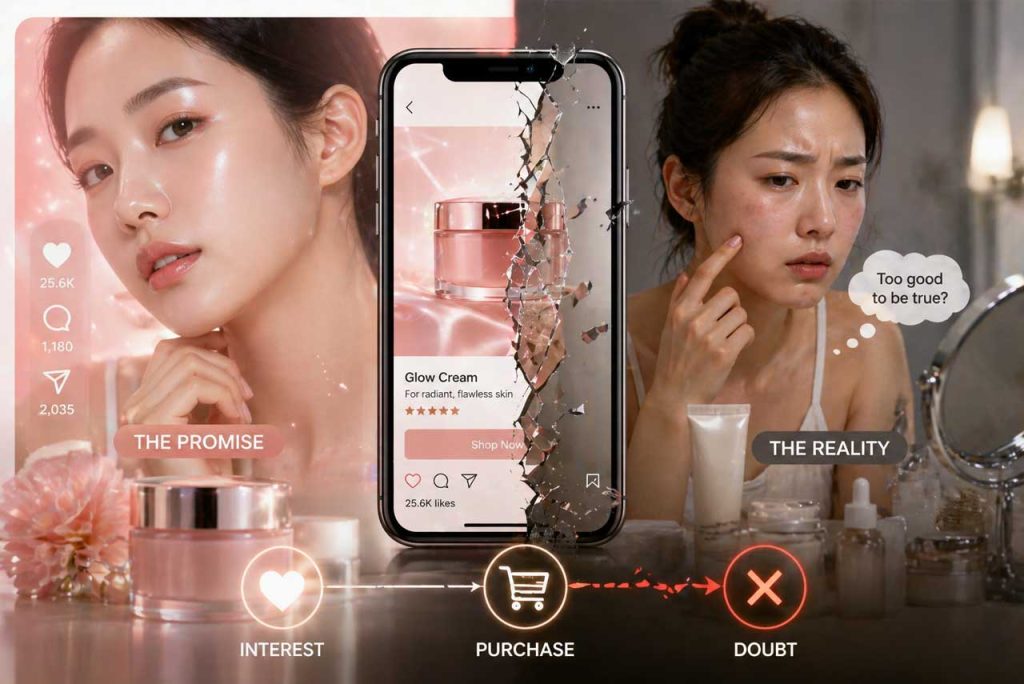 AI illustration of consumer trust in K-beauty
User-Generated Content Emerges as a Credibility Layer
As skepticism toward polished content increases, consumers are shifting toward alternative sources of validation.
Data from PowerReviews shows that 99.5% of consumers seek out user-generated photos or videos before making a purchase, and 68% consider such content more authentic than brand-produced visuals. The same research indicates that interaction with user-generated imagery can significantly increase conversion rates.
This shift is reshaping how beauty brands build credibility.
Anna Lena Maerz emphasized the role of realistic content in bridging the trust gap:
“Consumers need to see the product on real skin, with real texture, in real conditions. Realistic user-generated content becomes a bridge of truth between the brand and the consumer.”
The implication is not that brand-produced content loses relevance. Instead, it must be supported by layers of proof that feel independent, relatable, and verifiable.
In practice, this means moving away from a single, controlled narrative toward a distributed ecosystem of believable experiences.
Trust Signals Are Becoming Part of Market Infrastructure
As this shift becomes more visible, the broader ecosystem is starting to adjust accordingly.
In the United States, the Federal Trade Commission has introduced rules banning fake reviews and misleading testimonials, including those generated through artificial means. The regulation reflects a growing recognition that trust signals are integral to how consumers navigate digital marketplaces.
In parallel, industry analysis indicates that beauty consumers are increasingly influenced by peer content, community validation, and creator-driven storytelling. Traditional advertising remains relevant, but it no longer operates in isolation.
Instead, credibility is built through multiple layers:
Real user experience
Transparent representation of results
Consistency between claims and outcomes
For K-beauty brands entering Western markets, these layers are not optional enhancements. They are part of the conversion infrastructure.
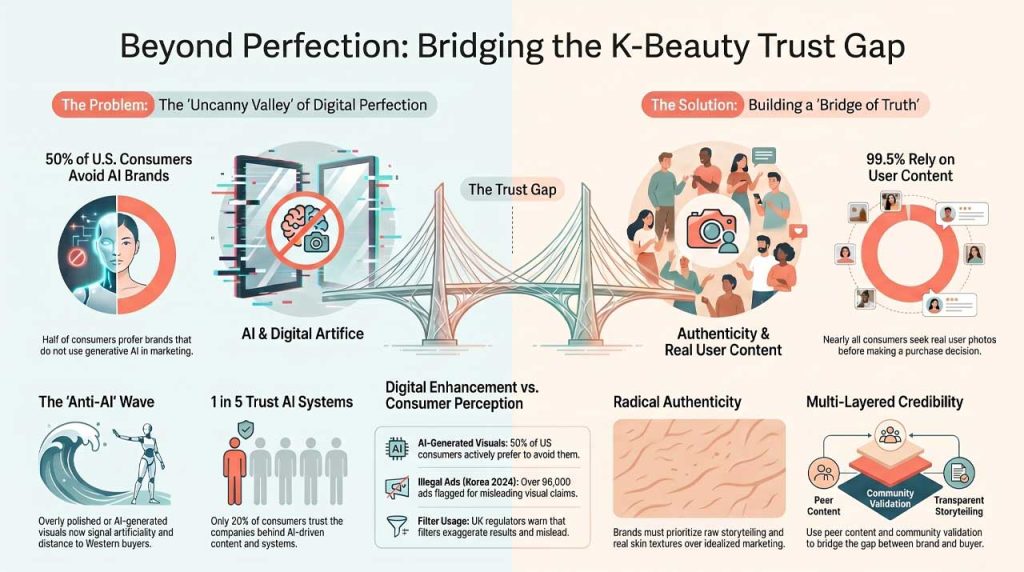 Bridging K-Beauty trust gap | AI infographic
The Next Phase of K-Beauty Expansion Is Believability
Finally, K-beauty’s global success has been built on product quality, innovation, and cultural influence. These strengths remain intact.
However, as the category matures internationally, the criteria for success are now evolving.
Consumers are no longer evaluating only what a product promises or how it is presented. They are evaluating whether the presentation itself can be trusted.
This requires a shift in execution logic.
Instead of maximizing visual perfection, brands must ensure that what they show aligns with what consumers expect to experience. Instead of relying solely on controlled campaigns, they must build systems that allow real-world validation to emerge.
Because in the current environment, attention can be generated through scale and visibility. Conversion, however, depends on credibility.
Key Takeaway
Global demand for K-beauty remains strong, but conversion increasingly depends on consumer trust, not just visibility or messaging clarity.
AI-generated and highly polished visuals can reduce trust in Western markets, where 50% of consumers prefer brands that avoid AI in consumer-facing content.
Regulators in Korea and the UK are tightening oversight on misleading visuals, filters, and AI-generated ads, signaling that credibility is becoming a compliance issue.
Unrealistic or overly idealized results create a “trust gap”, where consumers disengage before purchase despite initial interest.
User-generated content functions as a credibility layer, with 99.5% of consumers relying on real user visuals before buying.
The next competitive edge for K-beauty brands is believability, where real-world validation and authentic representation determine global conversion success.
🤝 Looking to connect with verified Korean companies building globally?
Explore curated company profiles and request direct introductions through beSUCCESS Connect.
– Stay Ahead in Korea’s Startup Scene –
Get real-time insights, funding updates, and policy shifts shaping Korea’s innovation ecosystem.
➡️ Follow KoreaTechDesk on LinkedIn, X (Twitter), Threads, Bluesky, Telegram, Facebook, and WhatsApp Channel.