





New research highlights soybean meal’s role beyond protein – driving energy efficiency, growth, disease resilience and summer performance
 11 May 2026

8 minute read
At the 2026 ASAS Midwest Section meeting, R. Dean Boyd, PhD, consultant at Animal Nutrition Research, LLC and Aaron Gaines, PhD, managing partner at Ani-Tek, LLC, PhD, spoke at the U.S. Soy sponsored Swine Application Symposium, presenting new research that challenges long-held assumptions and forcing nutritionists to rethink formulation strategies in modern pig production.
Drawing on a three-year private-sector research initiative supported by the United Soybean Board, their work outlines four key “pillars” that redefine soybean meal’s role – not just as a protein source, but as a driver of growth, health and profitability in commercial production systems.
Four pillars redefining soybean meal value
Boyd opened the session by framing the work as the culmination of years of collaborative research aimed at better understanding soybean meal’s role under real-world conditions.
“We have created a capstone paper that distills the most consequential findings that the study team found,” Boyd said, noting that much of the insight came from commercial production environments where pigs are exposed to stressors not present in controlled academic trials.
“We operated in both, but if not for the commercial environment, we wouldn’t have been able to detect some of the unique features,” he said.
From that work, four distinct categories of advancement emerged:
1. Energetic value
The first pillar focuses on soybean meal’s energy contribution, which Boyd argued has been underestimated when viewed strictly through traditional net energy systems. In academic settings, soybean meal energy values align closely with established benchmarks of around 2,500 kcal/kg dry matter. However, commercial observations told a different story, indicating expressed net energy at 3302 kcal/kg dry matter.
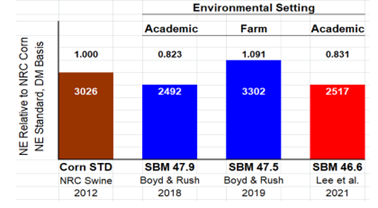
“In 2010, when we compared soybean meal to corn, I thought it was 78% of corn, but I realized I’d made a statistical error and it was 109% of corn,” Boyd said, describing how field data forced a complete reassessment of soybean meal’s relative energy value.
“It seemed inconceivable that it could be due to the soybean. We eventually decided it’s likely something in the soybean was causing a greater use of the total dietary energy,” he said.
This discrepancy led to the concept of “productive energy,” which accounts for how efficiently pigs utilize total dietary energy rather than simply measuring caloric content. Boyd suggested that soybean meal’s contribution may lie in its ability to improve the efficiency of energy use across the entire diet.
“It is our proposal that because of some of the functional components in soybean meal – that could reduce inflammation, increase viral clearance, etc. – that the pig’s body is coming forward with less energy spent on protective mechanisms,” he explained.
In this context, soybean meal may help reduce the metabolic cost of stress and immune function, allowing more energy to be directed toward growth.
2. Maximum growth and feed conversion efficiency (FCE)
The second pillar addresses a question that has challenged nutritionists for decades: how far soybean meal can be replaced with synthetic amino acids without compromising performance.
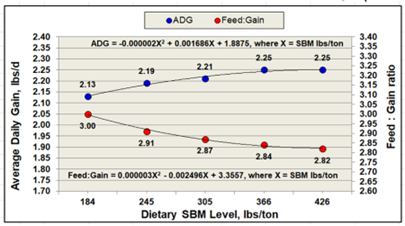
Boyd described experiments in which diets were formulated to identical amino acid profiles, with soybean meal progressively removed and replaced with synthetic sources and non-essential nitrogen. Despite meeting all known nutrient requirements, pigs on low-soybean meal diets exhibited reduced growth and altered body composition.
The findings suggest that something beyond amino acids becomes the first limiting factor to normal growth when soybean meal is removed.
Further research confirmed a consistent pattern: increasing soybean meal inclusion improved both growth rate and feed efficiency across multiple production phases. The implication is clear—minimum levels of soybean meal are required to achieve maximum biological performance.
 3. Mitigation of respiratory disease impaired growth
The third pillar highlights soybean meal’s role in supporting pigs under disease challenge, particularly porcine reproductive and respiratory syndrome (PRRS).
In PRRS-infected pigs, higher soybean meal diets were associated with improved growth, feed efficiency and survival, suggesting a practical role for soybean meal as a functional ingredient in health management.
Boyd described this as a “historic” finding, emphasizing that the observed benefits could not be explained by protein or amino acid content alone. Research points to bioactive compounds in soybean meal, such as isoflavones and saponins, as potential drivers of improved immune response and reduced inflammation.
4. Mitigation of carcass weight dip
The fourth pillar focuses on one of the most costly seasonal challenges in swine production: reduced carcass weights during summer months.
“If you want to get rid of the carcass dip, it’s easy to do,” said Boyd. “Or if you want to do least cost diets all your life, you’ll always have a carcass dip.”
Boyd emphasized that maintaining sufficient soybean meal levels is essential for sustaining growth under heat stress conditions. At the same time, he cautioned against excessive inclusion of distillers dried grains with solubles (DDGS), which can suppress feed intake and undermine performance. He suggested <10% DDGS inclusion, noting use above that level will undermine growth.
“You also have to adhere to maximum synthetic lysine levels,” he said.
Taken together, the four pillars point to a broader conclusion: soybean meal contributes value that extends beyond its nutrient profile. Boyd summarized this with a hypothesis that functional compounds in soybean meal enhance the efficiency of nutrient utilization, particularly in commercial environments where pigs face multiple stressors.
Translating research into practice
Building on Boyd’s framework, Dr. Aaron Gaines shifted the discussion toward practical application, outlining how nutritionists can incorporate these findings into feed formulation strategies by re-evaluating energy values.
Gaines began by addressing one of the most immediate implications of the research: how soybean meal’s energy value should be represented in formulation systems.
Depending on whether academic or commercial data are used, soybean meal’s relative energy value ranges widely—from approximately 85.5% of corn in an academic setting to 102% in a commercial setting. In practice, many producers have settled somewhere in between.
“We did a commercial industry survey and found that about half the industry has increased their energy value of soybean meal to 97% of corn,” Gaines said.
However, he cautioned that adjusting soybean meal energy values is not a simple substitution. Changes must be accompanied by corresponding adjustments to lysine-to-energy or phosphorus-to-energy ratios to maintain nutritional balance.
Defining minimum inclusion levels
Gaines said that while synthetic amino acids can effectively replace soybean meal in earlier growth phases, this strategy becomes less effective as pigs approach market weight.
“At about 150 pounds, particularly at 200+ pounds, there’s a barrier to extensive amino acid usage,” he said. “Unfortunately, we have not been able to resolve this for more than 20 years. It doesn’t matter if we formulate to equivalent net energy values or exceed the ideal pattern of amino acids for all 10 essential amino acids or add non-essential nitrogen. It’s just not provided resolution to the problem.”
Research indicates that maintaining at least modest levels of soybean meal – typically in the range of 4% to 8% – is necessary to sustain optimal growth and feed efficiency. In many cases, performance peaks at around 8% inclusion.
These findings raise important questions for formulation strategies, particularly in systems that rely heavily on least-cost approaches.
Using nutrition to support herd health
Gaines highlighted the practical application of soybean meal in managing swine respiratory disease. By aligning feeding strategies with expected disease challenges, nutritionists can play a more active role in supporting herd health and taking on PRRS and porcine epidemic diarrhea virus (PEDV) which continue to present a significant challenge to the industry.
“The idea is to apply high soybean meal diets at the timeframe of expected PRRS virus infection of weaned pig flows,” he explained.
In practice, this involves coordinating with veterinary and production teams to identify at-risk pig flows and implement higher-soybean meal diets during critical periods. The system would have a set of standard diets and high soybean meal diets available for implementation at the feed order desk.
While additional research is needed to determine optimal duration, the approach represents a shift toward more dynamic, health-focused nutrition programs.
Reassessing DDGS in modern diets
DDGS in swine diets have evolved since the ethanol boom in 2007. Changes in ethanol production have reduced oil content in DDGS, altering its nutritional and economic value.
“In 2007, DDGS were at 12% oil, and today it’s 4% oil or less. Many want to feed 6% to 8% oil products,” Gaines explained. “So, it does raise the question if distillers are as good of a value as in the past?”
Recent data suggests that lower-oil DDGS reduce feed intake and growth performance, with economic consequences that extend beyond feed cost savings. The response is variable and may be attributed to plant source or DDGS level utilized.
In some scenarios, modest feed cost reductions are offset by lower carcass weights and reduced income over feed cost.
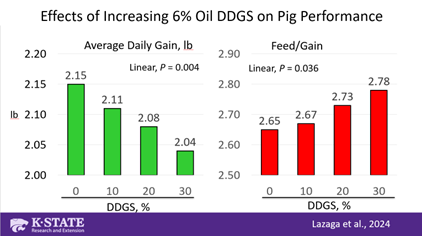
Gaines encouraged nutritionists to look at their current distiller source and make sure they are still delivering the value you expect.
Managing seasonal performance challenges
Building on Boyd’s earlier discussion, Gaines addressed strategies to mitigate summer carcass weight losses, noting diet composition plays a critical role.
“The problem is reduced feed intake, and it’s made worse by excessive levels of DDGS,” he said. “it can be further exacerbated if diets are too low in soybean meal.”
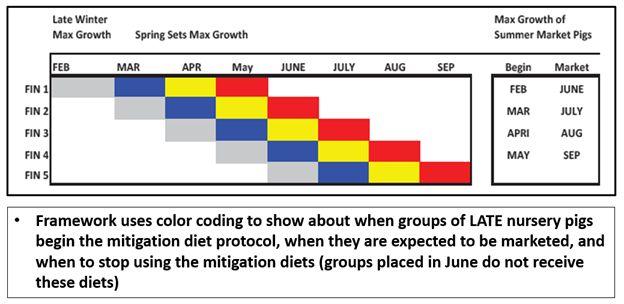
Maintaining adequate soybean meal and lysine levels while limiting DDGS inclusion is essential for preserving growth performance during summer months. Equally important is the timing of dietary adjustments.
“If pigs are being marketed in June, those pigs need to start on mitigation diets in February,” Gaines noted. “Timing is key to making this application work for you.”
 A shift in how soybean meal is valued
Together, Boyd and Gaines present a compelling case for re-evaluating soybean meal’s role in swine nutrition. Rather than serving solely as a protein source, soybean meal emerges as a multifunctional ingredient that infuences energy utilization, growth potential, disease resilience and seasonal performance.
Their work challenges the industry to move beyond least-cost formulation and consider the broader biological and economic value of feed ingredients. As Boyd summarized, the conclusions ultimately came from observing pigs under real-world conditions.
“We simply let the pigs do the talking,” he said.
Increasingly, those pigs are pointing toward a more complex and more valuable role for soybean meal in modern production systems.