




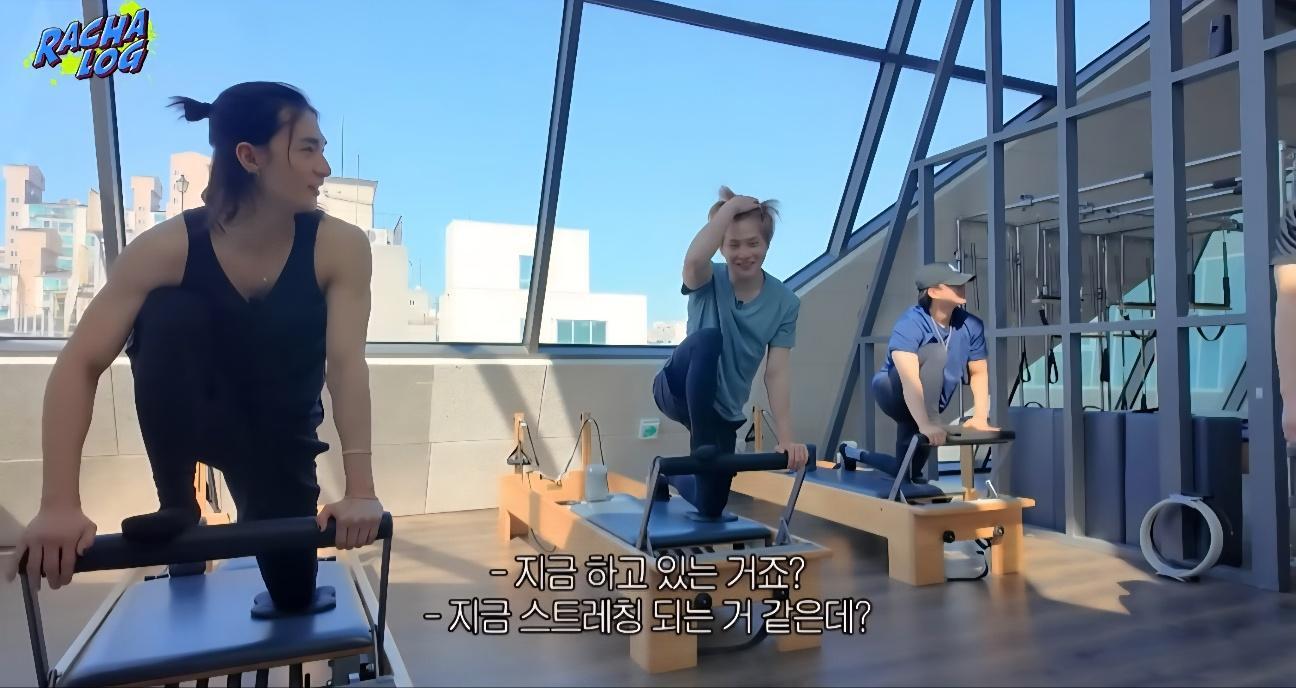
Members of Stray Kids attend a Pilates session. Captured from YouTube
Click here for more articles by Kormedi.com.
Interest in the benefits of Pilates has been growing after K-pop group Stray Kids shared footage of members taking on the workout challenge.
In a recent YouTube video, members Hyunjin, Changbin and I.N tried a Pilates session for the first time. Despite being idols known for their strong athletic ability and intense dance training, the workout proved far from easy.
Even a basic stretching position — placing the leg up on a barre hook to loosen the lower body — was difficult for Hyunjin. As his legs trembled from holding the pose, he joked, “My legs are calling me.” After trying several movements, the members reacted honestly, saying things like, “All my swelling disappeared,” “Men who do Pilates are real men” and “This is seriously hard.”
Although Pilates is often associated with women, it is actually an exercise focused less on gender and more on how precisely the body is used. So what kinds of benefits can Pilates offer men? And can it really help reduce swelling, as Hyunjin suggested?
Pilates may appear gentle and static, but it is actually a high-intensity form of exercise because it requires maintaining body alignment while continuously controlling movement and breathing.
Unlike workouts that rely on large explosive motions, Pilates demands stability, balance and muscle control. It activates deep core muscles, pelvic stabilizers and posture-supporting muscles along the spine in a very detailed way.
That is why even men who regularly do weight training or cardio can find Pilates unexpectedly challenging. Strong muscles alone do not guarantee precise control over smaller stabilizing muscles, and those movements can feel unfamiliar at first.

Stray Kids’ members take a break during a Pilates challenge. Captured from YouTube
Why Pilates helps men
Men generally have greater muscle mass and upper-body strength than women. However, having bigger muscles does not necessarily mean the body is balanced.
When only certain muscles become overly developed, flexibility can decrease and extra strain may be placed on the lower back, shoulders and knees.
Pilates strengthens the abdominal and pelvic muscles that support the body’s center. It also improves mobility in stiff thoracic spine and hip joints while correcting left-right body imbalances that place stress on specific areas.
Because of this, Pilates can work well as a complementary exercise for men who play golf, tennis, run or lift weights — all activities involving repetitive movement patterns. It is also commonly used to help prevent injuries.
For people who spend long hours sitting or using smartphones and laptops, the neck and shoulders often round forward while tension builds in the lower back and pelvis. Pilates helps correct these postural imbalances by reactivating core muscles and improving alignment.
The lighter feeling and reduced puffiness Hyunjin described after Pilates are likely related to improved circulation.
When people sit or stand for long periods, fluids can accumulate in the lower body, leading to swollen legs and ankles. Exercises like Pilates repeatedly engage the abdominal, pelvic and lower-body muscles, and the repeated contraction and relaxation of these muscles helps fluids move more efficiently.
Pilates also emphasizes deep breathing while maintaining core control. During this process, the abdominal and pelvic muscles repeatedly contract and relax, creating pressure changes inside the body that support blood flow and lymphatic circulation.
As a result, many people feel lighter after a workout and notice that facial or leg puffiness appears reduced.
According to the Korea Disease Control and Prevention Agency’s National Health Information Portal, exercise is one component of complex therapy used in managing lymphedema. The sensation of “reduced swelling” after Pilates may therefore be connected to temporary improvements in circulation.
Trying advanced poses immediately — like the heart-shaped challenge shown by the Stray Kids members — can put excessive strain on the body.
For male beginners especially, the goal should not be brute strength, but learning how to engage the core and maintain proper alignment. Because many Pilates positions are unfamiliar, beginners may accidentally overload the neck or lower back, causing pain.
It is better to start gradually by mastering the basics, including breathing, pelvic alignment and shoulder positioning, while adjusting movements to individual flexibility and strength levels.
This article from Kormedi.com, Korea’s top health care and medical portal, is translated by a generative AI system and edited by The Korea Times.